43
Lucian Freud
Annie
Full-Cataloguing
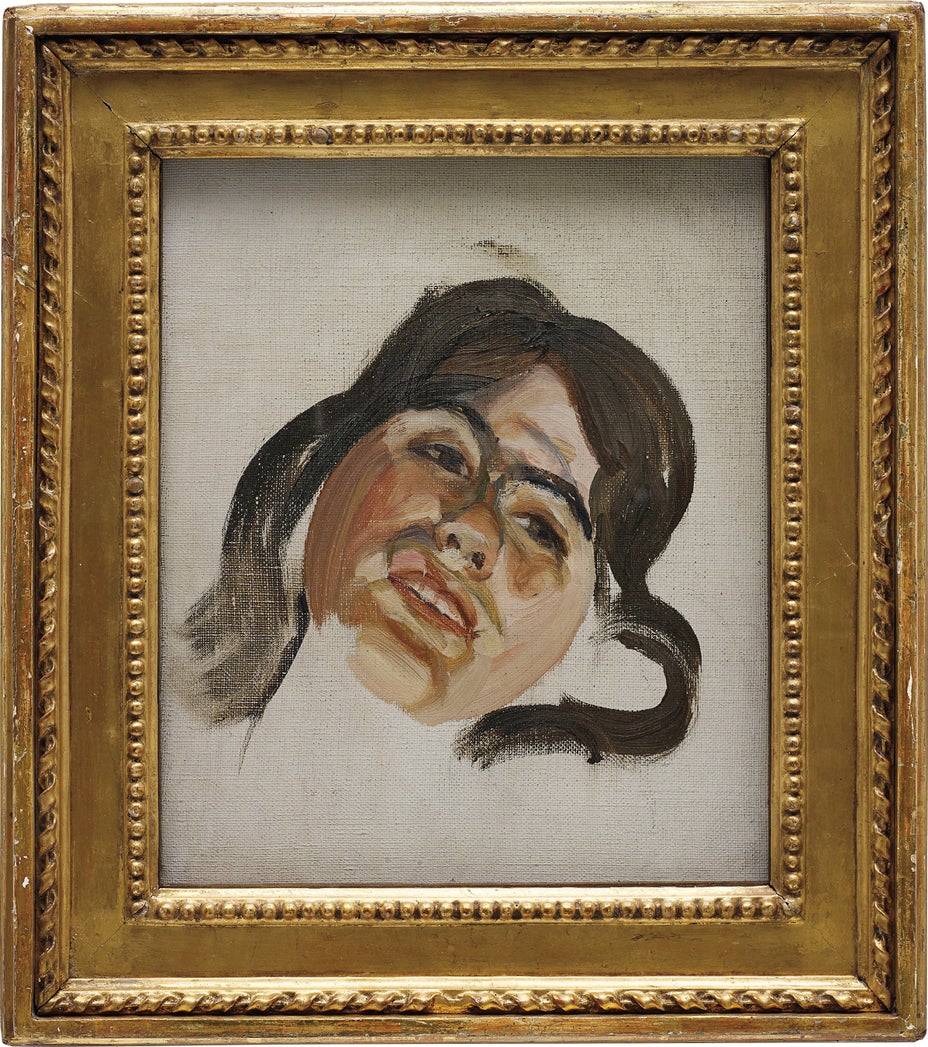
The present lot depicts Annie Freud, the first of the artist’s children by his wife Kitty Garman. Born in 1948, she would have been approximately twelve years of age at the time of painting. The palette is typically dampened; the deep brown of the sitter’s eyes and hair act as counterpoint to the graduated rose of her face. Although only her head is visible, its inclination suggests a reclining figure - a form that features in much of the artist’s work. The connotations are manifold; one senses leisure, lassitude, and even a hint of boredom. Save for the sitter’s image, the canvas is left blank; absent are the furnishings – the sofas, the beds and the sullied studios – that populate so many of the artist’s paintings. Confident in its own composition, the work is as assured as it is expressive.
It is characteristic of Freud’s practice to return to his subjects. From the performance artist Leigh Bowery to his own mother, many of his models are recurrent. So too is Annie. 1962 saw her appear in another work of the same title: pictured from slightly above, she stares with concerned intensity to the right of the image. A year later, she returned in Naked Child Laughing: a controversial nude, it pictures her seated on a green-brown sofa. Her chin resting on her palm, her gaze is cast downwards in contemplation.
In 1954, Lucian Freud wrote ‘my object in painting pictures is to try and move the senses by giving an intensification of reality.’ (Lucian Freud, 'Some Thoughts On Painting,' Encounter 3:1, July 1954, p.23). This early formulation finds expression in much of his work. In the present lot, this process of intensification is achieved through concentration. Those details which Freud does choose to paint bespeak character through materiality. The artist’s expressive brushwork attends to disposition and temperament as it does to form and texture. These concerns are interwoven with a characteristic alertness that marks the artists as a master of his medium.
Lucian Freud
British | B. 1922 D. 2011Renowned for his unflinching observations, Lucian Freud is considered one of the greatest figurative artists. He pushed the boundaries of decorum in terms of classical portraiture and nudes in order to explore his lifelong concern to honestly render the human figure, in what he called his "naked portraits."
In his paintings, Freud's layers of impasto jabs of paint create a surprisingly delicate, translucent depiction of flesh, while his etchings employ an economy of line that implies the figure more than it illustrates it. Charismatic but irascible, Freud worked only from sitters that he knew, consistently focusing on translating his direct perceptions. The resulting portraits are redolent with a stark and evocative psychological intensity, underpinned by an unexpected tenderness towards the subject.