6Ο︎
Louise Bourgeois
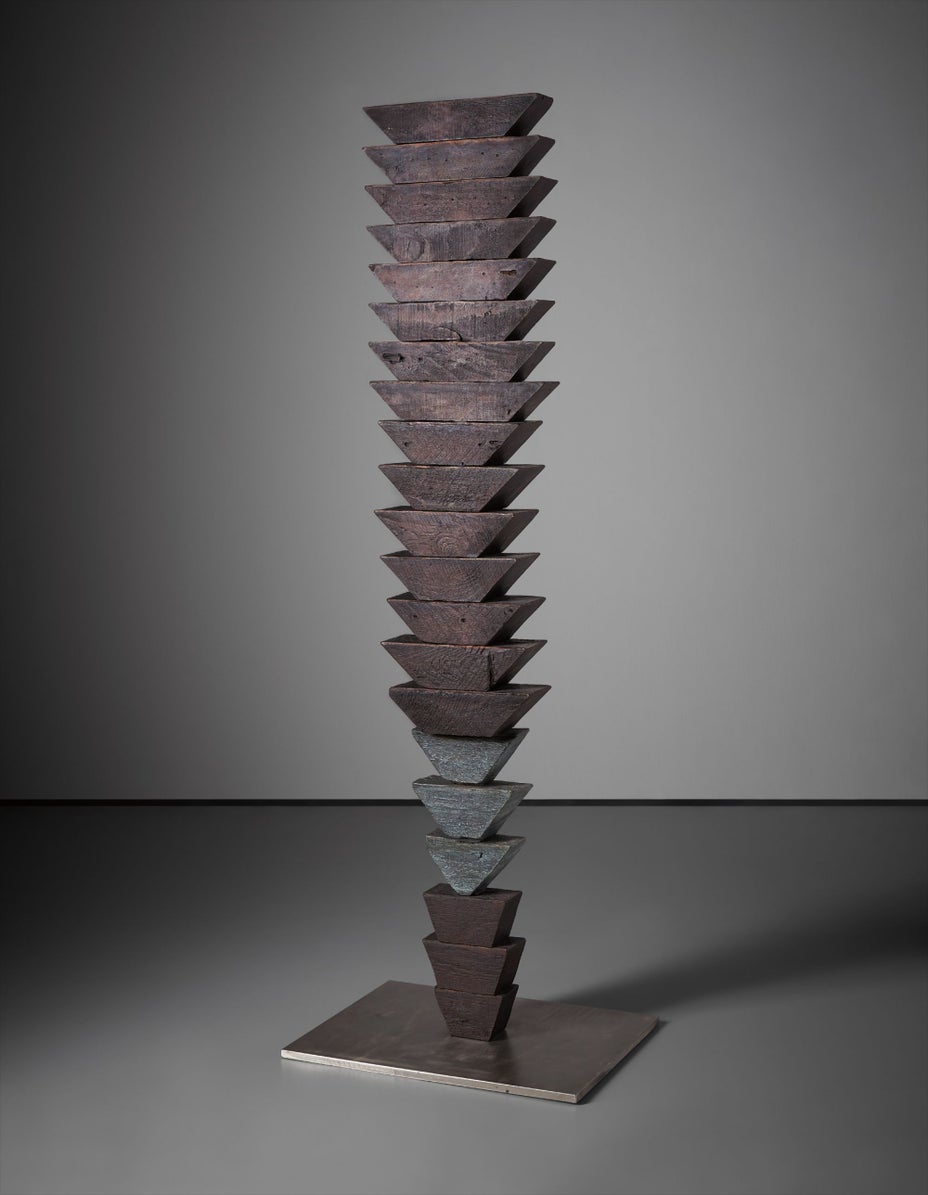
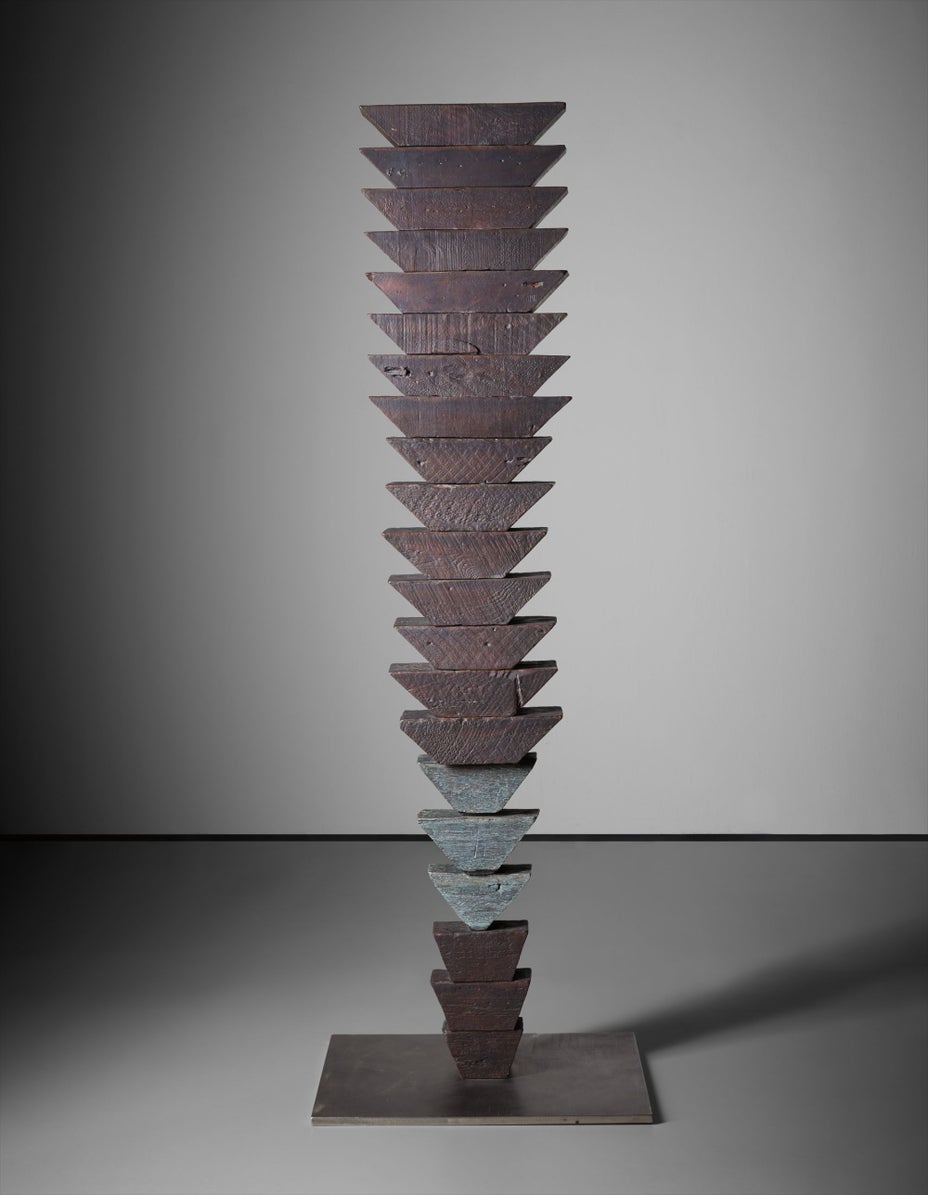
Untitled (The Wedges)
Estimate
$1,200,000–1,800,000
Sold For
$1,925,000
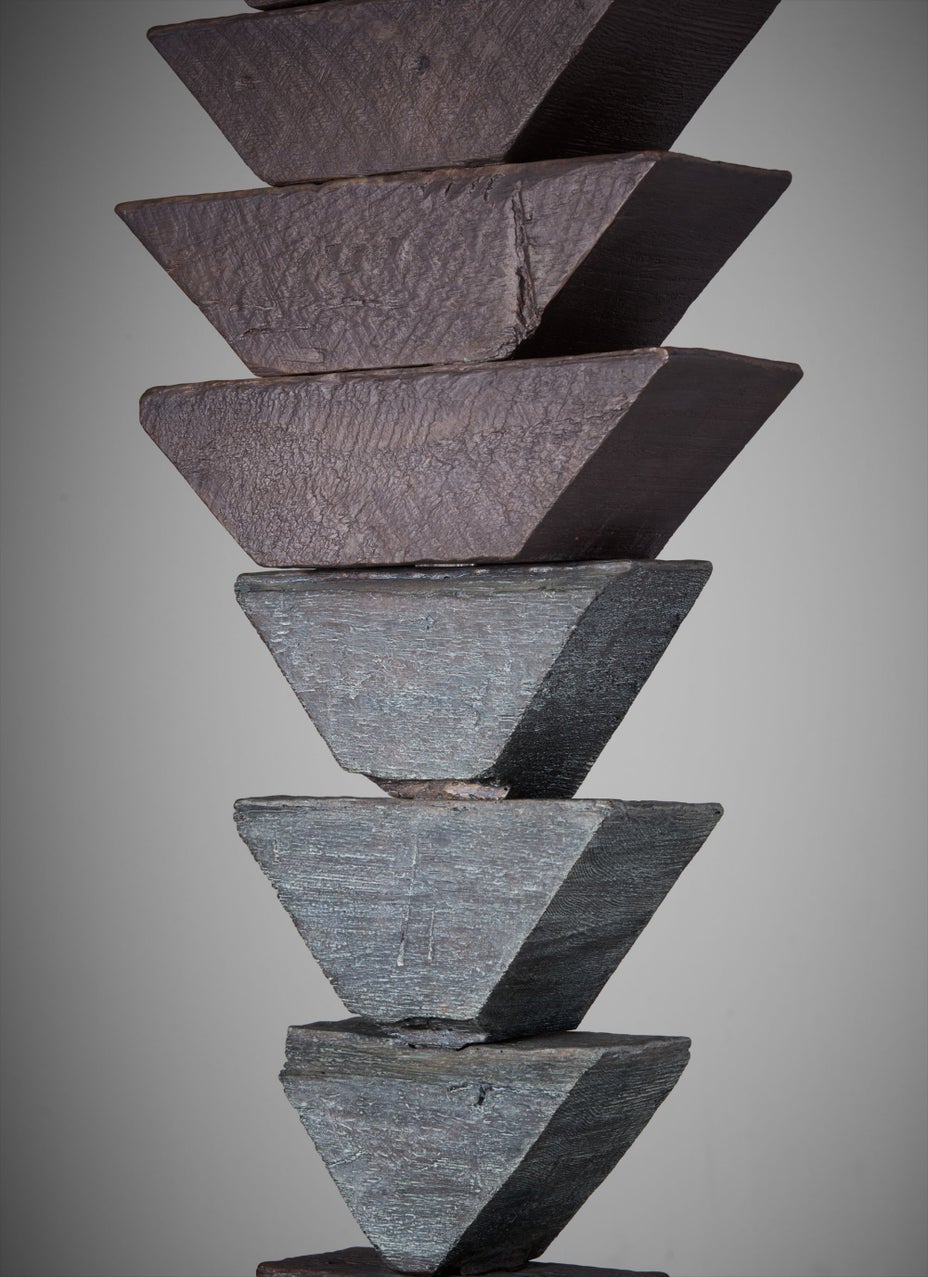
cast bronze and stainless steel
63 1/2 x 21 x 16 in. (161.3 x 53.3 x 40.6 cm)
Initialed and numbered "L.B. 4/6" on the lowest element; further stamped by the foundry and dated "91" on the lowest element. Conceived in 1950 and cast in 1991, this work is number 4 from an edition of 6 plus 1 artist's proof.
Full-Cataloguing
“It is not an image I am seeking. It’s not an idea. It is an emotion you want to recreate, an emotion of wanting, of giving, and of destroying.” Louise Bourgeois
Ever so delicately oblique, Untitled (The Wedges) possesses all of the elegantly expressed, provocative imagery critical to the formation of Louise Bourgeois’ work. For the artist, abstraction was yet another instrument to discern and contend with her emotions, which governed her artistic output. When characterizing her linear hatching, or her totemic forms and shapes, she would often use such terms as “caressing” or “calming”, her techniques echoing her fluctuating emotional states and moods. The act of repetition is central to her discipline, as much of her practice borrowed from the Surrealists’ trademark automatism. Her compositions are driven by intuition with allegorical nuances. Her series entitled Personages, of which the present lot is exemplary, bares a massive range of possible associations, from indigenous allusions, ancient artifacts, and domestic relics to icons of state-of-the art skyscrapers. At once inviting and disquieting, Untitled (The Wedges) imitates the primal basis of art, while demonstrating a deeply personal, impervious testimonial.
In 1941, Bourgeois set out to develop a new series of standing figures, aptly titled Personages. Living in Manhattan with her burgeoning family, she fled to the the roof of her house, which not only allowed her work to grow both in height and scope, but also served as a refuge from the confines of her small apartment and her seemingly perpetual domestic duties. Surrounded by sleek, towering skyscrapers—the exact opposite of the lavishly decorated homes from her childhood in France—Bourgeois questioned in earnest the possibilities of sculpture and their capacity to engage with nature, architecture and viewers. While the Personages speak to her modernist environment, the series also distinctively illustrates her complicated relationships to the friends and family she left in France. Bourgeois recalls, “Suddenly I had this huge sky space to myself, and I began doing these standing figures. A friend asked me what I was doing. I told him, 'I feel so lonely that I am rebuilding these people around me’'' (Louise Bourgeois in Michael Brenson, “A Sculptor Comes into Her Own”, The New York Times, October 31, 1982). The emotional aftermath of her arrival in New York offered the consummate landscape to articulate her desire for liberation and also her yearning for familiarity.
Bourgeois initially carved the Personages from wood, with the intention of later casting them in bronze; she made Untitled (The Wedges) in wood in 1950, and the present lot was cast in bronze in 1991. Extending the production of the Personages over many years, in differing circumstances, importantly enabled her to retain control over the works, to extend her exposure with them and keep them intimately as her own before they would ultimately be divorced from her care. On the occasion of her show at the Tate Modern in 2007, curator Josef Helfenstein commented "The Personages, the most distinct group of Bourgeois' early work, have only been recently recognized as an outstanding contribution to the history of sculpture in the Twentieth century. Although Bourgeois has developed her works in unprecedented directions after 1955, constantly shifting to new concepts, styles and materials, the Personages provide the key to crucial themes and concerns of her entire body of work." (Josef Helfenstein, "Personages: Animism versus Modernist Sculpture" in exh. cat., London, Tate Modern, Louise Bourgeois, 2009, p. 207)
Ever so delicately oblique, Untitled (The Wedges) possesses all of the elegantly expressed, provocative imagery critical to the formation of Louise Bourgeois’ work. For the artist, abstraction was yet another instrument to discern and contend with her emotions, which governed her artistic output. When characterizing her linear hatching, or her totemic forms and shapes, she would often use such terms as “caressing” or “calming”, her techniques echoing her fluctuating emotional states and moods. The act of repetition is central to her discipline, as much of her practice borrowed from the Surrealists’ trademark automatism. Her compositions are driven by intuition with allegorical nuances. Her series entitled Personages, of which the present lot is exemplary, bares a massive range of possible associations, from indigenous allusions, ancient artifacts, and domestic relics to icons of state-of-the art skyscrapers. At once inviting and disquieting, Untitled (The Wedges) imitates the primal basis of art, while demonstrating a deeply personal, impervious testimonial.
In 1941, Bourgeois set out to develop a new series of standing figures, aptly titled Personages. Living in Manhattan with her burgeoning family, she fled to the the roof of her house, which not only allowed her work to grow both in height and scope, but also served as a refuge from the confines of her small apartment and her seemingly perpetual domestic duties. Surrounded by sleek, towering skyscrapers—the exact opposite of the lavishly decorated homes from her childhood in France—Bourgeois questioned in earnest the possibilities of sculpture and their capacity to engage with nature, architecture and viewers. While the Personages speak to her modernist environment, the series also distinctively illustrates her complicated relationships to the friends and family she left in France. Bourgeois recalls, “Suddenly I had this huge sky space to myself, and I began doing these standing figures. A friend asked me what I was doing. I told him, 'I feel so lonely that I am rebuilding these people around me’'' (Louise Bourgeois in Michael Brenson, “A Sculptor Comes into Her Own”, The New York Times, October 31, 1982). The emotional aftermath of her arrival in New York offered the consummate landscape to articulate her desire for liberation and also her yearning for familiarity.
Bourgeois initially carved the Personages from wood, with the intention of later casting them in bronze; she made Untitled (The Wedges) in wood in 1950, and the present lot was cast in bronze in 1991. Extending the production of the Personages over many years, in differing circumstances, importantly enabled her to retain control over the works, to extend her exposure with them and keep them intimately as her own before they would ultimately be divorced from her care. On the occasion of her show at the Tate Modern in 2007, curator Josef Helfenstein commented "The Personages, the most distinct group of Bourgeois' early work, have only been recently recognized as an outstanding contribution to the history of sculpture in the Twentieth century. Although Bourgeois has developed her works in unprecedented directions after 1955, constantly shifting to new concepts, styles and materials, the Personages provide the key to crucial themes and concerns of her entire body of work." (Josef Helfenstein, "Personages: Animism versus Modernist Sculpture" in exh. cat., London, Tate Modern, Louise Bourgeois, 2009, p. 207)
Louise Bourgeois
French-American | B. 1911 D. 2010Known for her idiosyncratic style, Louise Bourgeois was a pioneering and iconic figure of twentieth and early twenty-first century art. Untied to an art historical movement, Bourgeois was a singular voice, both commanding and quiet.
Bourgeois was a prolific printmaker, draftsman, sculptor and painter. She employed diverse materials including metal, fabric, wood, plaster, paper and paint in a range of scale — both monumental and intimate. She used recurring themes and subjects (animals, insects, architecture, the figure, text and abstraction) as form and metaphor to explore the fragility of relationships and the human body. Her artworks are meditations of emotional states: loneliness, jealousy, pride, anger, fear, love and longing.