Property of an Important European Collector
36
Liu Wei
Purple Air D1
Estimate
HK$1,500,000–2,000,000
€161,000–215,000
$192,000–256,000
Sold For
HK$2,500,000
signed, titled and dated 'Liu Wei [in Chinese and Pinyin] "Purple Air D1" 2008' on the reverse
oil on canvas
180.3 x 220.1 cm. (70 7/8 x 86 5/8 in.)
Painted in 2008.
Full-Cataloguing
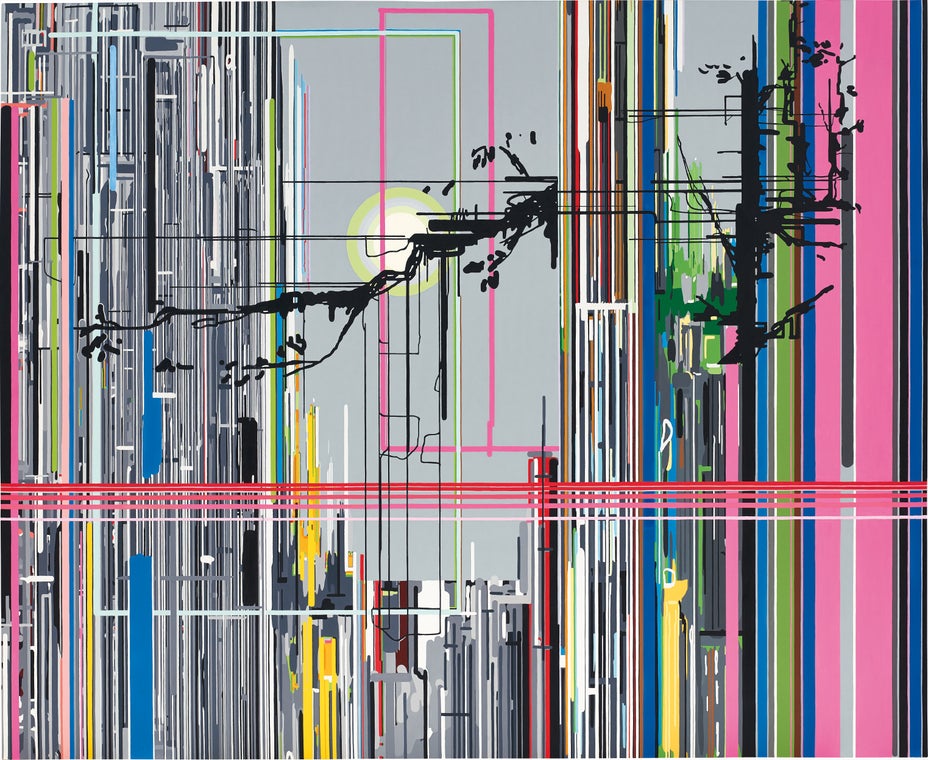
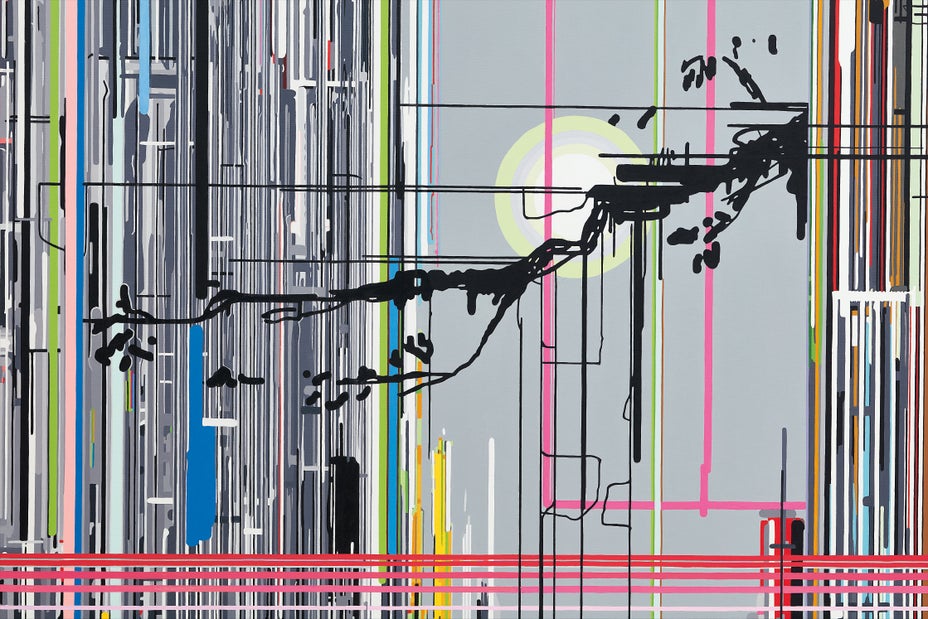
Captivating in its scale and dynamism, the present lot is a classic early example from Liu Wei’s most iconic painting series Purple Air D1, meticulously regenerating various segments of Beijing into digitalised geometrical structures of bright progressive hues of pinks, yellows, blues and greens. Painting a myriad of densely-packed vertical and horizontal lines all over the canvas with colours indicative of his personal sentiments to the city, Liu Wei conjures up a fantastical metropolis packed with high-rise buildings, ruled by the pixels of the globally digitalised world. Partially obscured yet peeping through the foreground, the looming moon behind the protruding branch of a pine tree breaks up the composition, creating a sharp contrast to the linear structure.
Seeking to transform and re-explore traditional Chinese landscape painting, the added elements of the moon and the pine tree imbues the work with an Eastern spirituality. Like other works from the same series, Purple Air D1 is in fact not made with a brush but digitally rendered on a computer which is then painted onto a larger canvas. This series emerged at a time of recognition and acclaim for the artist, where Liu exhibited at the Shanghai Biennale in 2004 and the Venice Biennale in 2005. 2008 also marks the year in which Liu won a Contemporary Chinese Art Award (CCAA), and the beginning of the Purple Air series for which he became renowned. The present work is thus one of the few early examples that represents a milestone and crucial turning point for the artist, where he not only underwent a change in artistic direction, but also in concept.
As one of China’s leading contemporary artists and deeply involved in the Post-Sense Sensibility group, Liu has worked in an array of styles and media ranging from sculpture, painting, installation and photography. Sharing a distaste for the political idealism and rationality of his predecessors, Liu embraced irrationality, improvisation and intuition as part of a generation in China that grew up during a period of rapid change and urbanisation. Frequently looking to his surroundings for inspiration in found objects and architectural constructions, Liu breaks away from subversively referencing politics to expressing his views of a changing material landscape.
Purple Air D1 is an enthralling work that condenses the ethos of Beijing and contemporary China, as well as that of the digitalized world where Liu finds a personal sense of order within the turbulent disorder of contemporary landscape.
Seeking to transform and re-explore traditional Chinese landscape painting, the added elements of the moon and the pine tree imbues the work with an Eastern spirituality. Like other works from the same series, Purple Air D1 is in fact not made with a brush but digitally rendered on a computer which is then painted onto a larger canvas. This series emerged at a time of recognition and acclaim for the artist, where Liu exhibited at the Shanghai Biennale in 2004 and the Venice Biennale in 2005. 2008 also marks the year in which Liu won a Contemporary Chinese Art Award (CCAA), and the beginning of the Purple Air series for which he became renowned. The present work is thus one of the few early examples that represents a milestone and crucial turning point for the artist, where he not only underwent a change in artistic direction, but also in concept.
As one of China’s leading contemporary artists and deeply involved in the Post-Sense Sensibility group, Liu has worked in an array of styles and media ranging from sculpture, painting, installation and photography. Sharing a distaste for the political idealism and rationality of his predecessors, Liu embraced irrationality, improvisation and intuition as part of a generation in China that grew up during a period of rapid change and urbanisation. Frequently looking to his surroundings for inspiration in found objects and architectural constructions, Liu breaks away from subversively referencing politics to expressing his views of a changing material landscape.
Purple Air D1 is an enthralling work that condenses the ethos of Beijing and contemporary China, as well as that of the digitalized world where Liu finds a personal sense of order within the turbulent disorder of contemporary landscape.