Property of an Important Latin American Collector
61
Léonard-Tsuguharu Foujita
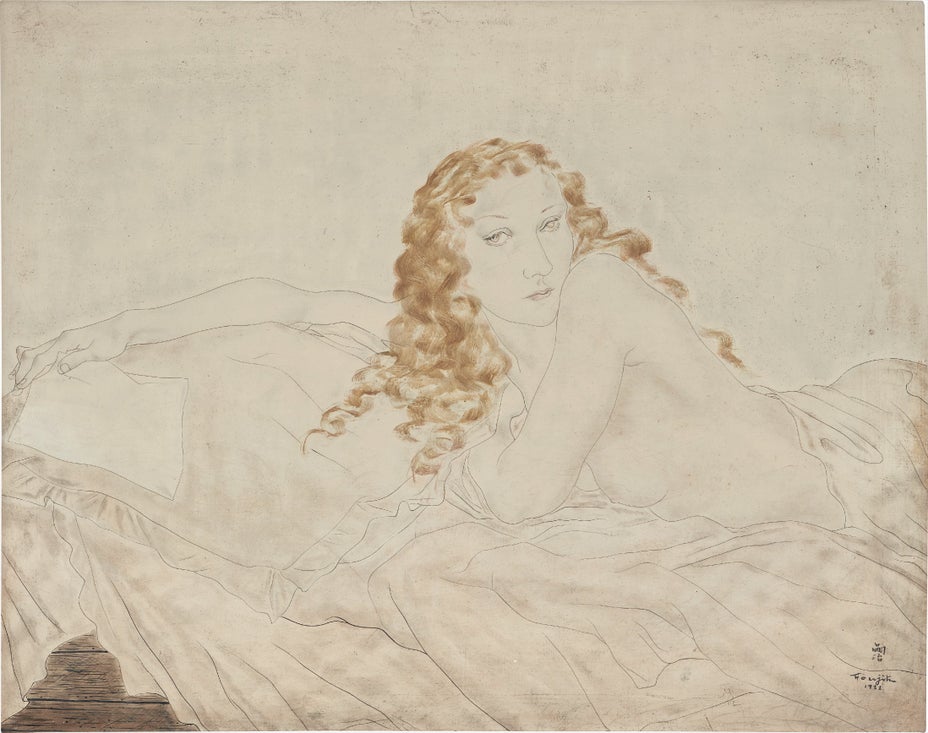
Reclining Nude
Estimate
HK$3,000,000–5,000,000
€331,000–552,000
$385,000–641,000
Sold For
HK$6,100,000
signed, inscribed and dated 'Tsuguharu [in Kanji] Foujita 1931' lower right
oil on canvas
65.5 x 80.7 cm. (25 3/4 x 31 3/4 in.)
Painted in 1931, this work is accompanied by a certificate of authenticity issued by Sylvie Buisson.
Full-Cataloguing
In the early twentieth century, bohemian culture flourished on the banks of the river Seine in Paris, drawing numerous artists to congregate. Rich cultures and artistic inspirations from all over the world interacted and collided with each other, forming a creative ethos which incubated the École de Paris. After his arrival in Paris in 1913, Léonard-Tsuguharu Foujita became active in its art scene, befriending established artists such as Modigliani and Matisse. Crucial for the artist himself however, the zealous and liberal-minded Montparnasse region freed his creative desire from some of the perceived constraints of Japanese artistic formality.
With a mastery of classical Western painting techniques, Foujita incorporated the delicacy of traditional Japanese aesthetics when approaching the depiction of nude human form, a subject matter rarely seen in traditional Japanese paintings. Foujita’s enthrallment with the French avant-garde was reciprocated when in 1925, he was awarded the Knight of the Legion of Honour.
After the divorce from his third wife Youki in 1931, he took his new muse, Madeleine Lequeux, to South America. During their sojourn in Brazil in that same year, Foujita held a solo exhibition at the Royal Hotel in Rio de Janeiro. The exhibition was well received by local art critics and collectors alike and continued on to be exhibited in São Paulo the following spring. An exceptional example of Foujita’s from this period, Reclining Nude is a testament to a particularly fruitful period of his life, with Madeleine as his model.
In this composition, the artist employs pure colours and brilliant draughtsmanship, constructing facial features and body contour of the woman with smooth lines in a concise manner, thus bringing out Foujita’s renowned technique – rendering the skin in a fine, ivory-like texture. The mild shimmering in her porcelain skin echoes the subtle and soft lines, which is then contrasted with Madeleine’s red curly hair, executed in loose brushstrokes.
A hint of erotica hovers in the ambiance of the empty background. The enchanting gaze and pouting lips of the female nude, complimented by the folds of the bed sheet caused by her languid pose, all suggest lustful sentiment. The white handkerchief held gently at her fingertips is redolent of the known visual symbol in the shunga (erotic painting) genre of ukiyo-e (‘floating world painting’) in Edo period Japan - reflecting Foujita’s intention of referencing past traditions. The artist renders white, a symbol of purity, in a large area of the canvas, in contrast with the flow of erotic emotion, generating a playful tension within the composition and attracting the viewers into boundless imagination.
With a mastery of classical Western painting techniques, Foujita incorporated the delicacy of traditional Japanese aesthetics when approaching the depiction of nude human form, a subject matter rarely seen in traditional Japanese paintings. Foujita’s enthrallment with the French avant-garde was reciprocated when in 1925, he was awarded the Knight of the Legion of Honour.
After the divorce from his third wife Youki in 1931, he took his new muse, Madeleine Lequeux, to South America. During their sojourn in Brazil in that same year, Foujita held a solo exhibition at the Royal Hotel in Rio de Janeiro. The exhibition was well received by local art critics and collectors alike and continued on to be exhibited in São Paulo the following spring. An exceptional example of Foujita’s from this period, Reclining Nude is a testament to a particularly fruitful period of his life, with Madeleine as his model.
In this composition, the artist employs pure colours and brilliant draughtsmanship, constructing facial features and body contour of the woman with smooth lines in a concise manner, thus bringing out Foujita’s renowned technique – rendering the skin in a fine, ivory-like texture. The mild shimmering in her porcelain skin echoes the subtle and soft lines, which is then contrasted with Madeleine’s red curly hair, executed in loose brushstrokes.
A hint of erotica hovers in the ambiance of the empty background. The enchanting gaze and pouting lips of the female nude, complimented by the folds of the bed sheet caused by her languid pose, all suggest lustful sentiment. The white handkerchief held gently at her fingertips is redolent of the known visual symbol in the shunga (erotic painting) genre of ukiyo-e (‘floating world painting’) in Edo period Japan - reflecting Foujita’s intention of referencing past traditions. The artist renders white, a symbol of purity, in a large area of the canvas, in contrast with the flow of erotic emotion, generating a playful tension within the composition and attracting the viewers into boundless imagination.