ULTIMATE
44
Lee Jeonglok
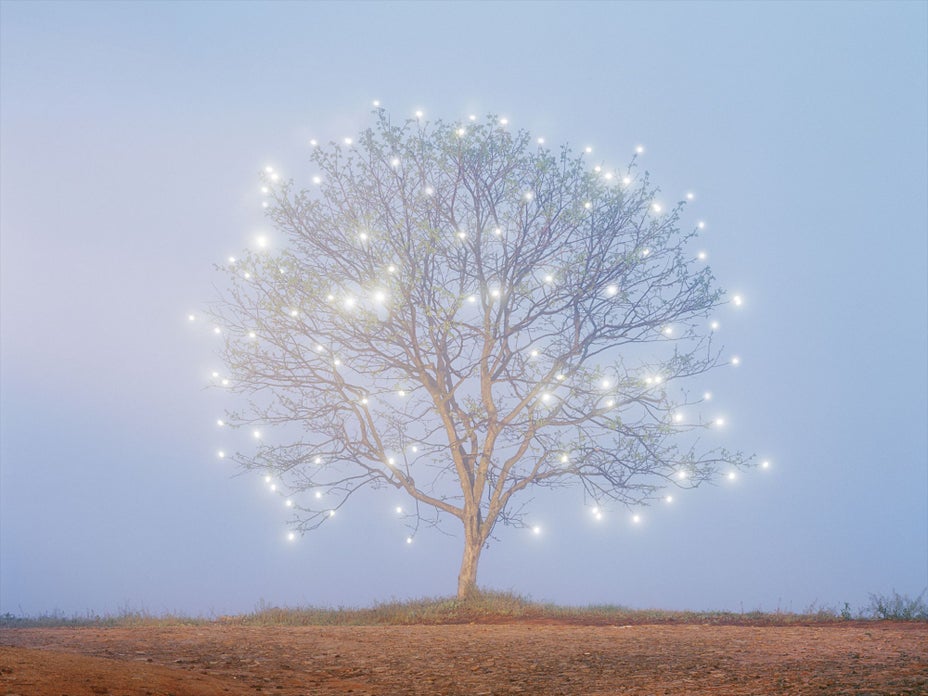
Tree of Life #1
Estimate
£7,000–9,000‡︎
Sold For
£22,500
2007
Chromogenic print, flush-mounted.
Image/Sheet: 119.9 x 160 cm (47 1/4 x 62 7/8 in.)
Frame: 126 x 166 cm (49 5/8 x 65 3/8 in.)
Frame: 126 x 166 cm (49 5/8 x 65 3/8 in.)
Signed and dated in ink, printed title, date and number AP1 on an artist label affixed to the reverse of the frame.
This work is AP1 from the sold-out edition of 3 + 2 AP. This image is sold out in all sizes and editions.
This work is AP1 from the sold-out edition of 3 + 2 AP. This image is sold out in all sizes and editions.
Full-Cataloguing
In creating his Tree of Life series, Lee Jeonglok contemplated the visible and the invisible and aimed ‘to metaphorically describe the vitality of a tree with light.’ His unique process for making these evocative photographs is analogue based and involves the use of artificial lights.
To create Tree of Life #1, the first work produced with his new technique, certain conditions were required – the shoot had to take place at night, in dense fog, without any wind. The artist installed two 4 x 5 inch large-format cameras, determined the exposure, then covered the cameras with black fabric without closing the aperture. Once the scene was dark, he removed the fabric, approached the tree and repeatedly popped a strobe towards the camera from the tree between 200 and 300 times. He concluded the process by shining a strong searchlight at the tree. The long exposure time varied from two to ten hours, during which the lights would be captured gradually, resulting in a haunting image of a bioluminescent tree. Works from Tree of Life are held at the Korean National Museum of Modern and Contemporary Art, Seoul; Gwangju Museum of Art, Gwangju; Daelim Museum, Seoul; and Ilmin Museum of Art, Seoul.
To create Tree of Life #1, the first work produced with his new technique, certain conditions were required – the shoot had to take place at night, in dense fog, without any wind. The artist installed two 4 x 5 inch large-format cameras, determined the exposure, then covered the cameras with black fabric without closing the aperture. Once the scene was dark, he removed the fabric, approached the tree and repeatedly popped a strobe towards the camera from the tree between 200 and 300 times. He concluded the process by shining a strong searchlight at the tree. The long exposure time varied from two to ten hours, during which the lights would be captured gradually, resulting in a haunting image of a bioluminescent tree. Works from Tree of Life are held at the Korean National Museum of Modern and Contemporary Art, Seoul; Gwangju Museum of Art, Gwangju; Daelim Museum, Seoul; and Ilmin Museum of Art, Seoul.