8
László Moholy-Nagy
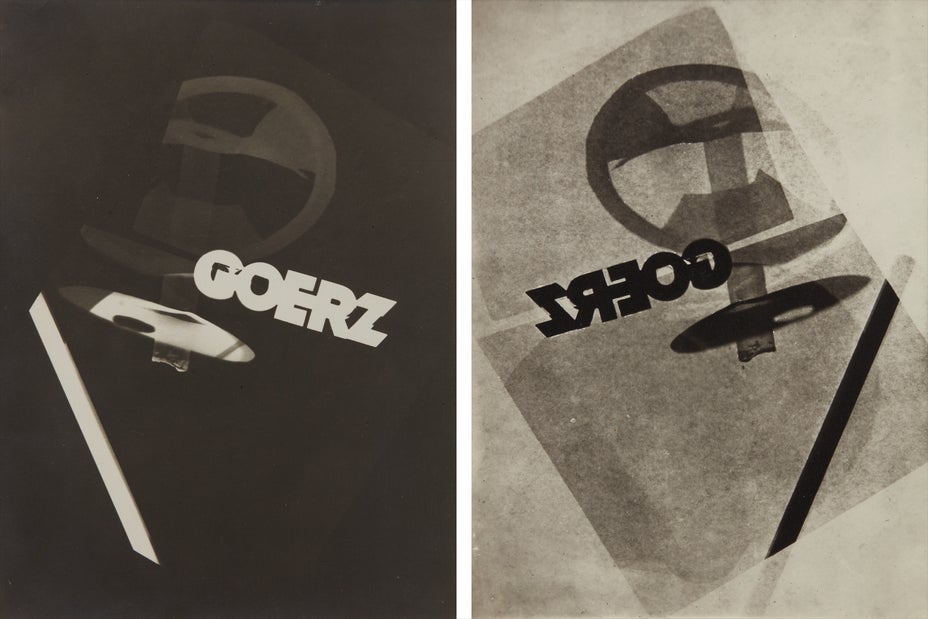
Photogram studies for Goerz (negative and positive)
Estimate
$150,000–250,000
Sold For
$212,500
1925
Two gelatin silver prints, printed 1926-1929.
Each 8 1/8 x 6 in. (20.6 x 15.2 cm)
Photogram: credited and annotated 'Photogram' likely by Lucia Moholy in pencil on the verso.
Reversed photogram: annotated 'bitte statt spiegel – / schrift, normal drehen GOERZ', dated in ink by the artist and 'berlin-chbg. 9' credit stamp on the verso.
Reversed photogram: annotated 'bitte statt spiegel – / schrift, normal drehen GOERZ', dated in ink by the artist and 'berlin-chbg. 9' credit stamp on the verso.
Full-Cataloguing
This pair of images, Photogram studies for Goerz (negative and positive), are an outstanding example of László Moholy-Nagy’s facility with the medium of photography, as well as his groundbreaking incorporation of typography within his work. These two compositions began as a series of exercises using the logo for Goerz, a Berlin manufacturer of cameras and optical instruments. The initial photogram was made by placing objects and letter forms onto a sheet of photographic paper, then exposing it to light. Moholy-Nagy made the second image, which he called a “revaluation,” by contact-printing the original photogram (fgm 116) onto photographic paper, creating a new image in which both the tonal values and the orientation of the original were reversed (fgm 116A). While Moholy-Nagy made several images in the Goerz series, it is believed the photographs offered here are the only Goerz positive/negative pair to appear at auction.
It is almost certain that the “revalued” print was intended for reproduction; Moholy-Nagy’s handwritten notations on the reverse instruct a picture editor to reverse the orientation so that the word Goerz would read correctly. Moholy-Nagy authority Renate Heyne suggests that the writing on the reverse of the photogram image is that of Moholy’s wife, Lucia. It is likely, based upon the size and format of these images, that they were printed from glass negatives Lucia made for her husband in 1926. A larger positive/negative pair of these images is in the collection of the Eastman Museum of Photography, Rochester.
Moholy-Nagy reveled in the flexibility of photography – what he called its “plasticity” – and he used the medium’s infinite reproducibility to serve his boundless creativity. He created a series of images using the same set of objects and Goerz typography, making a “revaluation” of each one. In 1926, a pair of the Goerz images (fgm 117, fgm 117A) illustrated his article “Fotoplastiche Reklame” (Photoplastic Advertising) in the journal Offset Buch und Werbekunst, with the caption “Werbefotogramm” (Advertising Photogram). It is not known whether any images from the series were ultimately used by Goerz in its advertising. The Goerz images may well have been made by Moholy-Nagy to demonstrate how photograms, typography, and revaluation could be used to make entirely new, visually adventurous advertisements. As this pair of images shows, Moholy-Nagy clearly found this an absorbing exercise, one that fired his creativity and resulted in a compelling and highly Modernist suite of images.
It is almost certain that the “revalued” print was intended for reproduction; Moholy-Nagy’s handwritten notations on the reverse instruct a picture editor to reverse the orientation so that the word Goerz would read correctly. Moholy-Nagy authority Renate Heyne suggests that the writing on the reverse of the photogram image is that of Moholy’s wife, Lucia. It is likely, based upon the size and format of these images, that they were printed from glass negatives Lucia made for her husband in 1926. A larger positive/negative pair of these images is in the collection of the Eastman Museum of Photography, Rochester.
Moholy-Nagy reveled in the flexibility of photography – what he called its “plasticity” – and he used the medium’s infinite reproducibility to serve his boundless creativity. He created a series of images using the same set of objects and Goerz typography, making a “revaluation” of each one. In 1926, a pair of the Goerz images (fgm 117, fgm 117A) illustrated his article “Fotoplastiche Reklame” (Photoplastic Advertising) in the journal Offset Buch und Werbekunst, with the caption “Werbefotogramm” (Advertising Photogram). It is not known whether any images from the series were ultimately used by Goerz in its advertising. The Goerz images may well have been made by Moholy-Nagy to demonstrate how photograms, typography, and revaluation could be used to make entirely new, visually adventurous advertisements. As this pair of images shows, Moholy-Nagy clearly found this an absorbing exercise, one that fired his creativity and resulted in a compelling and highly Modernist suite of images.