112
Keith Haring
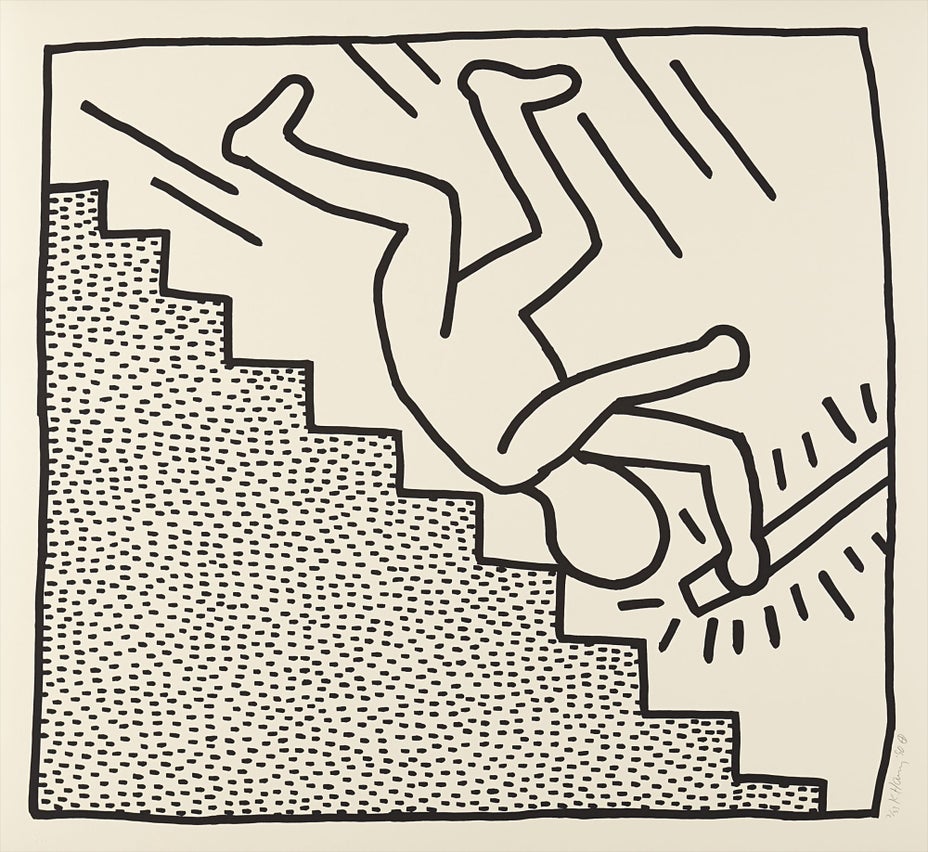
Blueprint Drawing #16
Estimate
$15,000–20,000
Sold For
$18,750
1990
Screenprint, on wove paper, with full margins,
I. 39 x 42 1/4 in. (99.1 x 107.3 cm)
S. 42 1/2 x 46 1/2 in. (108 x 118.1 cm)
S. 42 1/2 x 46 1/2 in. (108 x 118.1 cm)
signed, dated `90' and numbered 2/33 in pencil, published by Durham Press, Durham, Pennsylvania, framed.
Full-Cataloguing
These 17 drawings were created over a period of a few weeks between December 1980 and January 1981. The original drawings were executed on vellum with Sumi ink because I intended to make blueprint copies of each of the drawings. Periodically I would take my drawings to the local blueprinters, where I had much enjoyment trying to explain the content of these works to the men who operated the blueprint machines... Since then, many of the drawings have been sold and I don't know their whereabouts. However, before I sold many of them I made photostats of each of the drawings. These prints were made from those stats. They form a perfect time capsule of my beginning in New York City.
Keith Haring
Keith Haring
Keith Haring
American | B. 1958 D. 1990Haring's art and life typified youthful exuberance and fearlessness. While seemingly playful and transparent, Haring dealt with weighty subjects such as death, sex and war, enabling subtle and multiple interpretations.
Throughout his tragically brief career, Haring refined a visual language of symbols, which he called icons, the origins of which began with his trademark linear style scrawled in white chalk on the black unused advertising spaces in subway stations. Haring developed and disseminated these icons far and wide, in his vibrant and dynamic style, from public murals and paintings to t-shirts and Swatch watches. His art bridged high and low, erasing the distinctions between rarefied art, political activism and popular culture.