23
KAWS
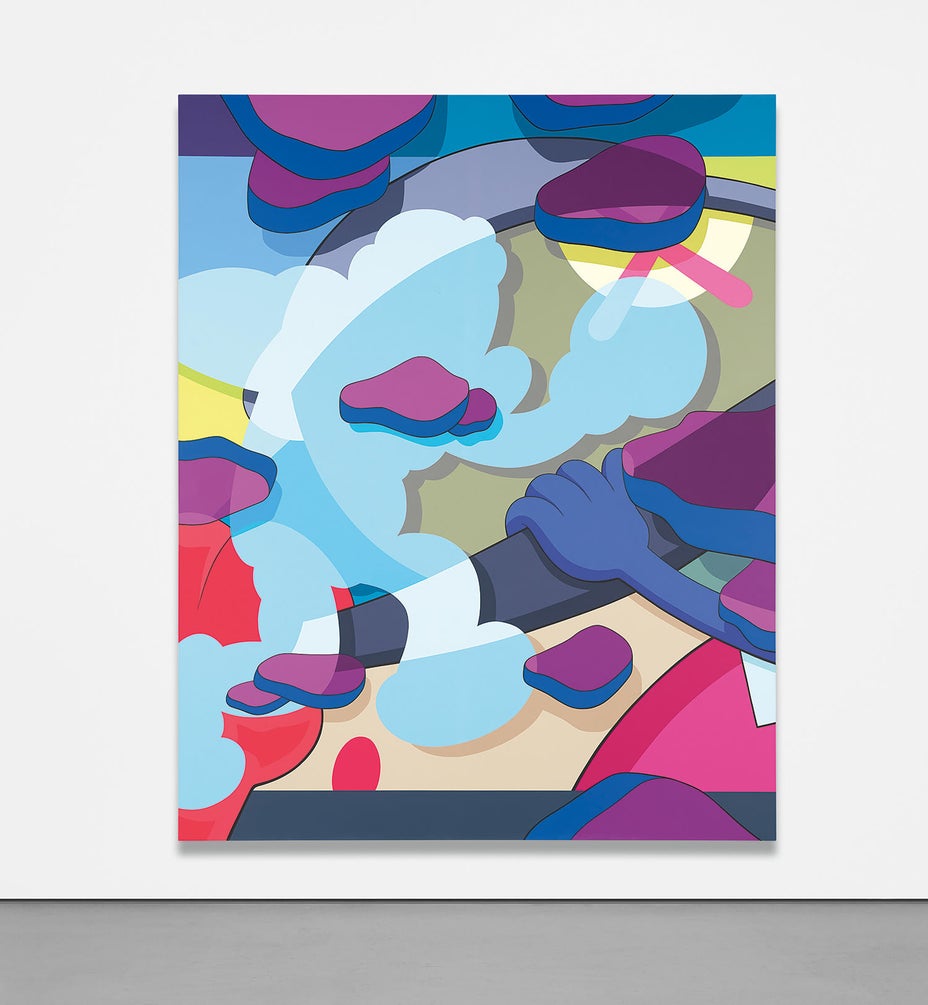
HALF FULL
Full-Cataloguing
Over the years KAWS has created a unique visual language spanning Pop Art, abstract painting, art history and popular culture. His innate understanding of the emotional and intellectual force of images is reflected in the range of inspiration he draws from art history as well as popular culture – for example Bauhaus artist Josef Alber’s experimental abstract works exploring colour interaction and the dynamic schematic compositions of Pop artist Roy Lichtenstein (see for example Modern Painting With Small Bolt, 1967), who also used cartoons as a starting point for his works.
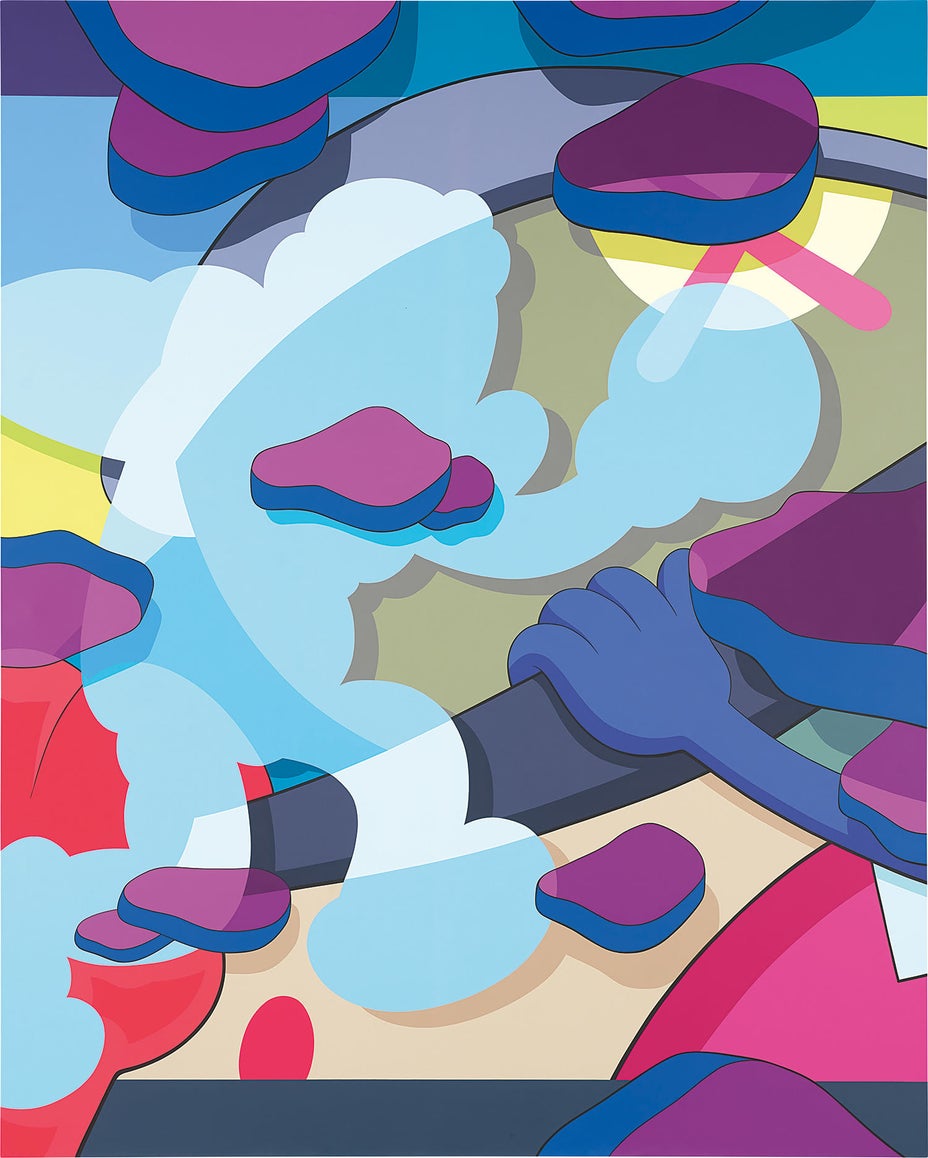
KAWS also cites the Swedish-American sculptor Claes Oldenburg as one of his favorite artists (KAWS quoted in an interview with The Inquirer, April 11, 2013, online). Like Oldenburg, KAWS established his name creating monumental works based on everyday consumer objects, elevating the banal to the extraordinary. Whilst Oldenburg used telephones, hamburgers, and cake slices, in HALF FULL KAWS draws inspiration from children’s animations, deconstructing familiar outlines and placing the abruptly disconnected elements into saturated, staccato compositions that pulsate with mutinous energy. A dismembered cartoon arm clings to an eye marked with KAWS’s trademark ‘X’, whilst a blood-red paw clutches at a face beneath the shadow of a cartoon figure striding into view.
Originally exhibited alongside a second painting, HALF EMPTY, KAWS draws upon a common proverbial phrase that conveys the subjectivity inherent to any situation, where pessimism and optimism are equally likely outcomes depending on individual worldviews and personal biases. Placed together, these works represent the two halves of an intensely-coloured, multi-dimensional reality: two ‘X’ eyes, a mouth open in a scream, falling debris, a choice to react with blue-like calmness (HALF FULL) or red-like defensiveness (HALF EMPTY).
HALF FULL demonstrates an instinctive understanding of the power of symbols in a world continuously in flux:
“Icons like Mickey, the Simpsons, the Michelin Man and Spongebob exist in a universal way that you forget their origin or even there [sic] narrative, and you just recognize them from the slightest glimpse of their image or sound.” (KAWS, quoted in conversation with K. Donoghue, Whitewall, December 2012).
KAWS’s creations, universally recognised amongst this generation, belong to the same pantheon of iconic characters. KAWS’s work captures the shifting boundaries between the real and virtual, the personal and public, and he continues to work deliberately to reject the air of exclusivity surrounding art, synthesizing elements of high and low culture across all areas of his work. His most recent solo exhibitions include KAWS: WHERE THE END STARTS at the Modern Art Museum of Fort Worth (Texas) and the Yuz Museum (Shanghai).
KAWS
American | 1974To understand the work of KAWS is to understand his roots in the skateboard and graffiti crews of New York City. Brian Donnelly chose KAWS as his moniker to tag city streets beginning in the 1990s, and quickly became a celebrated standout in the scene. Having swapped spray paint for explorations in fine art spanning sculpture, painting and collage, KAWS has maintained a fascination with classic cartoons, including Garfield, SpongeBob SquarePants and The Simpsons, and reconfigured familiar subjects into a world of fantasy.
Perhaps he is most known for his larger-than-life fiberglass sculptures that supplant the body of Mickey Mouse onto KAWS' own imagined creatures, often with 'x'-ed out eyes or ultra-animated features. However, KAWS also works frequently in neon and vivid paint, adding animation and depth to contemporary paintings filled with approachable imagination. There is mass appeal to KAWS, who exhibits globally and most frequently in Asia, Europe and the United States.