42
KAWS
Untitled
Full-Cataloguing
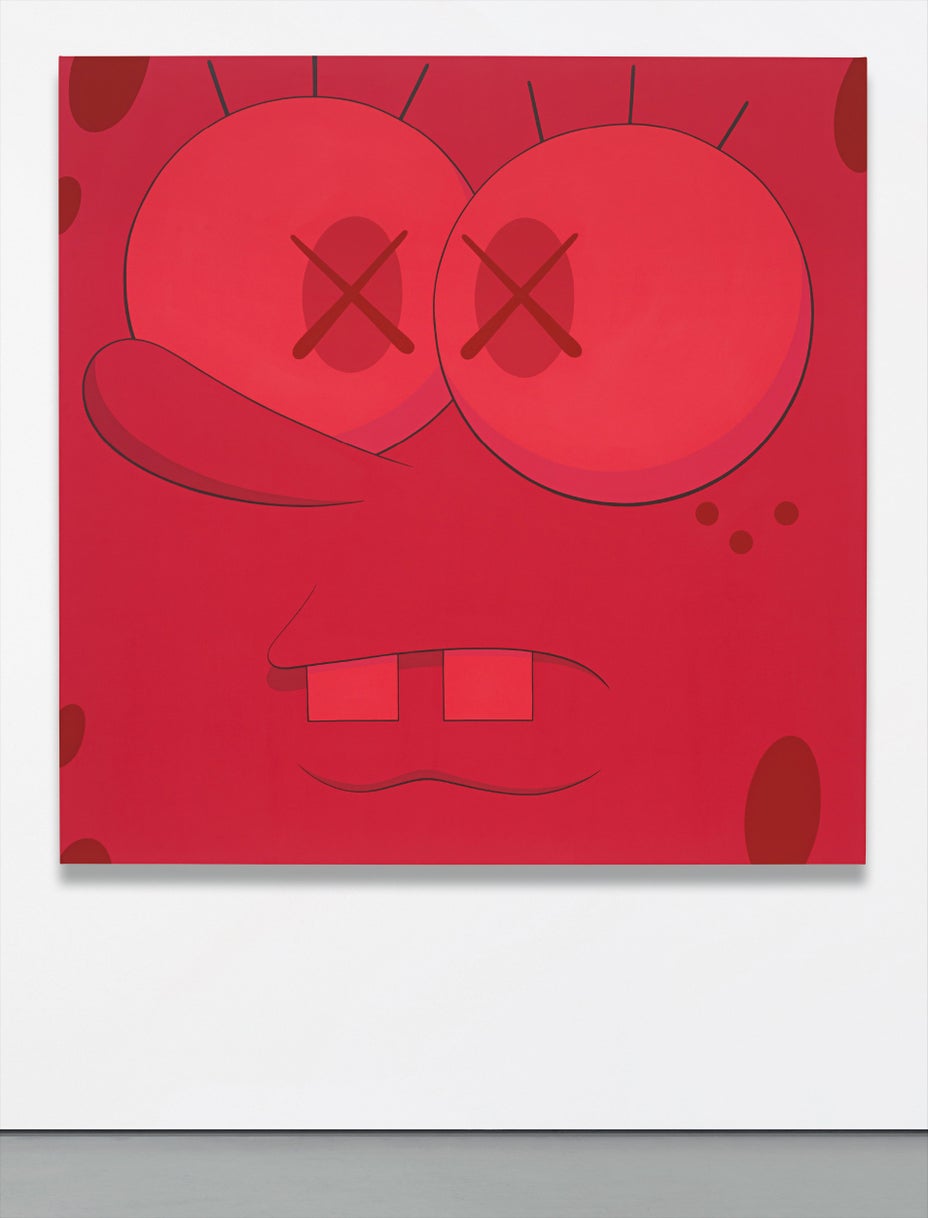
Having grown from the culture of downtown Manhattan in the 1990s, KAWS’s cartoonish style is rooted in the artist’s early career who would mediate public advertisements with his own seamlessly brushstroke-free additions. These interventionist artworks were so skilfully executed that it was difficult to distinguish the artist’s work from the original advertisement, a perfectionist mentality still evident in KAWS’s work today. In response to conventional distinctions between high versus low art, KAWS explains, “to me they involve the same thought process, so it’s funny that when I work big in bronze, it’s called a sculpture, but something I do that’s small and plastic is called a toy.” (KAWS quoted in Carlo McCormick, "From the Streets to TV to Fine Art Galleries, KAWS Is Everywhere," Paper, November 4, 2013) Though his current work channels the bright colours, commercialist attitudes, and refined graphic languages of Pop Artists Claes Oldenburg, Tom Wesselmann, and more recently, Takashi Murakami, KAWS has married the legacy of Pop Art with his own legendary re-appropriation of contemporary culture icons, an aesthetic that has amassed widespread appeal from viewers worldwide.
KAWS
American | 1974To understand the work of KAWS is to understand his roots in the skateboard and graffiti crews of New York City. Brian Donnelly chose KAWS as his moniker to tag city streets beginning in the 1990s, and quickly became a celebrated standout in the scene. Having swapped spray paint for explorations in fine art spanning sculpture, painting and collage, KAWS has maintained a fascination with classic cartoons, including Garfield, SpongeBob SquarePants and The Simpsons, and reconfigured familiar subjects into a world of fantasy.
Perhaps he is most known for his larger-than-life fiberglass sculptures that supplant the body of Mickey Mouse onto KAWS' own imagined creatures, often with 'x'-ed out eyes or ultra-animated features. However, KAWS also works frequently in neon and vivid paint, adding animation and depth to contemporary paintings filled with approachable imagination. There is mass appeal to KAWS, who exhibits globally and most frequently in Asia, Europe and the United States.