117
Josef Albers
Study for Homage to the Square: Decided
Estimate
$450,000–650,000
Sold For
$555,000
signed with the artist's monogram and dated "57" lower right; further signed, titled and dated "Study for Homage to the Square: "Decided" Albers 1957" on the reverse
oil on masonite
24 x 24 in. (61 x 61 cm.)
Painted in 1957, this work will be included in the forthcoming Josef Albers Catalogue Raisonné being prepared by The Josef and Anni Albers Foundation and is registered under number JAAF 1957.1.21.
Full-Cataloguing
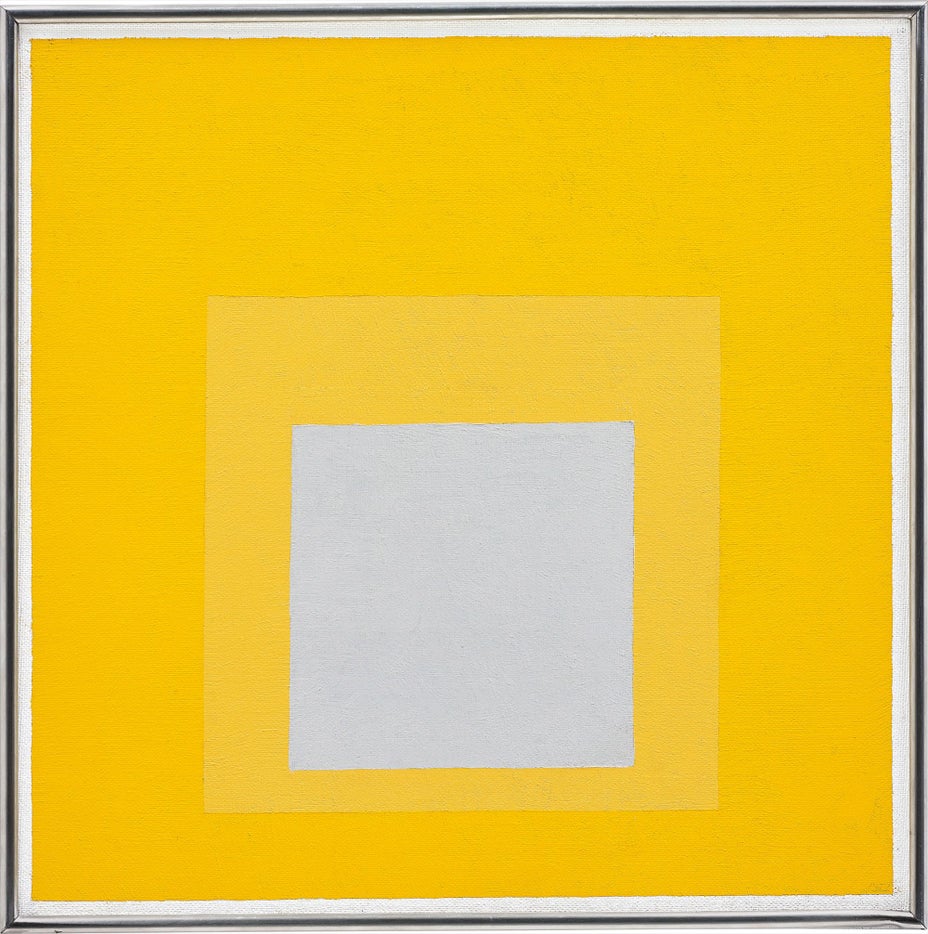
Josef Albers’ Study for Homage to the Square: Decided from 1957 is rendered in pure yellows with a central square of light slate gray. The colors vibrate and shimmer within the reductive stability of the picture’s basic geometry. The seeming logic of the painting belies the subtle visual tension where the differing hues meet and touch. The format of this series dates back to 1950, just after Albers left his recent teaching position at Black Mountain College. Having previously taught at the Bauhaus, his art was informed by a European design philosophy that favored simplistic, yet rigid and formal, artistic structures. From 1950 onward, Albers dedicated his artistic career to exploring the limitlessness combinations of color and form until his death in 1976.
The format of the square composition came to define his most iconic series of paintings. Albers explained that this seemingly repetitive template allowed for his experiments with diverse color combinations and the subtle, shifting tonalities to be found within a single color. Simultaneously this unchanged format ensures that the geometric shapes would remain the stable variant. “Color,” as Albers states, “is the means of my idiom...I’m not paying ‘homage to the square.’ It’s only the dish I serve my craziness about color in.” (Josef Albers, “Albers on Albers,” Art News, 1966, p. 48) The paint is applied with a palette knife, which can be seen in the careful, small applications of pigment that strangely imply a sense of depth into a seemingly flat, depthless field of clearly outlined shapes. Albers would describe his painting technique in often mundane terms; he likened it to how he spreads butter on his toast in the morning — he starts in the middle and moves out, the palette knife replacing his small butter knife. The practicality of his process was predicated on skills learned from his father, a builder and house painter. When painting a door, his father told him, start in the middle and paint outward. “That way you catch the drips, and don’t get your cuffs dirty.” There is a personal association to Albers’ Homage paintings, which make them visually poignant, but not at the expense of excluding the viewer’s own relation to these shapes and colors. “There is any personal experience that enters here; it is your own personal experience – your color associations, not the artist’s.” (Nicholas Fox Weber, Josef Albers, Milan 1988, p. 10) There is both an optical and emotional sense of immediacy to this painting and others like it. The purity of its forms and the limpid arrangement of its restrictive colors yield greater, not lesser, complexity of feeling and response in the mind and soul of the spectator.
The format of the square composition came to define his most iconic series of paintings. Albers explained that this seemingly repetitive template allowed for his experiments with diverse color combinations and the subtle, shifting tonalities to be found within a single color. Simultaneously this unchanged format ensures that the geometric shapes would remain the stable variant. “Color,” as Albers states, “is the means of my idiom...I’m not paying ‘homage to the square.’ It’s only the dish I serve my craziness about color in.” (Josef Albers, “Albers on Albers,” Art News, 1966, p. 48) The paint is applied with a palette knife, which can be seen in the careful, small applications of pigment that strangely imply a sense of depth into a seemingly flat, depthless field of clearly outlined shapes. Albers would describe his painting technique in often mundane terms; he likened it to how he spreads butter on his toast in the morning — he starts in the middle and moves out, the palette knife replacing his small butter knife. The practicality of his process was predicated on skills learned from his father, a builder and house painter. When painting a door, his father told him, start in the middle and paint outward. “That way you catch the drips, and don’t get your cuffs dirty.” There is a personal association to Albers’ Homage paintings, which make them visually poignant, but not at the expense of excluding the viewer’s own relation to these shapes and colors. “There is any personal experience that enters here; it is your own personal experience – your color associations, not the artist’s.” (Nicholas Fox Weber, Josef Albers, Milan 1988, p. 10) There is both an optical and emotional sense of immediacy to this painting and others like it. The purity of its forms and the limpid arrangement of its restrictive colors yield greater, not lesser, complexity of feeling and response in the mind and soul of the spectator.