16
Joan Miró
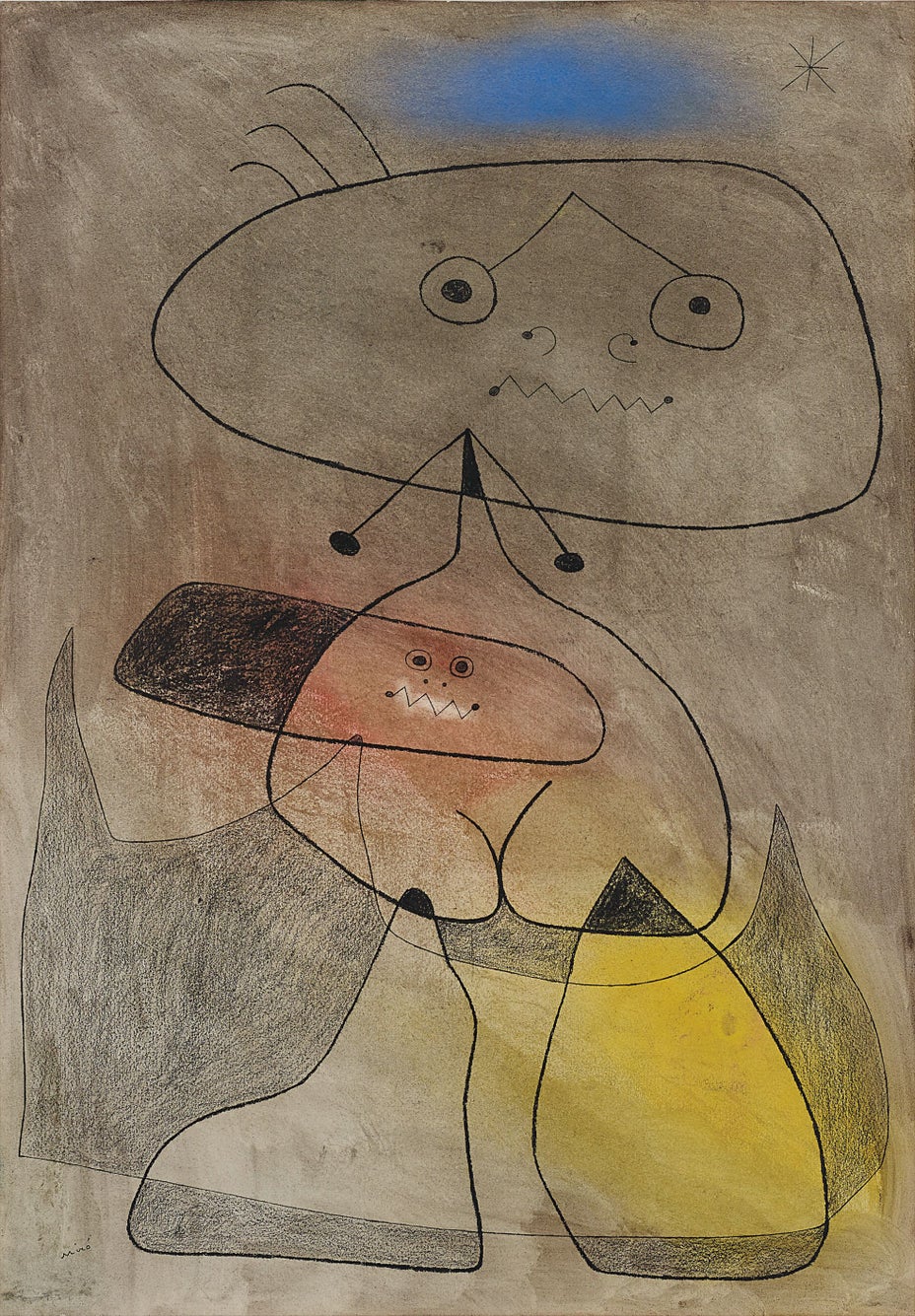
Femme, Oiseau, Etoile
Estimate
£400,000–600,000♠︎
Sold
gouache, wax crayon, pastel and pencil on paper
66 x 46 cm (25 7/8 x 18 1/8 in.)
Signed Miró lower left. Further signed, titled and dated 'Joan Miró "Femme, Oiseau, Etoile" 18-1-1943' on the reverse.
Full-Cataloguing
Femme, Oiseau, Etoile was produced in one of the most unstable periods of Joan Miró’s life. In 1938, the increasing violence of the Spanish Civil War forced him to leave Barcelona and withdraw to Paris with his wife and daughter. By 1940, Nazi air raids made the Mirós itinerants yet again. They settled on Mallorca, an island enclave slightly removed from the turmoil of the world around it. It was there, after completing his Constellation series, that the artist began a four year-long odyssey where he explored a variety of forms, signs and symbols with gouache, pastel, watercolor and pencil. The repeated use of these materials was due in part to the rising costs and scarcity of canvas and the lack of a permanent studio. Indeed, it seemed working on paper suited Miró’s quasi-nomadic and furtive existence. Despite the apparent obstacles, the early 1940s represented a highly productive creative period for the artist: hundreds of drawings were made, with many evolutions of the same title as this one.
These drawings were exorcisms against the perennial horrors of war that haunted Miró in the two countries he called home. Taking fantastical elements from the Constellation works, Femme, Oiseau, Etoile defied its two-dimensional plane to become a sublime break from reality. Amidst fine lines and freely formed organic shapes, there is an almost violent freedom from any literal representation. In between dusty hazes of blue and yellow pastel, craggy intangible forms recede into the distance. The central amorphous figure defies any categorization; one cannot distinguish woman from bird nor man from nature. The bloated and twisted head with its mask-like face and flattened features bears a small expression of anguish, related in but a few doodles. This expression, in tandem with the cruel distortions that affect the forms of this work, seem to be a mirror for the atrocities occurring in mainland Europe at the time. A lone abstract star twinkles in the corner of this drawing, the only glimmer of hope in this desolate slate-grey landscape. Despite 70 years having passed, the distress of this drawing remains palpable to the viewer today. When discussing Miró’s faces, stars and lines, André Breton described them existing 'outside the world and outside time, too.'
These drawings were exorcisms against the perennial horrors of war that haunted Miró in the two countries he called home. Taking fantastical elements from the Constellation works, Femme, Oiseau, Etoile defied its two-dimensional plane to become a sublime break from reality. Amidst fine lines and freely formed organic shapes, there is an almost violent freedom from any literal representation. In between dusty hazes of blue and yellow pastel, craggy intangible forms recede into the distance. The central amorphous figure defies any categorization; one cannot distinguish woman from bird nor man from nature. The bloated and twisted head with its mask-like face and flattened features bears a small expression of anguish, related in but a few doodles. This expression, in tandem with the cruel distortions that affect the forms of this work, seem to be a mirror for the atrocities occurring in mainland Europe at the time. A lone abstract star twinkles in the corner of this drawing, the only glimmer of hope in this desolate slate-grey landscape. Despite 70 years having passed, the distress of this drawing remains palpable to the viewer today. When discussing Miró’s faces, stars and lines, André Breton described them existing 'outside the world and outside time, too.'