PROPERTY FROM THE MILES AND SHIRLEY FITERMAN COLLECTION
129Ο︎
Joan Miró
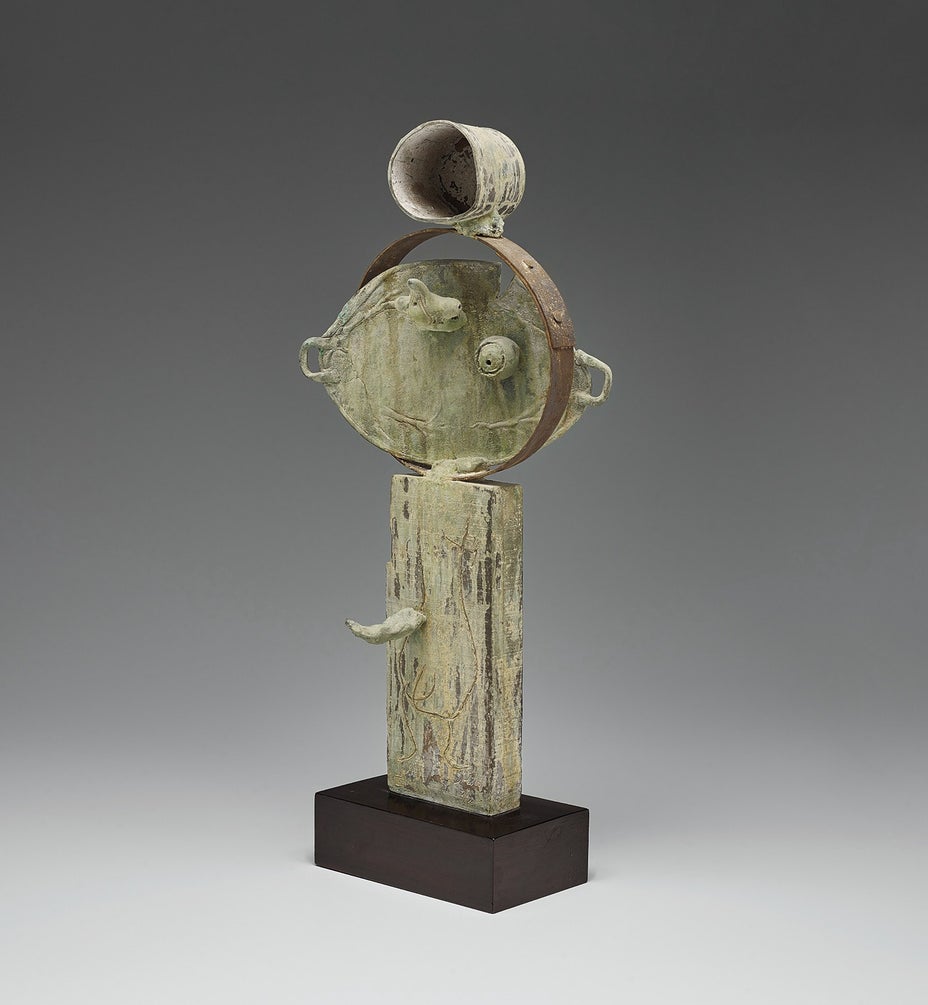
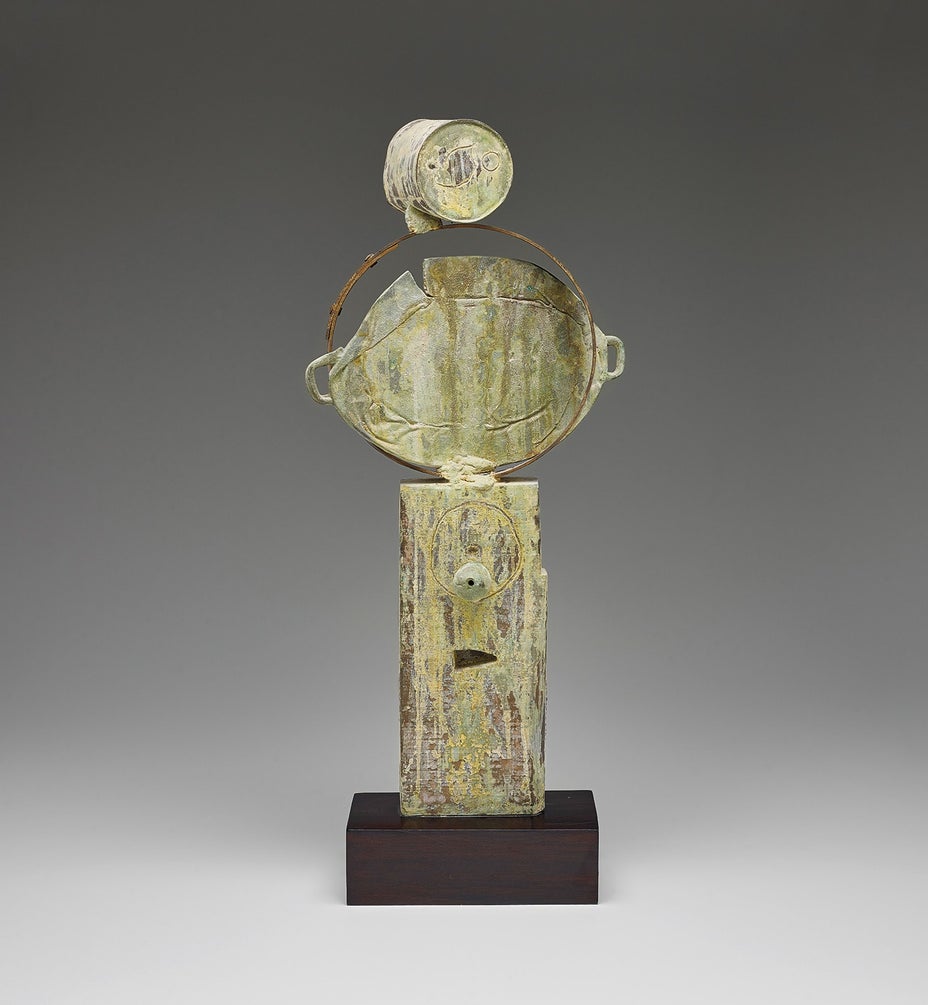
Personnage
Estimate
£150,000–200,000‡︎♠︎
Sold For
£175,000
incised with the artist's signature and number 'Miró 2/2' lower edge
bronze with green-grey patina
69.7 x 33 x 15.5 cm (27 1/2 x 12 7/8 x 6 1/8 in.)
Conceived in 1970 and cast by Fundició Parellada, Barcelona, this work is number 2 from an edition of 2 plus 1 artist's proof and 2 nominative casts realised in 1973 and 1987.
Full-Cataloguing
‘In an artwork, you should be able to discover new things every time you see it.’ – Joan Miro
Poetically and magically re-inventing traditional sculptural depictions of the female form, birds and figures, the current selection of works from the Fiterman Collection wonderfully demonstrate Joan Miró’s constant challenge of artistic norms since his initial spectacular emergence as a sculptor between 1946 and 1949 with the creation, modelling and casting of Lunar Bird and Solar Birds.
From the mid 1960’s, Miró adopted assemblage in the modelling of his women, birds and figures; subjects that appear intermittently throughout Miró’s output and typically assigned titles such as Personnage, Oiseau, Femme. Miró's assemblage sculptures, rooted in Surrealist collage and Goya’s Caprices, unite the marvel of childhood joy with the rustic wit of the Catalans. Reminiscent of ‘that brand of confused alchemy derived from Miró’s close friend Marcel Duchamp … Miró changed the experience of pictorial invention with his peasant-like, dogmatic instinct. He approached and re-examined the most familiar subjects – a pebble, a tap, a leaf, twig, piece of soap, a toy or a Catalan cake.’ (Jacques Dupin, in Emilio Fernández Miró and Pilar Ortega Chapel, Joan Miró: Sculptures. Catalogue raisonné 1928-1982, Paris, 2006, p. 21).
Objects collected such as iron, stones and other found and discovered treasures were combined during the evolution of his bronzes, thereby altering their artistic purpose and infusing the final work with a dynamic poetic spirit. ‘The real, almost unique inventiveness of Miró the sculptor lay in his work with assemblage. In the beginning, strange, disparate elements gradually evolved during the process of discovery to become recognisable pieces – parts of a construction in which they increasingly revealed themselves … to form a sculpture that was articulate and that unfolded like a musical fugue and variations.’ (Jacques Dupin, in Emilio Fernández Miró and Pilar Ortega Chapel, Joan Miró: Sculptures. Catalogue raisonné 1928-1982, Paris, 2006, p. 22).
Through these assemblage works, Miro was able to escape the constraints of everyday life. Explaining his process of using the found items he collected on his walks in the countryside, Miró noted, 'I feel attracted to an object by a magnetic force, without the slightest premeditation, and then I feel myself being drawn to another object which is added to the first, and in combination they create a poetic shock, preceded by that visual and physical revelation which makes poetry truly moving…' (the artist, quoted in Joan Miró: Selected Writings and Interviews, Boston, 1986, p. 125).
Conceived between 1970 and 1978, the following examples, Personnage, Femme and Personnage et oiseau, take Miró’s key motifs as their subject, delightfully conveying femininity and expressing the fantasy of found materials becoming animate and alive, leaving representation and reality to arouse the imagination. Miró devised a new poetry and denotation that conjure unconscious primitive forms and prehistoric traditions.
Poetically and magically re-inventing traditional sculptural depictions of the female form, birds and figures, the current selection of works from the Fiterman Collection wonderfully demonstrate Joan Miró’s constant challenge of artistic norms since his initial spectacular emergence as a sculptor between 1946 and 1949 with the creation, modelling and casting of Lunar Bird and Solar Birds.
From the mid 1960’s, Miró adopted assemblage in the modelling of his women, birds and figures; subjects that appear intermittently throughout Miró’s output and typically assigned titles such as Personnage, Oiseau, Femme. Miró's assemblage sculptures, rooted in Surrealist collage and Goya’s Caprices, unite the marvel of childhood joy with the rustic wit of the Catalans. Reminiscent of ‘that brand of confused alchemy derived from Miró’s close friend Marcel Duchamp … Miró changed the experience of pictorial invention with his peasant-like, dogmatic instinct. He approached and re-examined the most familiar subjects – a pebble, a tap, a leaf, twig, piece of soap, a toy or a Catalan cake.’ (Jacques Dupin, in Emilio Fernández Miró and Pilar Ortega Chapel, Joan Miró: Sculptures. Catalogue raisonné 1928-1982, Paris, 2006, p. 21).
Objects collected such as iron, stones and other found and discovered treasures were combined during the evolution of his bronzes, thereby altering their artistic purpose and infusing the final work with a dynamic poetic spirit. ‘The real, almost unique inventiveness of Miró the sculptor lay in his work with assemblage. In the beginning, strange, disparate elements gradually evolved during the process of discovery to become recognisable pieces – parts of a construction in which they increasingly revealed themselves … to form a sculpture that was articulate and that unfolded like a musical fugue and variations.’ (Jacques Dupin, in Emilio Fernández Miró and Pilar Ortega Chapel, Joan Miró: Sculptures. Catalogue raisonné 1928-1982, Paris, 2006, p. 22).
Through these assemblage works, Miro was able to escape the constraints of everyday life. Explaining his process of using the found items he collected on his walks in the countryside, Miró noted, 'I feel attracted to an object by a magnetic force, without the slightest premeditation, and then I feel myself being drawn to another object which is added to the first, and in combination they create a poetic shock, preceded by that visual and physical revelation which makes poetry truly moving…' (the artist, quoted in Joan Miró: Selected Writings and Interviews, Boston, 1986, p. 125).
Conceived between 1970 and 1978, the following examples, Personnage, Femme and Personnage et oiseau, take Miró’s key motifs as their subject, delightfully conveying femininity and expressing the fantasy of found materials becoming animate and alive, leaving representation and reality to arouse the imagination. Miró devised a new poetry and denotation that conjure unconscious primitive forms and prehistoric traditions.