25Ο︎◆︎
Jeff Koons
Naked
Estimate
$5,000,000–7,000,000
Sold For
$5,765,000
porcelain
45 1/2 x 27 x 27 in. (115.6 x 68.6 x 68.6 cm)
This work is the artist's proof from an edition of 3 plus 1 artist's proof.
Full-Cataloguing
“I think art teaches us how to feel, what our parameters can be, what sensations can be like; it makes you more engaged with life.” Jeff Koons
Jeff Koons’s porcelain sculpture Naked, 1988, from his Banality series, addresses the timeless and profound dilemma of shame and guilt. The Banality sculptures are credited for launching the artist to international fame, in no doubt partly due to their simultaneous global showing with Sonnabend in New York, Donald Young in Chicago and Max Hetzler in Cologne. Culling his content from popular culture, the series of near life-sized polychromed wood and porcelain sculptures, presents a diverse range of subject matter from comedian Buster Keaton to the Pink Panther to Michael Jackson and his pet chimpanzee Bubbles that are thematically held together by what Hans Werner Holzwarth notes are “several basic elements: saccharine cuteness, sexual clichés, and Christian symbolism [that] materialize in an explosion of pastel, white and guilt.” (Hans Werner Holzwarth, ed., JEFF KOONS, Cologne 2009, p. 252) The series, conceived from a flurry of pop culture imagery and religious iconography amassed by the artist from high and low visual culture, puts forward a cast of characters which inhabit Koons’s idealized world of art or “Garden of Eden.” As the artist explains, “In the Banality work, I started to be really specific about what my interests were. Everything here is a metaphor for the viewer’s cultural guilt and shame. Art can be a horrible discriminator. It can be used either to be uplifting and to give self-empowerment, or to debase people and disempower them. And on the tightrope in between, there is one’s cultural history. These images are aspects from my own, but everybody’s cultural history is perfect, it can’t be anything other than what it is—it is absolute perfection. Banality was the embracement of that.””(Jeff Koons in Hans Werner Holzwarth, ed., JEFF KOONS, Cologne 2009, p. 252)
Following his Statuary series of portrait busts and cultural figures cast in stainless steel, the Banality series extended into a more expansive investigation of popular culture. Employing established Italian and German craftsmen who historically decorated religious items, Koons engaged these traditional tradesmen to work in gilt porcelain and polychromed wood, not mediums typical found in contemporary art but rather on the shelves of tourist gift shops. As in so much of Koons’s practice, his choice of material is not incidental but a mode from which to further propel his thematic concerns. Porcelain deftly plays on Koons’s chosen themes of high and low art and seduction, all very much at play in Naked. As Koons has noted, "In the porcelain pieces I wanted to be able to show the sexuality of the material. Porcelain is a material which was created in the service of the monarch and made in the King's oven. Of course, over the centuries it has become totally democratized but still the material always wants to return to the service of the monarch. There is this uplifting quality about it, this feeling of one's social standing being increased just by being around the material." (Jeff Koons, quoted in Sadie Coles and Robert Violette, eds., The Jeff Koons Handbook, London 1992, p. 100)
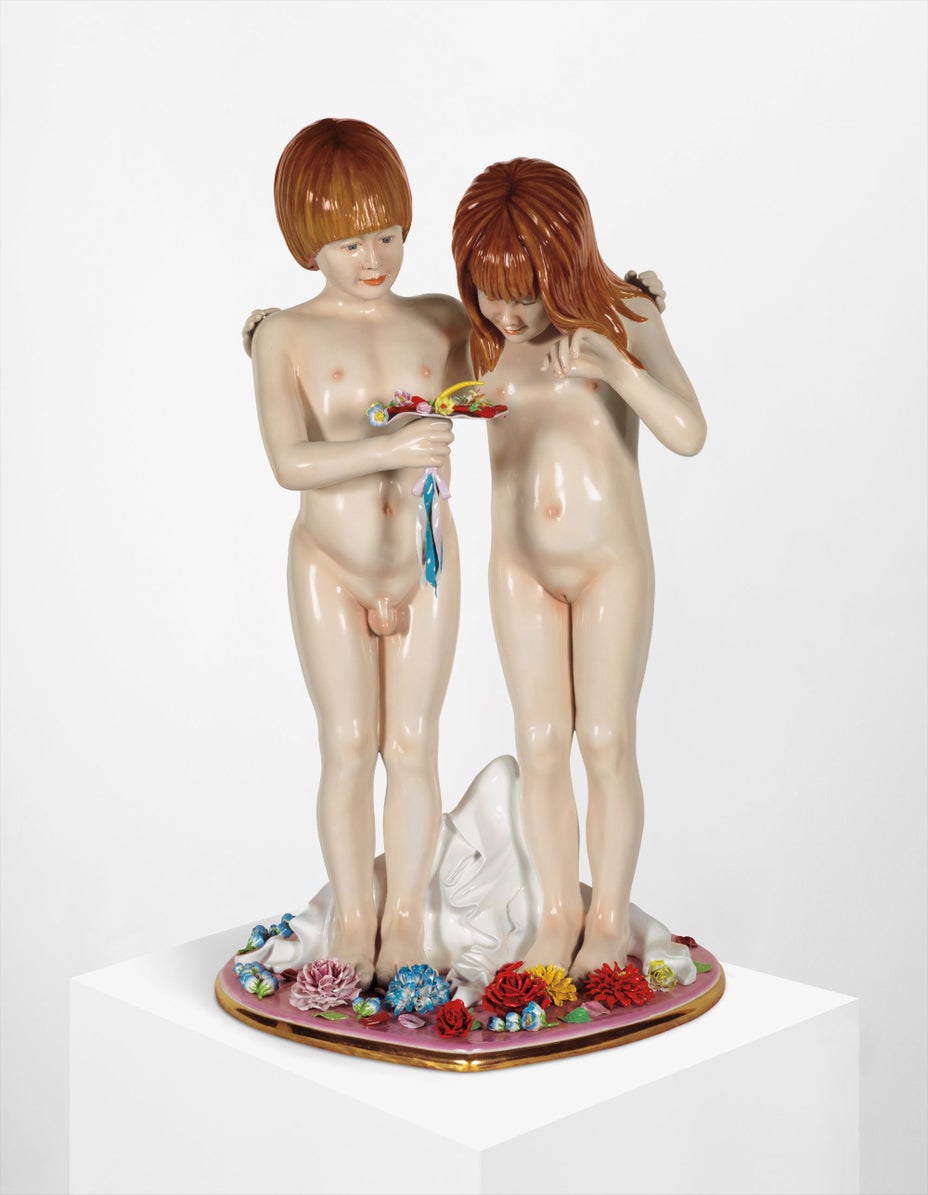
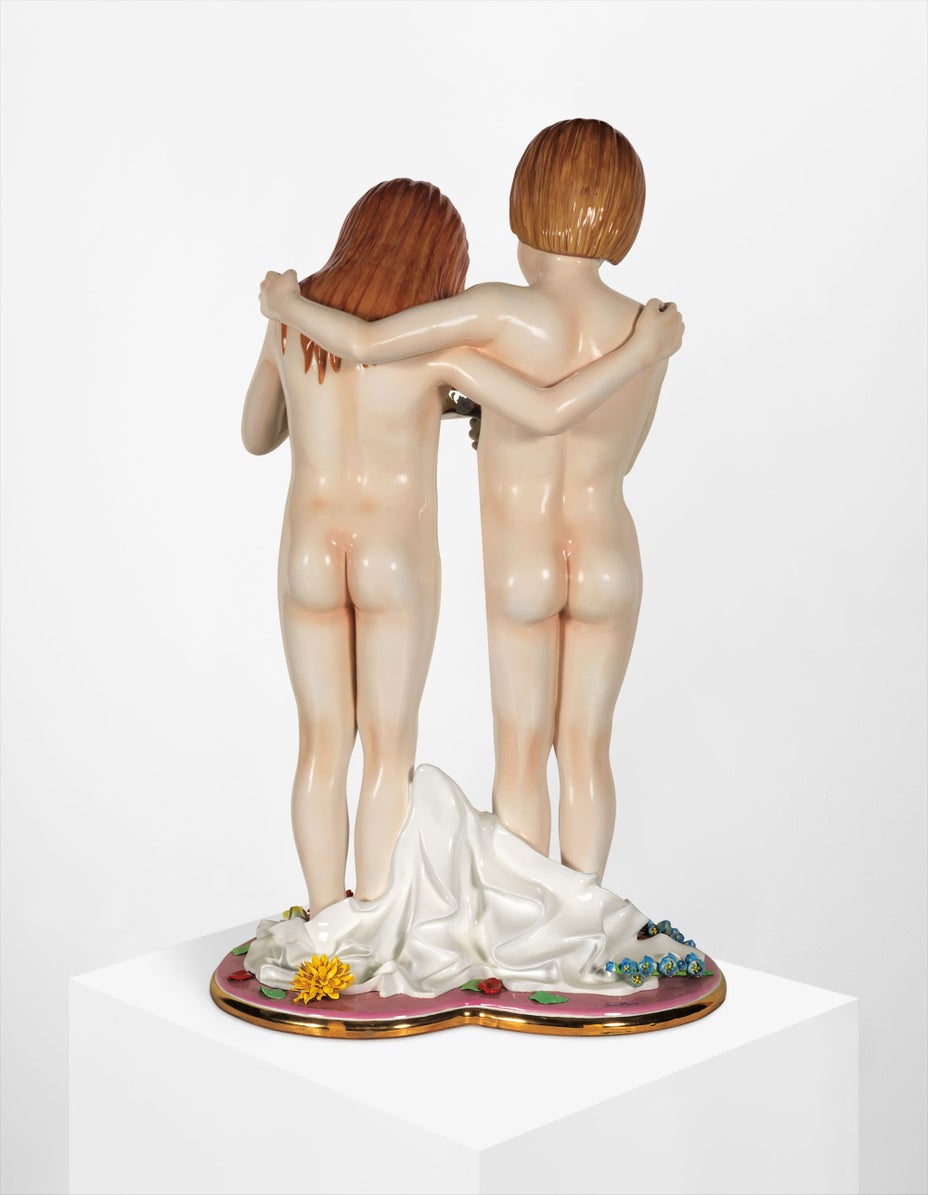
In Naked the youthful figures, ostensibly of Adam and Eve stand nude before the viewer, examining a bouquet of flowers which Adam clutches in his right hand. Adam with his bowl haircut and Eve with her angular bangs, appear as classic children of the 1980’s, directly from Koons’s world. Standing on a heart shaped base, a white sheet gathers around their feet while colorful flowers seem to have miraculously sprouted beneath them. A phallic pistil emerges from the center of the bouquet which Eve is intently examining, raising her hand to touch it. This lavish, fetishized depiction of a classic religious scene is imbued with certain ornamental elements of the Rococo. Seduced by the garden and its floral charm, Koons’s rendition of Adam and Eve are at the brink of purity, lured by temptation. As art writer Jim Lewis explains, "Few things in this world are more perplexing, even astonishing, than other people's desires, especially when the objects toward which they're directed don't accord with one's own choices; and few things are more disturbing than those desires enlarged to the point where they fill one's field of vision." (Jim Lewis, Jeff Koons, exh. cat., Museum of Modern Art, San Francisco, 1992, p. 16) Koons’s Adam and Eve, though re-imagined with figures younger than those of classical biblical depiction, captures that same moment of their fall from grace, or in the case of Naked, a loss of innocence. Indeed the title itself seems to echo this subtle change, with “naked” carrying charges of exposure or shame that a title of “nude,” would not. As such, Banality succeeds in standing within Koons’s practice as an intricate allegory, an invitation from the artist to revel in our affection for the visual nostalgia embodied in the tokens and imagery our childhood.
Jeff Koons’s porcelain sculpture Naked, 1988, from his Banality series, addresses the timeless and profound dilemma of shame and guilt. The Banality sculptures are credited for launching the artist to international fame, in no doubt partly due to their simultaneous global showing with Sonnabend in New York, Donald Young in Chicago and Max Hetzler in Cologne. Culling his content from popular culture, the series of near life-sized polychromed wood and porcelain sculptures, presents a diverse range of subject matter from comedian Buster Keaton to the Pink Panther to Michael Jackson and his pet chimpanzee Bubbles that are thematically held together by what Hans Werner Holzwarth notes are “several basic elements: saccharine cuteness, sexual clichés, and Christian symbolism [that] materialize in an explosion of pastel, white and guilt.” (Hans Werner Holzwarth, ed., JEFF KOONS, Cologne 2009, p. 252) The series, conceived from a flurry of pop culture imagery and religious iconography amassed by the artist from high and low visual culture, puts forward a cast of characters which inhabit Koons’s idealized world of art or “Garden of Eden.” As the artist explains, “In the Banality work, I started to be really specific about what my interests were. Everything here is a metaphor for the viewer’s cultural guilt and shame. Art can be a horrible discriminator. It can be used either to be uplifting and to give self-empowerment, or to debase people and disempower them. And on the tightrope in between, there is one’s cultural history. These images are aspects from my own, but everybody’s cultural history is perfect, it can’t be anything other than what it is—it is absolute perfection. Banality was the embracement of that.””(Jeff Koons in Hans Werner Holzwarth, ed., JEFF KOONS, Cologne 2009, p. 252)
Following his Statuary series of portrait busts and cultural figures cast in stainless steel, the Banality series extended into a more expansive investigation of popular culture. Employing established Italian and German craftsmen who historically decorated religious items, Koons engaged these traditional tradesmen to work in gilt porcelain and polychromed wood, not mediums typical found in contemporary art but rather on the shelves of tourist gift shops. As in so much of Koons’s practice, his choice of material is not incidental but a mode from which to further propel his thematic concerns. Porcelain deftly plays on Koons’s chosen themes of high and low art and seduction, all very much at play in Naked. As Koons has noted, "In the porcelain pieces I wanted to be able to show the sexuality of the material. Porcelain is a material which was created in the service of the monarch and made in the King's oven. Of course, over the centuries it has become totally democratized but still the material always wants to return to the service of the monarch. There is this uplifting quality about it, this feeling of one's social standing being increased just by being around the material." (Jeff Koons, quoted in Sadie Coles and Robert Violette, eds., The Jeff Koons Handbook, London 1992, p. 100)
In Naked the youthful figures, ostensibly of Adam and Eve stand nude before the viewer, examining a bouquet of flowers which Adam clutches in his right hand. Adam with his bowl haircut and Eve with her angular bangs, appear as classic children of the 1980’s, directly from Koons’s world. Standing on a heart shaped base, a white sheet gathers around their feet while colorful flowers seem to have miraculously sprouted beneath them. A phallic pistil emerges from the center of the bouquet which Eve is intently examining, raising her hand to touch it. This lavish, fetishized depiction of a classic religious scene is imbued with certain ornamental elements of the Rococo. Seduced by the garden and its floral charm, Koons’s rendition of Adam and Eve are at the brink of purity, lured by temptation. As art writer Jim Lewis explains, "Few things in this world are more perplexing, even astonishing, than other people's desires, especially when the objects toward which they're directed don't accord with one's own choices; and few things are more disturbing than those desires enlarged to the point where they fill one's field of vision." (Jim Lewis, Jeff Koons, exh. cat., Museum of Modern Art, San Francisco, 1992, p. 16) Koons’s Adam and Eve, though re-imagined with figures younger than those of classical biblical depiction, captures that same moment of their fall from grace, or in the case of Naked, a loss of innocence. Indeed the title itself seems to echo this subtle change, with “naked” carrying charges of exposure or shame that a title of “nude,” would not. As such, Banality succeeds in standing within Koons’s practice as an intricate allegory, an invitation from the artist to revel in our affection for the visual nostalgia embodied in the tokens and imagery our childhood.