18Ο︎◆︎
Jeff Koons
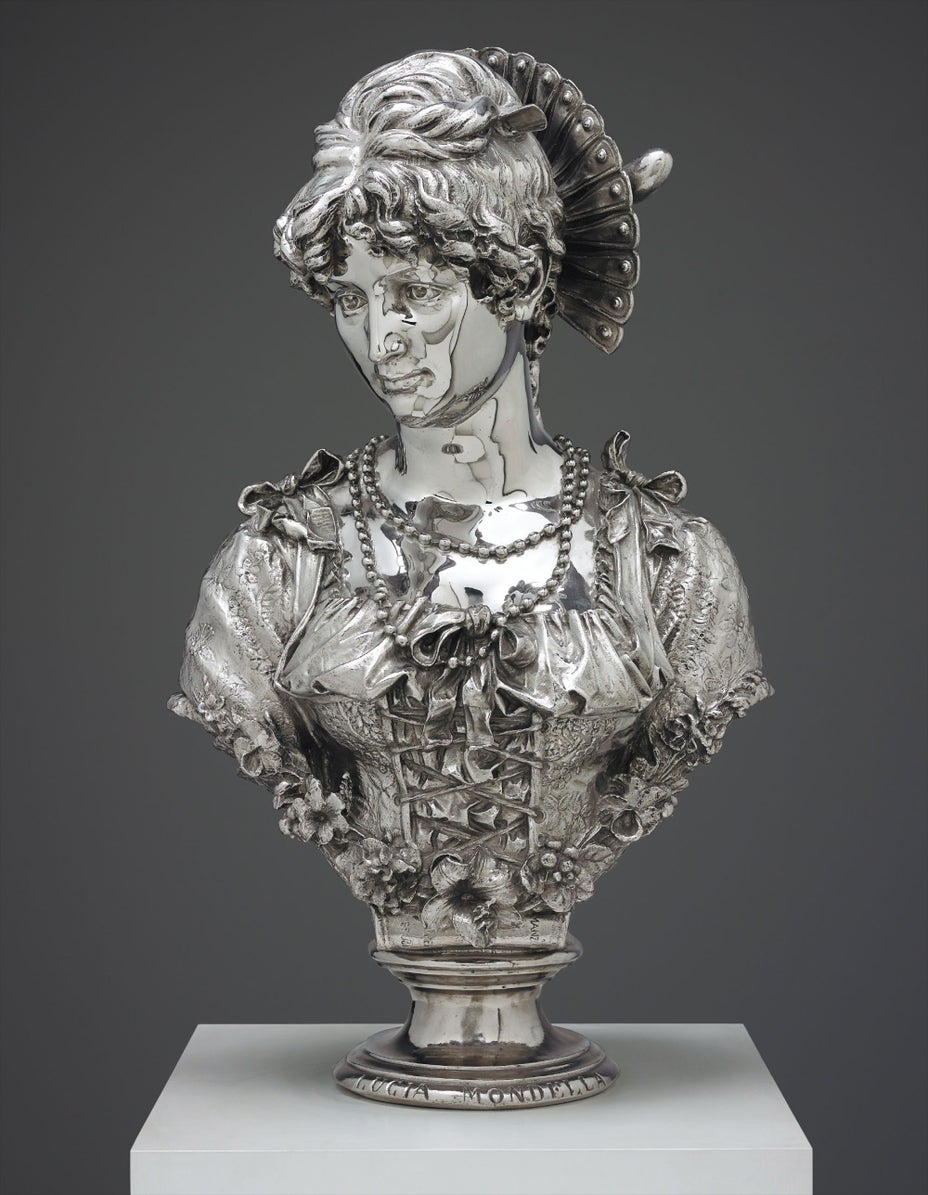
Italian Woman
Estimate
$3,000,000–5,000,000
Sold For
$3,610,000
inscribed "Enrico Lapine Fece Firenze 1893" on the reverse
stainless steel
30 x 18 x 11 in. (76.2 x 45.7 x 27.9 cm.)
Executed in 1986, this work is the artist's proof from an edition of 3 plus 1 artist’s proof.
Full-Cataloguing
"The Italian Woman would be a symbol of the artist going after beauty." Jeff Koons
Italian Woman, is part of Koons's Statuary series, created in 1986. In Statuary, Koons extended the formal concerns of his seminal Luxury and Degradation series from earlier that year, questioning notions of taste and visual culture, two foundational themes of his practice to this day.
With Statuary, Koons brings together objects that extend the breadth of high and low art, from the culturally eminent to the mainstream. From Revolutionary France to bourgeois culture, the ten seemingly disparate objects comprising Statuary illustrate Koons’s adroitness at probing the hierarchies of cultural taste. As such, Koons’s Statuary series stands as an eloquent union of many of the themes in his practice from Marcel Duchamp’s readymades to the idea of newness, desire and beauty. As art historian Katy Siegel notes, “The series marked the emergence of an important theme in Koons’s work: the validation of popular taste as linked to the class background of individuals. The stainless steel tchotchkes reassure us that the things we secretly or naturally love (like decorative figurines) are just as significant and worthy of respect as those things (like high art) that we are supposed to appreciate.” (Katy Siegel, Jeff Koons, Cologne, 2009, p. 222) Statuary was conceived for the artist’s first group show in 1986 at the gallery of legendary art dealer Ileana Sonnabend, who invited Koons to exhibit after his groundbreaking shows at International With Monument.
In Italian Woman, the bust of a young girl emerges from a wreath of flowers, the gleaming surface of her skin accentuates her delicately wrought visage of slightly downcast eyes peeking below a cascade of curls, all framed by a semi-haloed formal headdress. Along the base is the name Lucia Mondella, one of the central characters from Alessandro Manzoni’s, The Betrothed, a 19th century novel so central to Italian culture that it has not only been re-cast multiple times as an opera and film but Pope Francis has also promoted it as an edifying text. Set in 17th century Milan, at the time of its publication the novel was singular for its astonishing portrayal of a female protagonist as an object of acute desire. In one of the most well-known scenes in Italian literature, Lucia is forced to escape a nefarious kidnapping attempt by cruel Spanish nobleman Don Rodrigo, after he forcibly prevented her marriage to her love, Renzo. Alongside Helen of Troy and the Sabine Women, Lucia Mondella stands as a symbol in Western culture of the pursuit of beauty and seduction. Speaking of the conception of Statuary, Koons said “The basic story line is about art leaving the realm of the artist, when the artist loses control of the work…The body of work is based around statuary representing different periods of Western European art. Each work in the show is coded to be more or less specific about art being used as a symbol or representation of a certain theme that takes place in art… Italian Woman would be a symbol of the artist going after beauty.” (Jeff Koons, quoted in Interview with Klaus Ottmann, Journal of Contemporary Art, October 1986) Inspired by and re-invented, Koons’s Lucia Mondella stands as the paradigm of beauty, transformed from a singular woman to become the Italian Woman.
In Statuary, Koons’s exemplifies his adroitness utilizing of artistic mediums. The burnished opulence of the figure’s dress contrasts with the pure, glistening skin. Her mirrored visage reflects our own gaze, engendering the viewer to become one with Koons’s work. Employing polished stainless steel in his work for the first time in 1986, the artist noted, “Polishing the metal lent it a desirous surface, but also one that gave affirmation to the viewer. And this is also the sexual part—it’s about affirming the viewer, telling him, ‘You exist!’ When you move, it moves. The reflection changes. If you don’t move, nothing happens. Everything depends on you, the viewer. And that’s why I work with it. It has nothing to do with narcissism” (Jeff Koons, quoted in “Isabelle Graw in Conversation with Jeff Koons,” Jeff Koons: The Painter, exh. cat., Schirn Kunsthalle Frankfurt, Frankfurt, 2012, p. 78).
Italian Woman is one of the first examples in Koons’s practice that questions the concept of “high art.” Up until this point, the artist’s focus was on the elevation of “low art”—domestic products, ads, and other cultural artifacts—into the realm of “high art” in his re-imaging or presentation of them in vitrines or bronze. By elevating popular cultural objects to the same level as fine art and vice versa, Koons endeavors in Statuary to democratize art. And he does it with stainless steel, the de facto material for much of America’s consumer goods’ mass-production. While the visual qualities of stainless steel convey an opulence akin to silver or platinum, its utilitarian uses are incongruous with the symbolism of elite luxury conveyed by precious metals. “I chose high-grade stainless steel as my material for the sense of security it emanates,” Koons has explained of his practice. “The polish only emphasizes that security, as does the fact that the saucepans Mom used to cook with were steel too. In the high-grade steel works there’s a direct link with religious relics, which are polished too. So they make a spiritual appeal to the beholder and fill him with confidence.”
Italian Woman, is part of Koons's Statuary series, created in 1986. In Statuary, Koons extended the formal concerns of his seminal Luxury and Degradation series from earlier that year, questioning notions of taste and visual culture, two foundational themes of his practice to this day.
With Statuary, Koons brings together objects that extend the breadth of high and low art, from the culturally eminent to the mainstream. From Revolutionary France to bourgeois culture, the ten seemingly disparate objects comprising Statuary illustrate Koons’s adroitness at probing the hierarchies of cultural taste. As such, Koons’s Statuary series stands as an eloquent union of many of the themes in his practice from Marcel Duchamp’s readymades to the idea of newness, desire and beauty. As art historian Katy Siegel notes, “The series marked the emergence of an important theme in Koons’s work: the validation of popular taste as linked to the class background of individuals. The stainless steel tchotchkes reassure us that the things we secretly or naturally love (like decorative figurines) are just as significant and worthy of respect as those things (like high art) that we are supposed to appreciate.” (Katy Siegel, Jeff Koons, Cologne, 2009, p. 222) Statuary was conceived for the artist’s first group show in 1986 at the gallery of legendary art dealer Ileana Sonnabend, who invited Koons to exhibit after his groundbreaking shows at International With Monument.
In Italian Woman, the bust of a young girl emerges from a wreath of flowers, the gleaming surface of her skin accentuates her delicately wrought visage of slightly downcast eyes peeking below a cascade of curls, all framed by a semi-haloed formal headdress. Along the base is the name Lucia Mondella, one of the central characters from Alessandro Manzoni’s, The Betrothed, a 19th century novel so central to Italian culture that it has not only been re-cast multiple times as an opera and film but Pope Francis has also promoted it as an edifying text. Set in 17th century Milan, at the time of its publication the novel was singular for its astonishing portrayal of a female protagonist as an object of acute desire. In one of the most well-known scenes in Italian literature, Lucia is forced to escape a nefarious kidnapping attempt by cruel Spanish nobleman Don Rodrigo, after he forcibly prevented her marriage to her love, Renzo. Alongside Helen of Troy and the Sabine Women, Lucia Mondella stands as a symbol in Western culture of the pursuit of beauty and seduction. Speaking of the conception of Statuary, Koons said “The basic story line is about art leaving the realm of the artist, when the artist loses control of the work…The body of work is based around statuary representing different periods of Western European art. Each work in the show is coded to be more or less specific about art being used as a symbol or representation of a certain theme that takes place in art… Italian Woman would be a symbol of the artist going after beauty.” (Jeff Koons, quoted in Interview with Klaus Ottmann, Journal of Contemporary Art, October 1986) Inspired by and re-invented, Koons’s Lucia Mondella stands as the paradigm of beauty, transformed from a singular woman to become the Italian Woman.
In Statuary, Koons’s exemplifies his adroitness utilizing of artistic mediums. The burnished opulence of the figure’s dress contrasts with the pure, glistening skin. Her mirrored visage reflects our own gaze, engendering the viewer to become one with Koons’s work. Employing polished stainless steel in his work for the first time in 1986, the artist noted, “Polishing the metal lent it a desirous surface, but also one that gave affirmation to the viewer. And this is also the sexual part—it’s about affirming the viewer, telling him, ‘You exist!’ When you move, it moves. The reflection changes. If you don’t move, nothing happens. Everything depends on you, the viewer. And that’s why I work with it. It has nothing to do with narcissism” (Jeff Koons, quoted in “Isabelle Graw in Conversation with Jeff Koons,” Jeff Koons: The Painter, exh. cat., Schirn Kunsthalle Frankfurt, Frankfurt, 2012, p. 78).
Italian Woman is one of the first examples in Koons’s practice that questions the concept of “high art.” Up until this point, the artist’s focus was on the elevation of “low art”—domestic products, ads, and other cultural artifacts—into the realm of “high art” in his re-imaging or presentation of them in vitrines or bronze. By elevating popular cultural objects to the same level as fine art and vice versa, Koons endeavors in Statuary to democratize art. And he does it with stainless steel, the de facto material for much of America’s consumer goods’ mass-production. While the visual qualities of stainless steel convey an opulence akin to silver or platinum, its utilitarian uses are incongruous with the symbolism of elite luxury conveyed by precious metals. “I chose high-grade stainless steel as my material for the sense of security it emanates,” Koons has explained of his practice. “The polish only emphasizes that security, as does the fact that the saucepans Mom used to cook with were steel too. In the high-grade steel works there’s a direct link with religious relics, which are polished too. So they make a spiritual appeal to the beholder and fill him with confidence.”