

8
Jean Royère
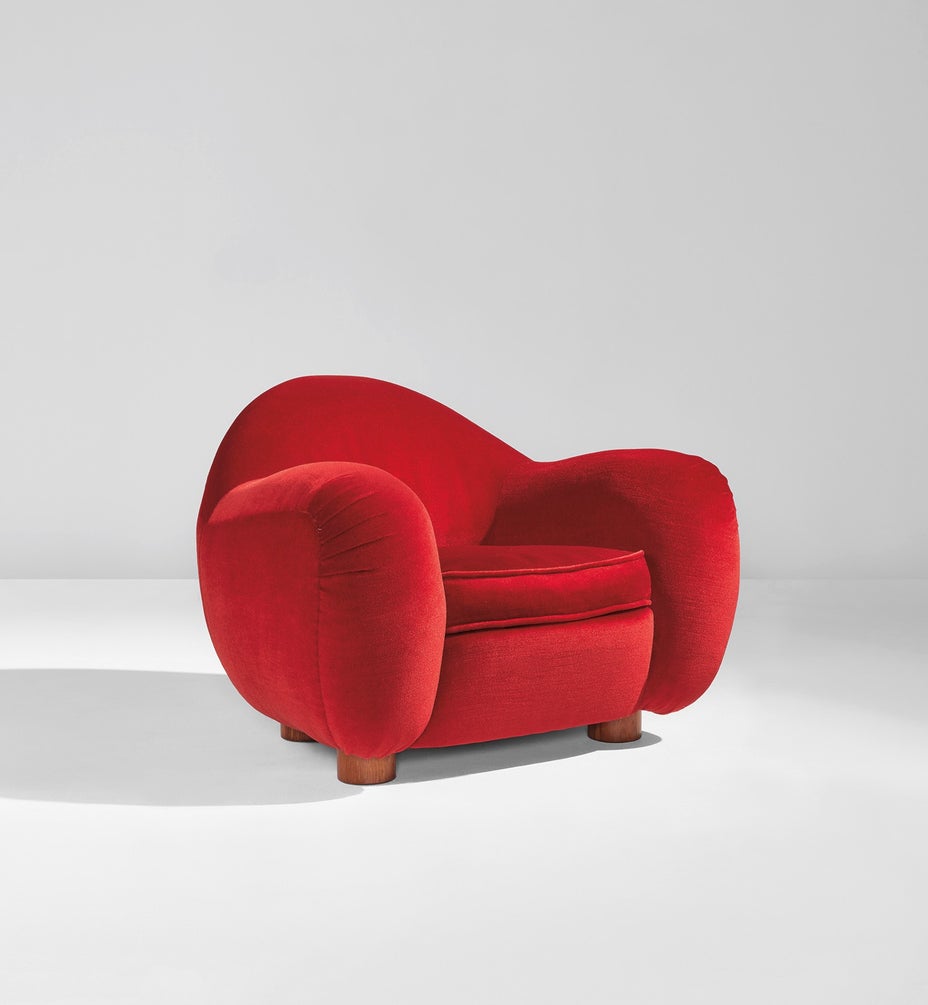
"Boule" armchair
- Estimate
- $120,000 - 180,000
$125,000
Lot Details
Fabric upholstery, oak.
circa 1957
27 1/2 x 38 1/2 x 37 1/2 in. (69.9 x 97.8 x 95.3 cm)
Specialist
Full-Cataloguing
Catalogue Essay
The present Boule armchair was acquired in 1957 from the architect Nadim Majdalani in Beirut. Majdalani had met Jean Royère in Paris and subsequently, in the late 1940s, the two opened an office of decoration and architecture together under both their names on avenue des Français in Beirut. The collaboration would continue into the 1960s. Majdalani also owned a furniture workshop and began to execute Royère’s designs according to the detailed plans he had sent over from Paris. Nadine Begdache, the daughter of Majdalani, recounted that Royère’s furniture was “distinguished by their originality and their audacity…Everything he imagined was of great freshness and above all great comfort (Fifi Abou Dib, “En tandem avec Nadim Majdalani,” L’Orient-Le Jour, May 5, 2000).”
Royère and Majdalani would go on to collaborate on a large number of both residential and commercial interiors throughout Lebanon, which at the time was experiencing a great deal of growth and new construction. These interiors appeared in French publications throughout the period, with Nadim Majdalani noted as a collaborator in the captions. For his part, Royère loved to travel and throughout his career sought out new markets across the world. As he recounted in 1963, “What you have to remember is that in these new and developing countries, cooperation between architect and decorator is facilitated by the fact that, unlike in France, people don’t spend their time patching up and modernizing old buildings (Revue de l’Ameublement, December 1963).”
The form of the present armchair, a variation of the lower-back version now commonly referred to as the Ours Polaire armchair, had been exhibited by Royère as early as 1942 in the Salon des artistes décorateurs.
Royère and Majdalani would go on to collaborate on a large number of both residential and commercial interiors throughout Lebanon, which at the time was experiencing a great deal of growth and new construction. These interiors appeared in French publications throughout the period, with Nadim Majdalani noted as a collaborator in the captions. For his part, Royère loved to travel and throughout his career sought out new markets across the world. As he recounted in 1963, “What you have to remember is that in these new and developing countries, cooperation between architect and decorator is facilitated by the fact that, unlike in France, people don’t spend their time patching up and modernizing old buildings (Revue de l’Ameublement, December 1963).”
The form of the present armchair, a variation of the lower-back version now commonly referred to as the Ours Polaire armchair, had been exhibited by Royère as early as 1942 in the Salon des artistes décorateurs.
Provenance
Literature
Jean Royère
French | B. 1902 D. 1981Jean Royère took on the mantle of the great artistes décorateurs of 1940s France and ran with it into the second half of the twentieth century. Often perceived as outside of the modernist trajectory ascribed to twentieth-century design, Royère was nonetheless informed by and enormously influential to his peers. Having opened a store in Paris in 1943 before the war had ended, he was one of the first to promote a new way of life through interior decoration, and his lively approach found an international audience early on in his career.
In addition to commissions in Europe and South America, Royère had a strong business in the Middle East where he famously designed homes for the Shah of Iran, King Farouk of Egypt and King Hussein of Jordan. The surrealist humor and artist's thoughtful restraint that he brought to his furniture designs continue to draw admiration to this day.
Browse ArtistIn addition to commissions in Europe and South America, Royère had a strong business in the Middle East where he famously designed homes for the Shah of Iran, King Farouk of Egypt and King Hussein of Jordan. The surrealist humor and artist's thoughtful restraint that he brought to his furniture designs continue to draw admiration to this day.