61
Jean-Michel Basquiat
Untitled (Wooden Triptych)
(ii) 13 1/2 x 11 3/4 in. (34.3 x 29.8 cm)
(iii) 25 x 9 3/4 in. (63.5 x 24.8 cm)
Full-Cataloguing
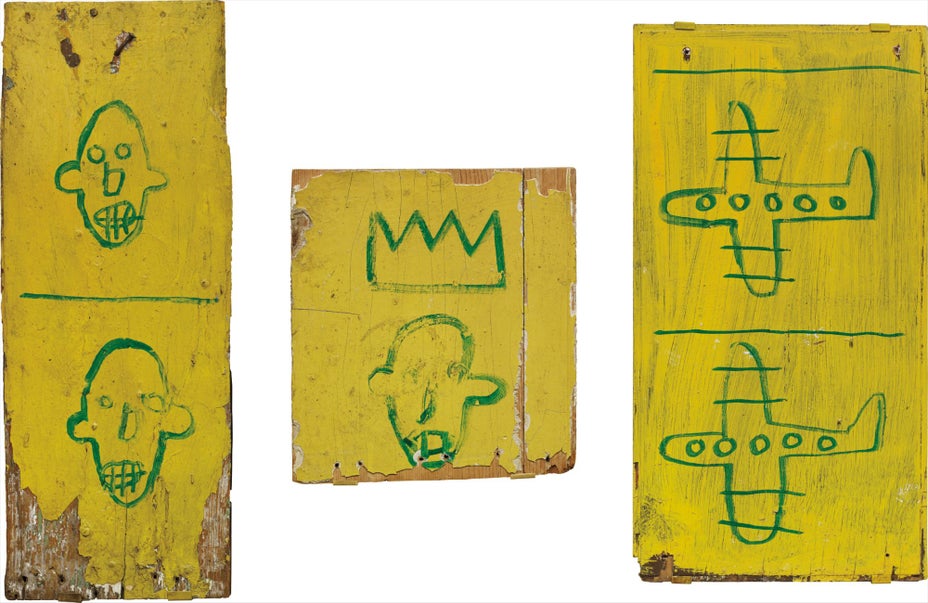
This three-paneled painting by Basquiat comes from the collection of Glenn O’Brien, the first editor of Interview, founded in 1969 by Andy Warhol and journalist John Wilcock. O’Brien also wrote and produced the independent film Downtown 81, filmed over a six-week period in 1980 and 1981. It not only stars the 19-year-old Basquiat amidst the 1980s post-punk subculture in New York’s East Village neighborhood, a vastly dissimilar landscape from today’s, but the present lot, with its radiant yellow background, makes an appearance as well. Basquiat and O’Brien became acquainted through O’Brien’s public access TV show “TV Party,” which featured underground figures such as David Byrne, Blondie, and The Clash. Downtown 81 follows the artist as he navigates back to his tenement apartment after his release from a hospital. Key members of the flourishing downtown art and music scene—including graffiti artists Lee Quiñones and Fab Five Freddy—appear in spontaneous succession as he weaves from apartments to clubs to rehearsal spaces, all while scrawling poetry on the walls of abandoned buildings. Featuring music by Basquiat’s own band, Gray, the film serves as both a unique visual and aural record of Basquiat in the beginnings of his brief yet highly prolific artistic career.
Basquiat famously stated in an interview with Metropolitan Museum curator Henry Geldzahler that “royalty, heroism, and the streets” served largely as his subject matter. The crown that appears in the central panel of this work became his moniker, alongside symbols such as the skull, seen here across two panels. His recurrent reference to the human body stems from his lasting impression of anatomical drawings in Gray’s Anatomy, given to him while in recovery at the hospital after a childhood accident. Additionally, the triptych format and choice of wood as medium perhaps echoes altarpieces from the early Christian and Gothic periods. As exemplified by Untitled (Wooden Triptych), Basquiat’s oeuvre synthesizes an acute sociopolitical awareness with an equally profound cultural one.
Jean-Michel Basquiat
American | B. 1960 D. 1988One of the most famous American artists of all time, Jean-Michel Basquiat first gained notoriety as a subversive graffiti-artist and street poet in the late 1970s. Operating under the pseudonym SAMO, he emblazoned the abandoned walls of the city with his unique blend of enigmatic symbols, icons and aphorisms. A voracious autodidact, by 1980, at 22-years of age, Basquiat began to direct his extraordinary talent towards painting and drawing. His powerful works brilliantly captured the zeitgeist of the 1980s New York underground scene and catapulted Basquiat on a dizzying meteoric ascent to international stardom that would only be put to a halt by his untimely death in 1988.
Basquiat's iconoclastic oeuvre revolves around the human figure. Exploiting the creative potential of free association and past experience, he created deeply personal, often autobiographical, images by drawing liberally from such disparate fields as urban street culture, music, poetry, Christian iconography, African-American and Aztec cultural histories and a broad range of art historical sources.