44
Jean-Michel Basquiat
Back of the Neck
Full-Cataloguing
-- Jean-Michel Basquiat
At the age of seven, Jean-Michel Basquiat was playing ball on his street in Brooklyn when he was hit by a car, resulting in a broken arm and various internal injuries that led to a month’s recuperation in hospital. During his incarceration, his mother gave him a copy of the medical text, Gray’s Anatomy. Filled with detailed anatomical drawings and diagrams, this book had a profound influence on the young artist who, throughout his oeuvre and particularly in his drawings and prints, has compulsively detailed fragments of the human body.
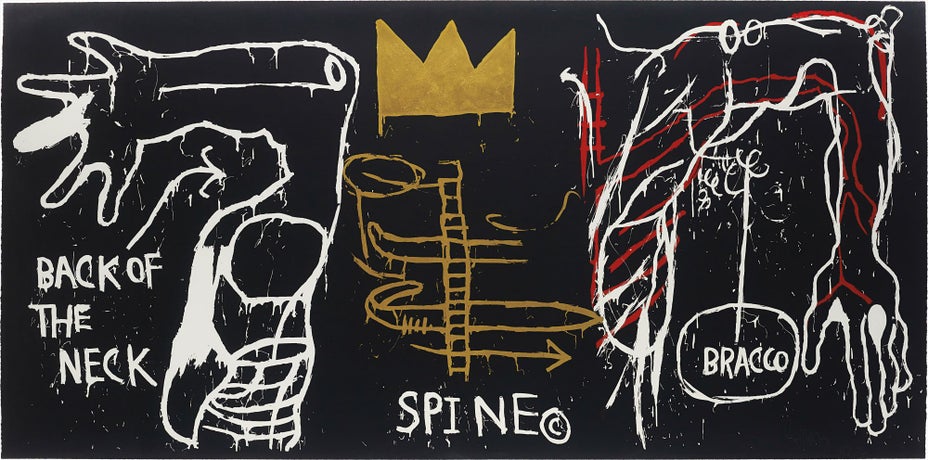
The artist’s obsession with anatomical imagery is evident in his first experimentation with printmaking: the two series Anatomy, 1982 and Untitled (from Leonardo), 1983. These stark monochromatic prints diagrammatically catalogue a variety of individual body parts, almost as a child’s homework would name the various joints and ligaments. However, it is only in the present lot, Back of the Neck that these disparate limbs are combined to create an image that transcends the sterile illustrations of medical textbooks.
In the present lot, Basquiat penetrates the human figure with a unique x-ray vision, presenting the viewer with a skeletal spine flanked by two dismembered arms: one almost entirely clad in flesh, the other flayed to muscle and sinew. The artist’s disquieting cross-section of a human figure calls to mind Gerard David’s The Flaying of Sisamnes, 1498, wherein the peeling of the corrupt judge’s skin away from his lower leg is carefully rendered in grotesque detail.
Basquait explained that he was, “…interested in painting the black person, he’s the protagonist in most of my paintings.” Yet if that is the case in Back of the Neck then the black person he is depicting appears hardly as a protagonist, remaining both faceless and nameless. The artist chose instead to spell out (in aggressive white lettering) the compartmentalised sections of the body he is displaying, including his trademark copyright sign to individually brand the isolated limbs. The subject of this work has been torn asunder, his body parts scattered across the paper, exuding perhaps the intensely felt, but fragmented experience of the artist’s astronomic acceleration to fame, and the scrutiny he faced in a culture that both rejected and exoticised Basquiat as a black artist.
As Dick Hebdige has stated, Basquiat was obsessed “with the black male body’s history as property, pulverized meat and popular entertainment…” and as a black artist, was acutely aware of “performing the splitting, doubling, and stitching-up procedures which lie behind a production of identity.” Back of the Neck, redolent with taut energy in its expressive lines and rich, violent colours, illustrates such a performance. The body in this work remains poignantly vulnerable: the back of the neck, only visible when the head is bowed, the bared, brittle spine and the flayed arm, stripped to sinew and raised to expose the delicate armpit. The outpouring of fury that this work initially casts to the viewer belies the vulnerability of a ragged figure laid bare upon the paper. And yet, this figure remains crowned: a fallen king or a martyr, but nonetheless, a hero.
Jean-Michel Basquiat
American | B. 1960 D. 1988One of the most famous American artists of all time, Jean-Michel Basquiat first gained notoriety as a subversive graffiti-artist and street poet in the late 1970s. Operating under the pseudonym SAMO, he emblazoned the abandoned walls of the city with his unique blend of enigmatic symbols, icons and aphorisms. A voracious autodidact, by 1980, at 22-years of age, Basquiat began to direct his extraordinary talent towards painting and drawing. His powerful works brilliantly captured the zeitgeist of the 1980s New York underground scene and catapulted Basquiat on a dizzying meteoric ascent to international stardom that would only be put to a halt by his untimely death in 1988.
Basquiat's iconoclastic oeuvre revolves around the human figure. Exploiting the creative potential of free association and past experience, he created deeply personal, often autobiographical, images by drawing liberally from such disparate fields as urban street culture, music, poetry, Christian iconography, African-American and Aztec cultural histories and a broad range of art historical sources.