Property from a Distinguished Private Collection, Florida
171
Jean Dubuffet
Figure VIII
Estimate
$150,000–250,000
Sold For
$262,500
signed with the artist's initials and dated "J.D. 74" lower right
vinyl on laminated panel
37 x 50 1/2 in. (94 x 128.3 cm.)
Painted in July 1974.
Full-Cataloguing
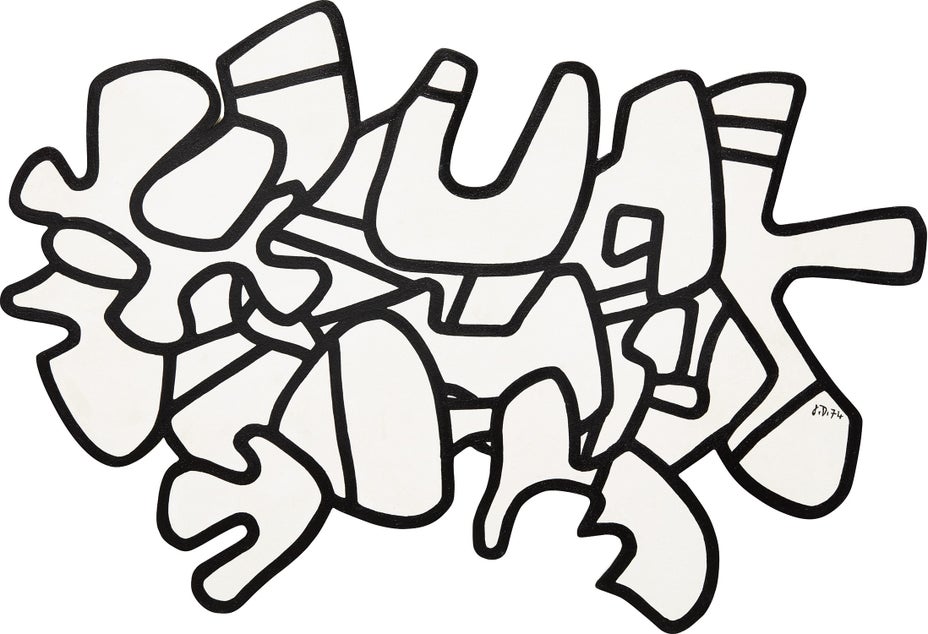
Jean Dubuffet’s Figure VII is emblematic of the artist’s l’Hourloupe paintings and sculptures, Dubuffet’s longest and most original series which culminated in 1974, the year in which the present work was executed. A lifelong proponent of Art Brut, Dubuffet consistently discovered new ways to emphasize a more immediate and rudimentary quality in art, one that he was able to fully explore within the l’Hourloupe cycle. The series’ signature characteristic is the looping nature of the line and Dubuffet’s ability to wield it as a double-edged sword – delineating natural forms and also intricately describing abstract thoughts and shapes.
Figure VII transmutes the linearity of Dubuffet’s geometric drawings into a dramatic three-dimensional form that extends off the wall and into the viewers’ physical space. The spontaneous black outlines that encapsulate white space exquisitely illustrate the main themes of the series, begun in 1962 and initially inspired by pen doodles drawn while talking on the telephone. This work embodies a jigsaw-like pattern in which the pieces seem simultaneously calculated and disjointed, evoking an immediacy that engages the viewer. Dubuffet’s work defies traditional creative processes and is not representative of life or nature, but was instead invented from the ideas explored within his own mind. “Ordinary art depicts the perceived world…Whereas…mental space does not resemble three-dimensional perceived space and has no use for such notions such as above or below, in front of or behind, close or distant. [Mental space] presents itself as flowing, whirling, meandering water and therefore its transcription requires entirely different devices from those deemed appropriate for transcribing the perceived world” (Thomas Messer, Jean Dubuffet: A Retrospective, New York, 1973, p. 24).
Figure VII transmutes the linearity of Dubuffet’s geometric drawings into a dramatic three-dimensional form that extends off the wall and into the viewers’ physical space. The spontaneous black outlines that encapsulate white space exquisitely illustrate the main themes of the series, begun in 1962 and initially inspired by pen doodles drawn while talking on the telephone. This work embodies a jigsaw-like pattern in which the pieces seem simultaneously calculated and disjointed, evoking an immediacy that engages the viewer. Dubuffet’s work defies traditional creative processes and is not representative of life or nature, but was instead invented from the ideas explored within his own mind. “Ordinary art depicts the perceived world…Whereas…mental space does not resemble three-dimensional perceived space and has no use for such notions such as above or below, in front of or behind, close or distant. [Mental space] presents itself as flowing, whirling, meandering water and therefore its transcription requires entirely different devices from those deemed appropriate for transcribing the perceived world” (Thomas Messer, Jean Dubuffet: A Retrospective, New York, 1973, p. 24).