
45
Jasper Johns
Land's End
- Estimate
- $10,000 - 15,000
$18,750
Lot Details
Lithograph, on Kurotani paper, the full sheet.
1979
S. 52 x 36 1/4 in. (132.1 x 92.1 cm)
Signed, dated and numbered 56/70 in pencil (there were also 12 artist's proofs), published by Gemini G.E.L., Los Angeles (with their blindstamp), framed.
Specialist
Full-Cataloguing
Catalogue Essay
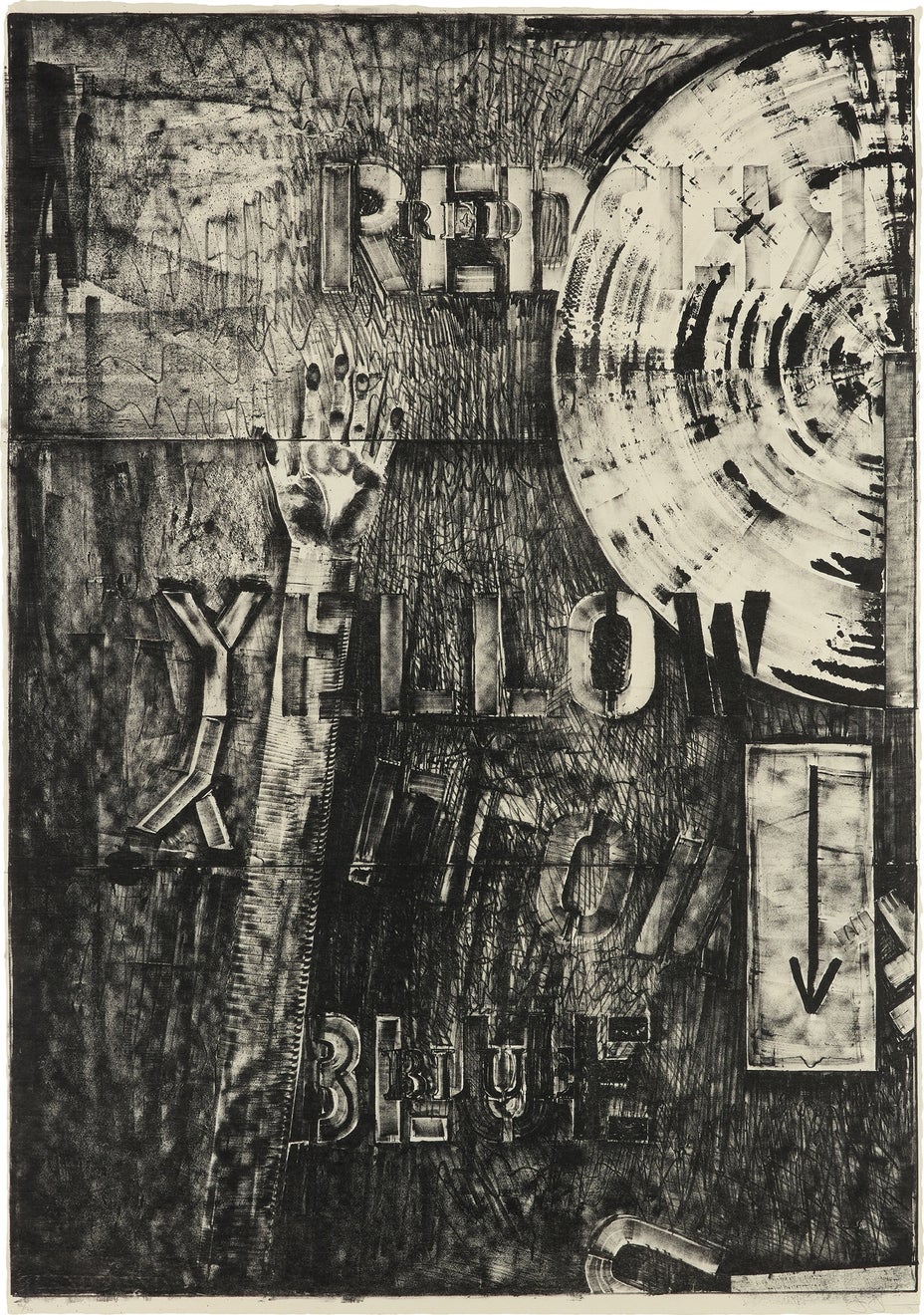
The planar surface of Lands End reveals itself through a complex overlapping of forms. Rife with motifs used by Johns throughout his work, an arm, an arrow, a target, and stenciled letters, all are defined by tones of gray. Gray tends to connote ambiguity, but in Land’s End, gray defines surface, uncomplicated by additions of color. Created using a solid lithographic crayon and a single plate, Johns pushed the tonality of this print to its limits. The surface of the plate had to be inked with great precision in order to capture the slight variations in tone that Johns was after. “… a long project,” said Tyler Graphics master printer, Charly Ritt, “there was something very subtle next to something very dark and you had to get that dark, dark and rich, and you had to keep that subtlety and openness of something that was light.”
Literature
Jasper Johns
American | 1930Jasper Johns is a painter and printmaker who holds a foundational place in twentieth century art history. Quoting the evocative gestural brushstroke of the Abstract Expressionists, Johns represented common objects such as flags, targets, masks, maps and numbers: He sought to explore things "seen and not looked at, not examined" in pictorial form. Drawing from common commercial and 'readymade' objects, such as newspaper clippings, Ballantine Ale and Savarin Coffee cans, Johns was a bridge to Pop, Dada and Conceptual art movements.
Beyond the historical significance, each work by Johns is individually considered in sensuous form. A curiosity of medium led him to employ a range of materials from encaustic and commercial house paint to lithography, intaglio and lead relief.
Browse ArtistBeyond the historical significance, each work by Johns is individually considered in sensuous form. A curiosity of medium led him to employ a range of materials from encaustic and commercial house paint to lithography, intaglio and lead relief.