This lot is sold with no reserve.
54
Jamel Shabazz
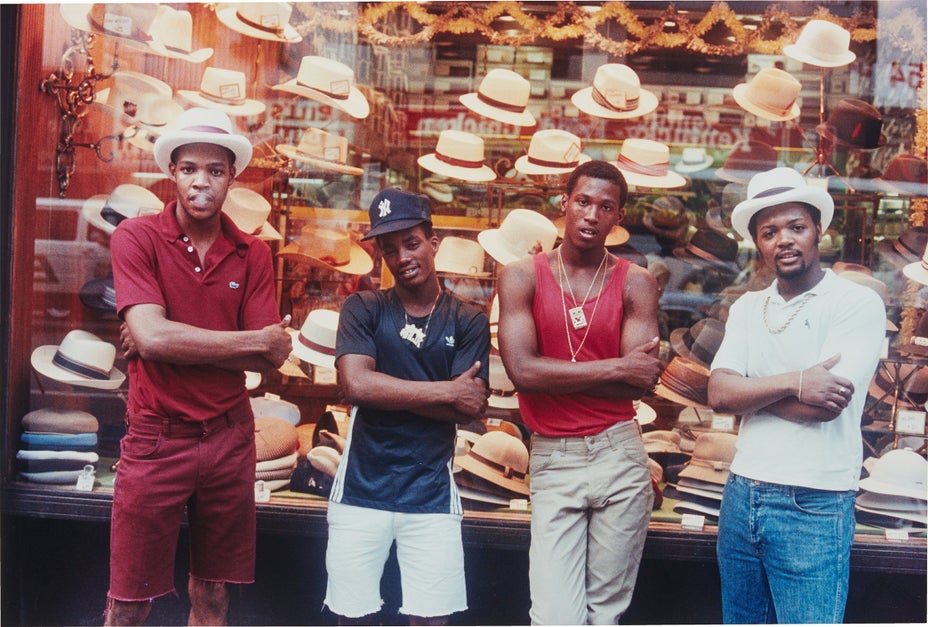
Untitled (Hat Guys)
Estimate
$500–700•︎
signed and numbered "JAMEL SHABAZZ 7/9" on the reverse
c-print
image 13 1/8 x 19 3/8 in. (33.3 x 49.2 cm.)
sheet 16 x 20 in. (40.6 x 50.8 cm.)
sheet 16 x 20 in. (40.6 x 50.8 cm.)
Executed circa 1980, this work is number 7 from an edition of 9.
Full-Cataloguing
When you were shooting people’s personal style, what drew you to your subjects?
Initially, it was my friends, because I had the closest relationships with them, and everyone was already fashionable, so that gave me the idea to approach people and capture the fashion. Later on, I was drawn to people who seemed to have a lot of influence, because the time that we were living in, in the ’80s, there was a lot of tension in certain areas, so I strove to connect with men or organizations that represented strength or influence. I would go for them and I would start to engage them in conversation and photograph them later on, but I was drawn to this strength and their ability to influence people in a positive direction. Or they might have been struggling on the path of life and I came to guide or serve as a mentor to a lot of these young men. That’s why a lot of people in my photographs are a couple of years younger than me, because they represented my younger brothers. That was a generation where a lot of young men, about three or four years younger than me, were dying in the streets. That was my main focus, and I would place myself in locations where a lot of these young men would be. Downtown Brooklyn in the 1980s was that nucleus, that hub, that drew men from all areas of Brooklyn. That became my studio for many years. Jamel Shabazz, 2016
Initially, it was my friends, because I had the closest relationships with them, and everyone was already fashionable, so that gave me the idea to approach people and capture the fashion. Later on, I was drawn to people who seemed to have a lot of influence, because the time that we were living in, in the ’80s, there was a lot of tension in certain areas, so I strove to connect with men or organizations that represented strength or influence. I would go for them and I would start to engage them in conversation and photograph them later on, but I was drawn to this strength and their ability to influence people in a positive direction. Or they might have been struggling on the path of life and I came to guide or serve as a mentor to a lot of these young men. That’s why a lot of people in my photographs are a couple of years younger than me, because they represented my younger brothers. That was a generation where a lot of young men, about three or four years younger than me, were dying in the streets. That was my main focus, and I would place myself in locations where a lot of these young men would be. Downtown Brooklyn in the 1980s was that nucleus, that hub, that drew men from all areas of Brooklyn. That became my studio for many years. Jamel Shabazz, 2016