64
Jürgen Kuhls
"DUS Flying Tourbillon"
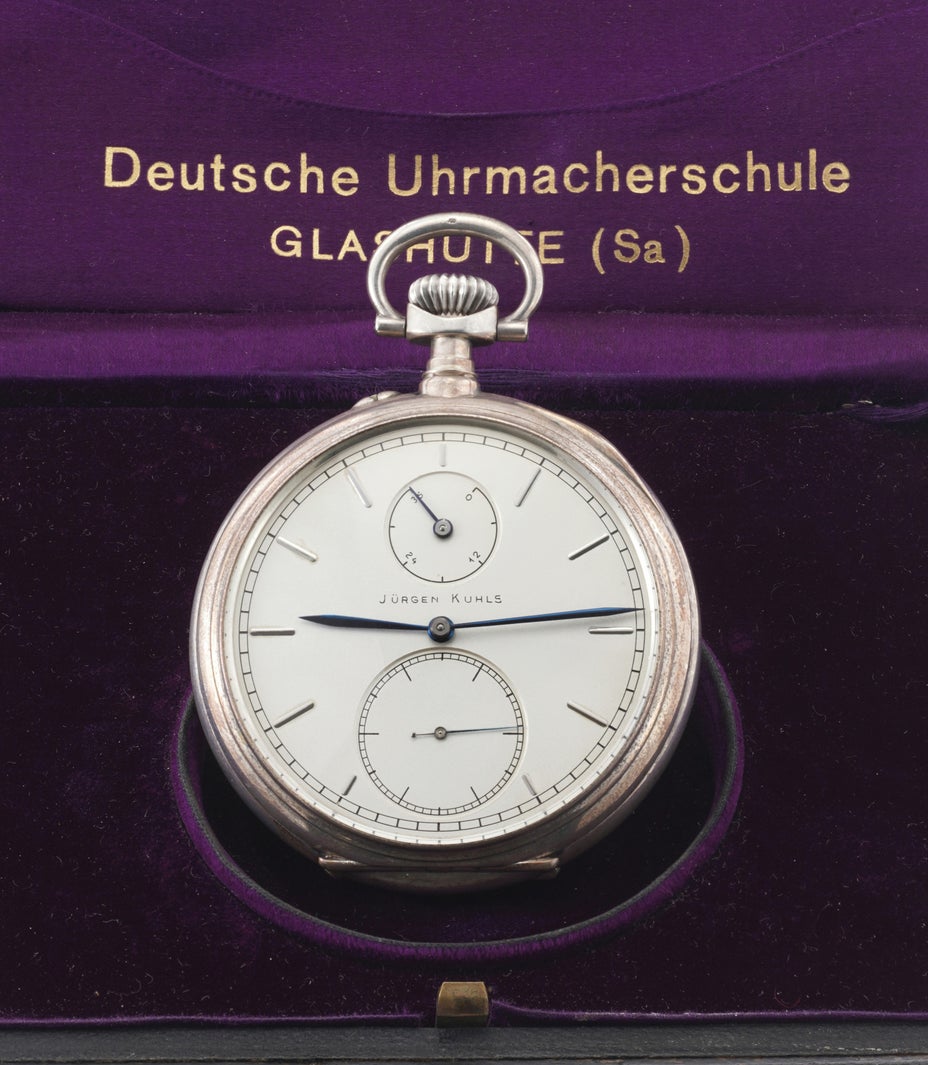
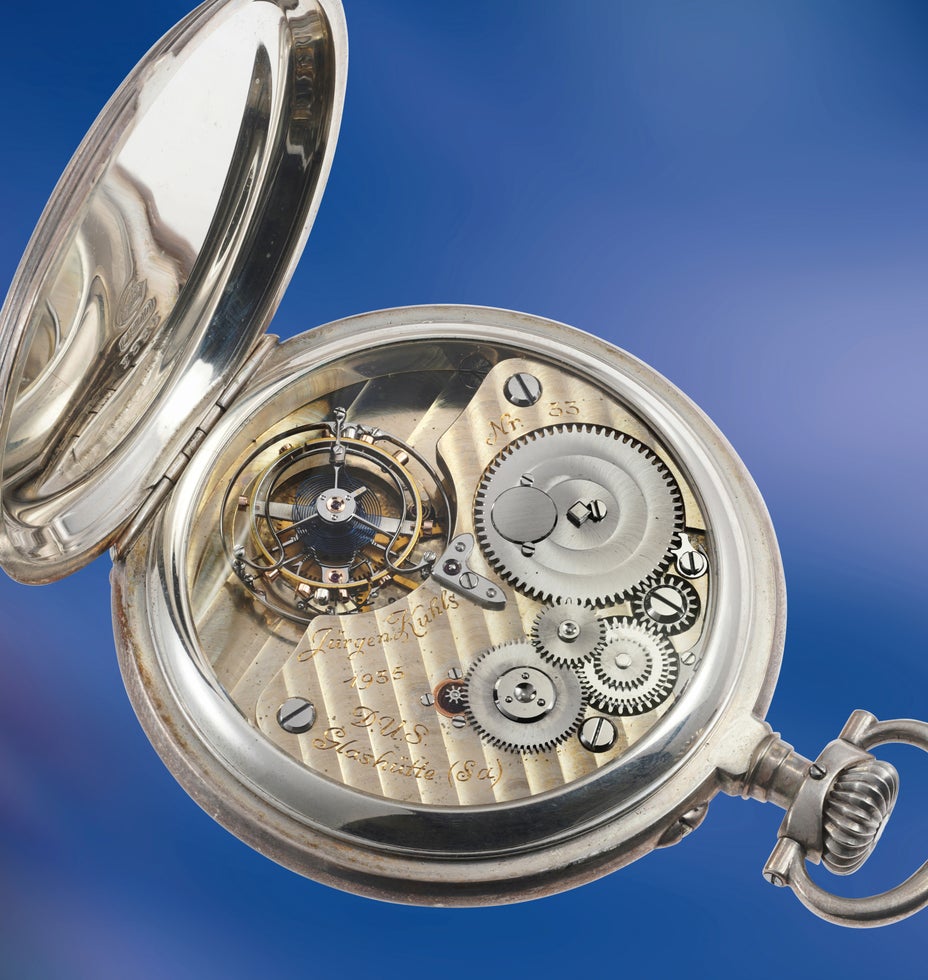
An incredible silver open face flying tourbillon school watch, with spring detent escapement made at the Deutsche Uhrmacherschule
Estimate
CHF80,000–160,000
€85,600–171,000
$96,200–192,000
Manufacturer
Jürgen Kuhls
Year
Circa 1935
Movement No
33
Case No
3885
Model Name
"DUS Flying Tourbillon"
Material
"Coin silver" .900
Calibre
Manual, jeweled
Dimensions
58mm diameter
Signed
Dial and movement signed
Accessories
Accompanied by fitted case signed Deutsche Uhrmacherschule Glashütte
Full-Cataloguing
Good To Know:
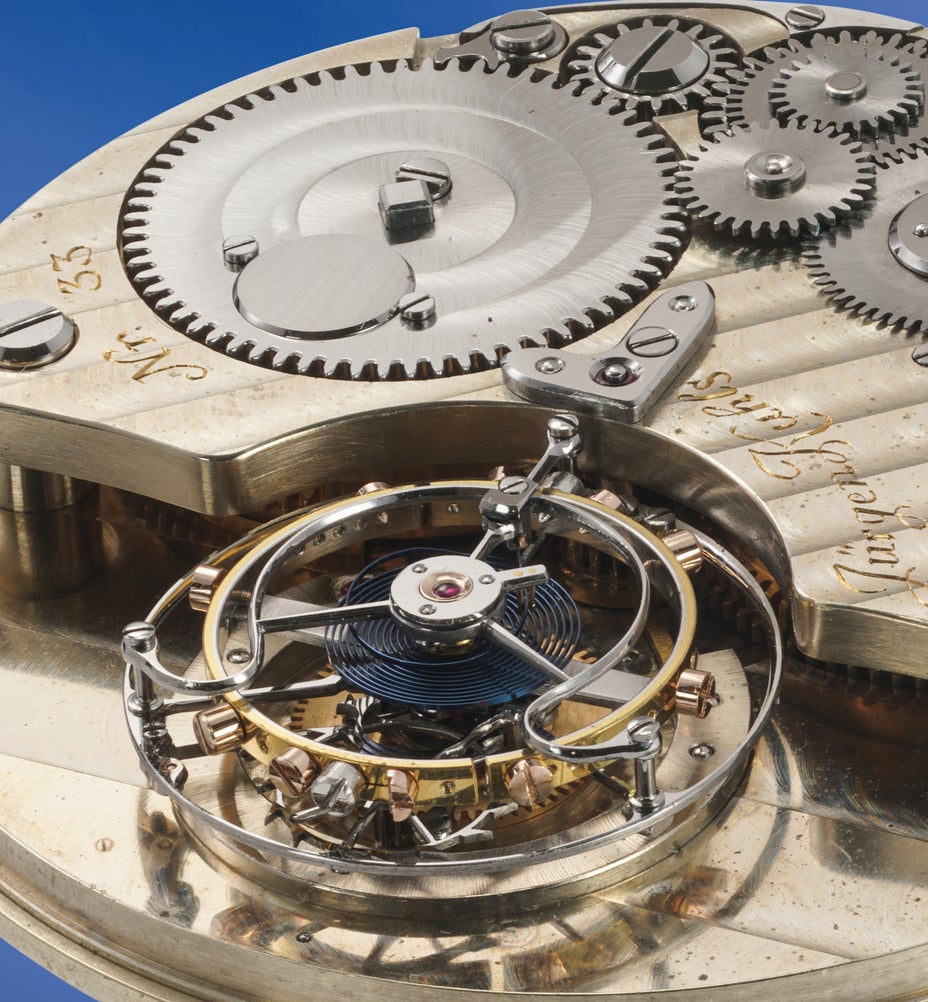
- One-minute flying tourbillon paired with a high-precision spring detent escapement
- Fresh to the auction market
- A similar piece from 1935 (number 34) and made by Karl Geitz also for the DUS under the mentorship of Alfred Helwig was sold at Phillips Geneva in May 2026 for CHF 355,600.
The present watch (numbered 33) was made in 1935 by Jürgen Kuhls as his masterwork at the Deutsche Uhrmacherschule Glashütte, one of the foremost institutions for the training of precision watchmakers in Germany. Established in 1878, the school placed particular emphasis on chronometry and the practical construction of complicated timepieces, with students required to demonstrate their technical abilities through the creation of highly demanding school watches.
Kuhls’ work was undertaken under the supervision of Alfred Helwig, who served as instructor at the school and is best remembered for his development of the flying tourbillon in 1920. The present watch incorporates this distinctive construction in the form of a flying one-minute tourbillon, in which the upper bridge is dispensed with, leaving the rotating carriage apparently suspended within the movement and requiring immense skill to stabilize, especially when combined with a spring detent escapement sensitive to shocks. Featuring a power reserve indicator and a bimetallic compensating balance, the watch represented the absolute limit of mechanical refinement achievable by any watchmaker, let alone a student, of that era.
The combination of these features is characteristic of the advanced level of precision watchmaking taught at Glashütte during this period. Unlike commercially produced watches, school watches were individually conceived and executed by the students themselves, often requiring an extended period of work and serving as the culmination of their training. As a result, surviving examples are highly individual and comparatively scarce.
The 1935 date of the present watch is of particular interest, placing it in the later history of the Deutsche Uhrmacherschule, when the institution continued the rigorous tradition of Glashütte precision watchmaking shortly before the upheavals that would profoundly alter the German watch industry. With its flying tourbillon executed under the guidance of Helwig, the watch represents not only the technical accomplishment of its maker, but also a tangible record of the teaching and horological traditions of the Glashütte school.
- One-minute flying tourbillon paired with a high-precision spring detent escapement
- Fresh to the auction market
- A similar piece from 1935 (number 34) and made by Karl Geitz also for the DUS under the mentorship of Alfred Helwig was sold at Phillips Geneva in May 2026 for CHF 355,600.
The present watch (numbered 33) was made in 1935 by Jürgen Kuhls as his masterwork at the Deutsche Uhrmacherschule Glashütte, one of the foremost institutions for the training of precision watchmakers in Germany. Established in 1878, the school placed particular emphasis on chronometry and the practical construction of complicated timepieces, with students required to demonstrate their technical abilities through the creation of highly demanding school watches.
Kuhls’ work was undertaken under the supervision of Alfred Helwig, who served as instructor at the school and is best remembered for his development of the flying tourbillon in 1920. The present watch incorporates this distinctive construction in the form of a flying one-minute tourbillon, in which the upper bridge is dispensed with, leaving the rotating carriage apparently suspended within the movement and requiring immense skill to stabilize, especially when combined with a spring detent escapement sensitive to shocks. Featuring a power reserve indicator and a bimetallic compensating balance, the watch represented the absolute limit of mechanical refinement achievable by any watchmaker, let alone a student, of that era.
The combination of these features is characteristic of the advanced level of precision watchmaking taught at Glashütte during this period. Unlike commercially produced watches, school watches were individually conceived and executed by the students themselves, often requiring an extended period of work and serving as the culmination of their training. As a result, surviving examples are highly individual and comparatively scarce.
The 1935 date of the present watch is of particular interest, placing it in the later history of the Deutsche Uhrmacherschule, when the institution continued the rigorous tradition of Glashütte precision watchmaking shortly before the upheavals that would profoundly alter the German watch industry. With its flying tourbillon executed under the guidance of Helwig, the watch represents not only the technical accomplishment of its maker, but also a tangible record of the teaching and horological traditions of the Glashütte school.