11
Irving Penn
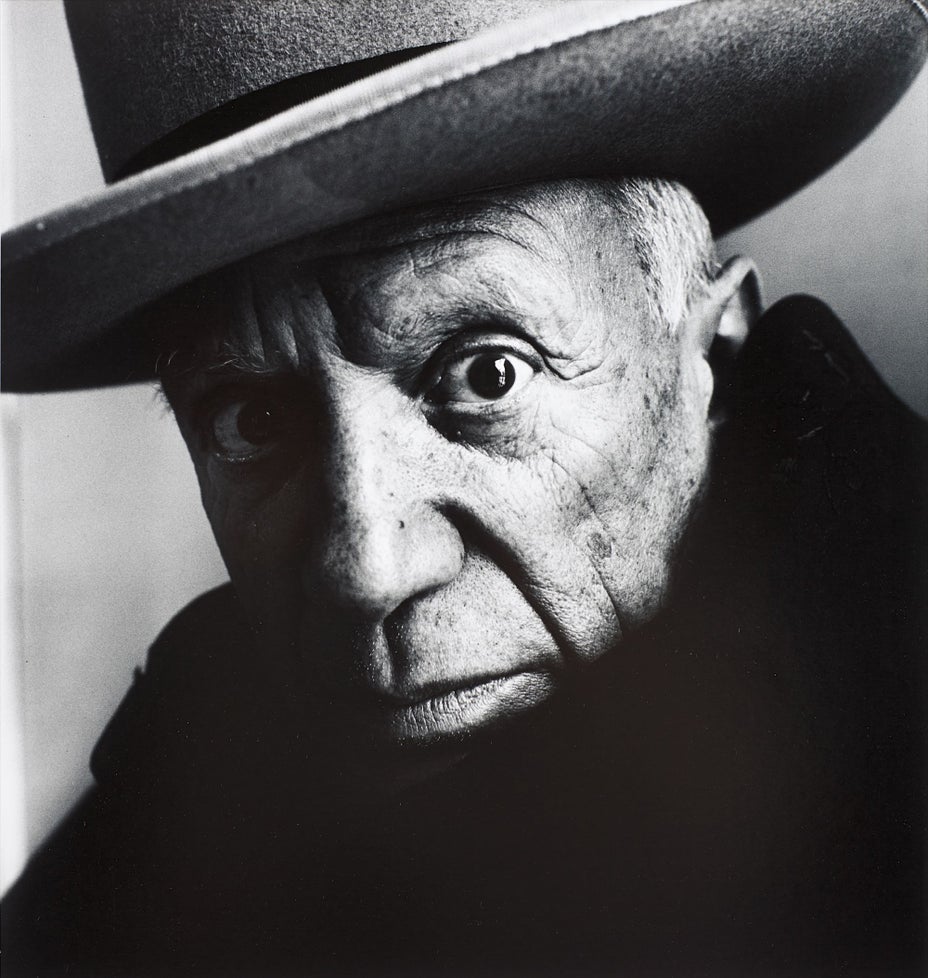
Picasso (B), Cannes
Full-Cataloguing
From early on in his career, Irving Penn adhered to the principles underlying the medium of photography, especially with close attention to clarity, illumination, and linearity. As early as 1947, Penn began repudiating the pictorialist-inspired modes in photography—be it fashion or portraiture—by stripping away lavish interiors and contrived narratives. By doing so, Penn enabled the clothes and the sitters to assume the central role of his images. Of this, John Szarkowski had remarked, “[Penn’s photographs] are not stories, but simply pictures.” Penn rejected the notion that portraits ought to be set within a context that readily identified the sitters—writers at their desk; singers by a microphone; thespians on stage; or artists at their studio—and layer by layer, removed the common traps that detracted from the point of focus. In fact, it was Penn’s studio—not a lavish mansion, or a Louis XV boudoir, or a Victorian library—that became the sole space within which sitters were captured under his lens.
From the late 1940s and throughout the 1950s, Penn continuously simplified his portraits, gradually removing the architectural corners he had been using to photograph such notables as Alfred Hitchock and Marlene Dietrich. By 1957, the year the present lot, Picasso (B), Cannes, was taken, Penn had removed not only any gratuitous props but also any bodily references or gestures that could have compromised the unique individuality of the famed Spanish artist, by then already one of the art world’s leading figures. The close-up portrait is skillfully and almost perfectly centered by Picasso’s cyclopean eye, paying homage to the Cubist style that he was instrumental in popularizing with Georges Braque. References to the Modernist style, in fact, abound in the photograph: the strong tonal contrasts, the robe framing the jawline, the cropping of the ear, the different lines dissecting the plain. Indeed, the portrait is far more akin to Picasso’s gris-toned Buste de Femme, 1956, than any of Penn’s other portraits. In that regard, the image is more likely how Penn imagined Picasso would envision himself. Ultimately, Picasso (B), Cannes, is a carefully nuanced composition commemorating the legacy of not one, but two great masters, each delicately revealing his undeniable skill and style on different sides of the same lens.
Irving Penn
American | B. 1917 D. 2009Irving Penn was one of the 20th century’s most significant photographers, known for his arresting images, technical mastery, and quiet intensity. Though he gained widespread acclaim as a leading Vogue photographer for over sixty years, Penn remained a private figure devoted to his craft. Trained under legendary art director Alexey Brodovitch in Philadelphia, he began his career assisting at Harper’s Bazaar before joining Vogue in 1943, where editor and artist Alexander Liberman recognized Penn’s distinctive eye and encouraged him to pursue photography. Penn’s incomparably elegant fashion studies reset the standard for the magazine world, and his portraits, still lifes, and nude studies broke new ground. His 1960 book Moments Preserved redefined the photographic monograph with its dynamic layout and high-quality reproductions. In 1964, Penn began printing in platinum and palladium, reviving this 19th-century process to serve his own distinct vision. An innovator in every sense, Penn’s approach to photography was endlessly adventurous. Few photographers of his generation experimented as widely with both conventional and historic print processes, and none achieved Penn’s level of excellence in all.