
PROPERTY FROM THE COLLECTION OF ROBERT A. TAUB, SOLD TO BENEFIT THE ACQUISITION FUNDS
79
Irving Penn
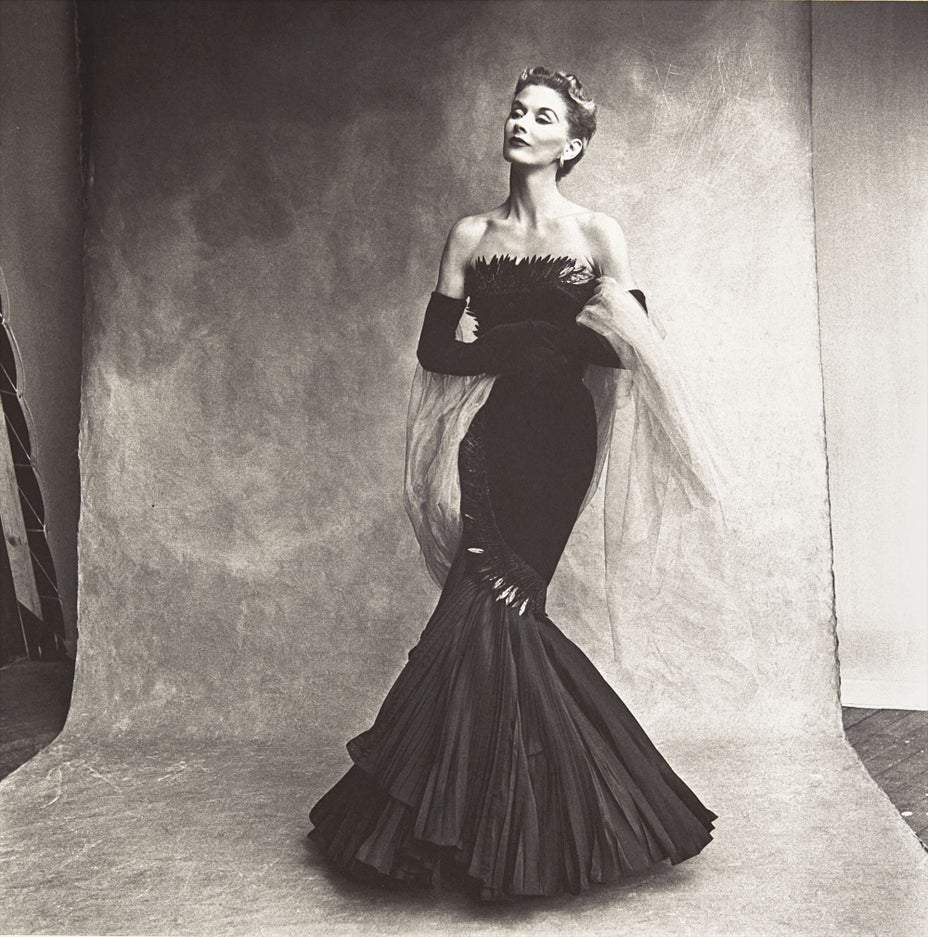
Mermaid Dress (Rochas), Lisa Fonssagrives-Penn
- Estimate
- $80,000 - 120,000
$93,750
Lot Details
Platinum-palladium print, printed 1979.
1950
19 1/2 x 19 5/8 in. (49.5 x 49.8 cm)
Signed, titled, numbered 2/25, annotated 'Paris' in pencil, Condé Nast copyright credit reproduction limitation and edition stamps on the reverse of the aluminum flush-mount.
Specialist
Full-Cataloguing
Catalogue Essay
In 1950, Vogue photographer Irving Penn was commissioned to photograph the Paris haute-couture collections. Penn had already established his reputation as a trailblazing fashion photographer, celebrated for his minimalist settings and his emphasis on volume, texture, and silhouette. He requested that Vogue set him up in a studio with ample natural light, on the seventh floor of a defunct photography school. Over the course of ten days Penn worked with three of the leading models of the day— Régine, Jean Patchett, and, as seen in the current lot, Lisa Fonssagrives, in a variety of poses that showcased the groundbreaking fashions of postwar Paris. The statuesque Fonssagrives, just shy of her fortieth birthday and in the prime of her career—she and Penn had married earlier in the year—is seen wearing a dress by Marcel Rochas, among the most celebrated couturiers at the time. The dramatic silhouette of the gown is accentuated by the voluminous ruffled skirt and the ethereal shawl that is elegantly draped around her torso. Mermaid Dress (Rochas), Lisa Fonssagrives-Penn is an homage to fashion, to Penn’s new consort, and to his distinct eye for the elegant and the awe-inducing.
In 1997, Irving Penn donated his archive to the Art Institute of Chicago. Divided in two parts- the paper archives and the photographic archives- the gift offers a window into the career of the legendary photographer and also helped establish the Art Institute as a leading repository for his work. Comprised of negatives, transparencies, contact sheets and test prints, including the Vogue tear sheet where Mermaid Dress (Rochas), Lisa Fonssagrives-Penn originally appeared, the photographic archive complements the extensive collection of Penn exhibition prints in the Art Institute’s collection which encompasses over 200 works. The print offered here, a duplicate to the platinum-palladium print held in that gift, was one of the first in the edition made by Penn in 1979 and was purchased soon afterward by Mr. Taub.
Literature
Irving Penn
American | B. 1917 D. 2009Irving Penn was one of the 20th century’s most significant photographers, known for his arresting images, technical mastery, and quiet intensity. Though he gained widespread acclaim as a leading Vogue photographer for over sixty years, Penn remained a private figure devoted to his craft. Trained under legendary art director Alexey Brodovitch in Philadelphia, he began his career assisting at Harper’s Bazaar before joining Vogue in 1943, where editor and artist Alexander Liberman recognized Penn’s distinctive eye and encouraged him to pursue photography. Penn’s incomparably elegant fashion studies reset the standard for the magazine world, and his portraits, still lifes, and nude studies broke new ground. His 1960 book Moments Preserved redefined the photographic monograph with its dynamic layout and high-quality reproductions. In 1964, Penn began printing in platinum and palladium, reviving this 19th-century process to serve his own distinct vision. An innovator in every sense, Penn’s approach to photography was endlessly adventurous. Few photographers of his generation experimented as widely with both conventional and historic print processes, and none achieved Penn’s level of excellence in all.
Browse Artist