101
Ingo Maurer
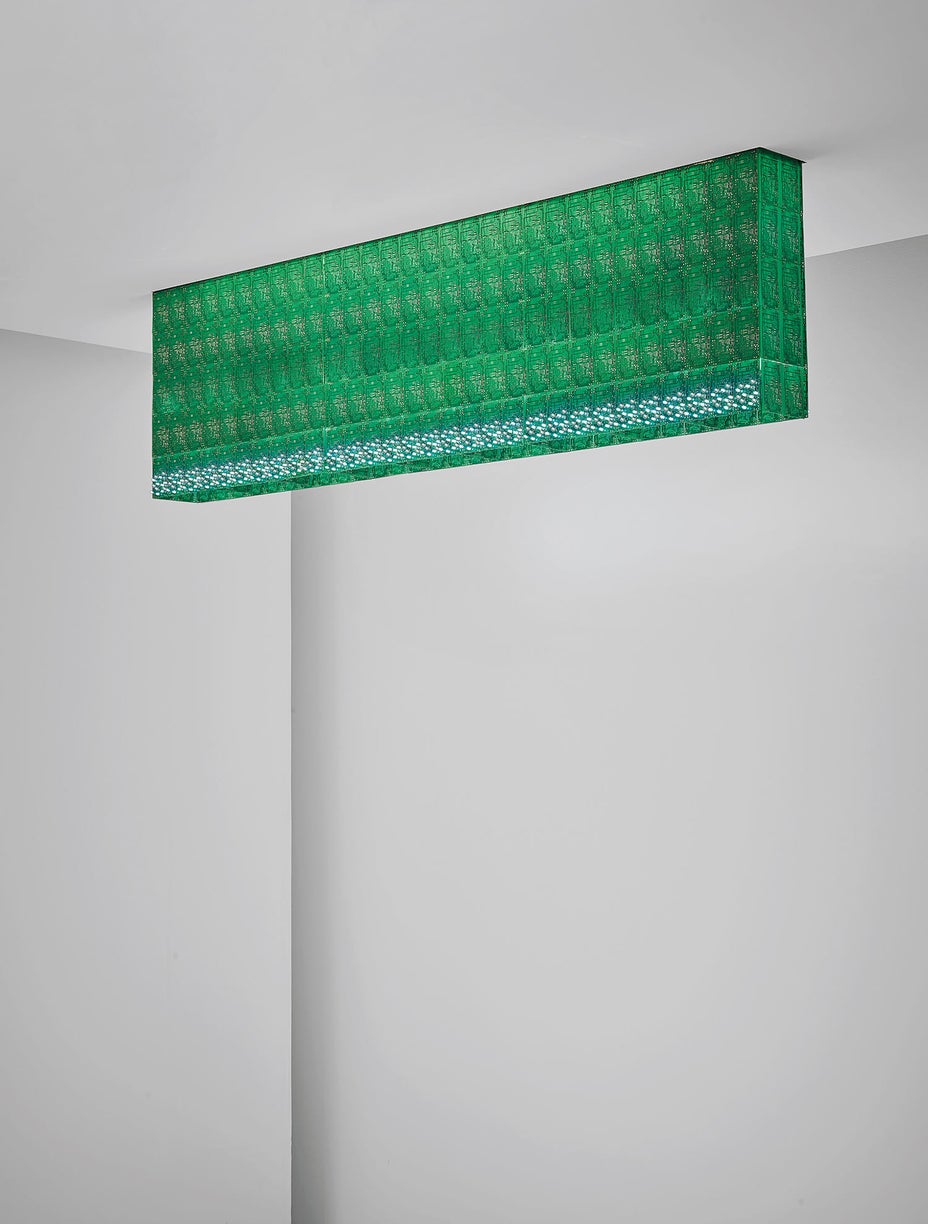
Unique ceiling light, designed for a private commission, London
Estimate
£18,000–24,000
1997-1998
Circuit board, LED, painted aluminium, painted steel.
50.4 x 179.1 x 18.4 cm (19 7/8 x 70 1/2 x 7 1/4 in.)
Manufactured by Ingo Maurer GmbH, Munich, Germany.
Full-Cataloguing
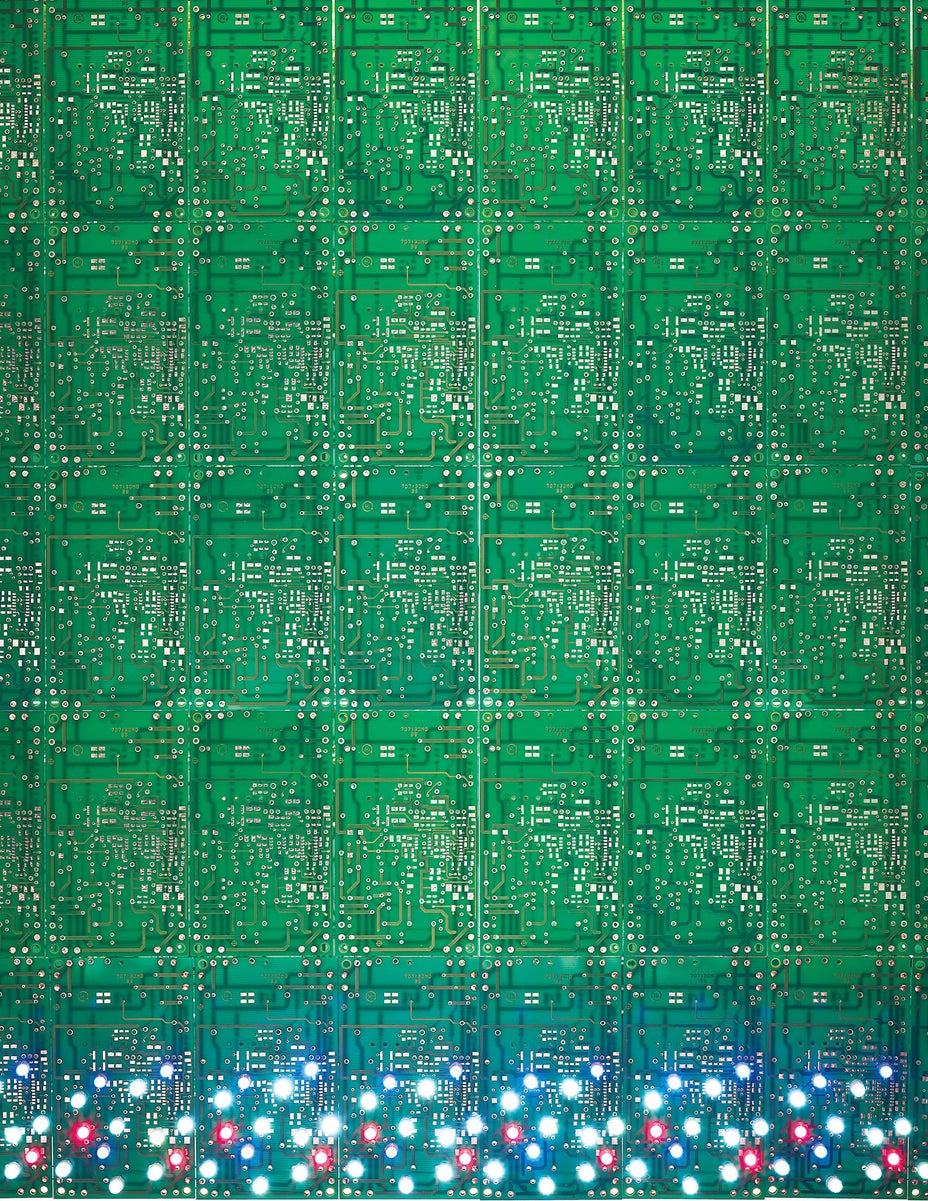
It all started in the late 1990s. An engineer showed me light‐emitting diodes. At that time LEDs were not very powerful as light source. I was fascinated not only by the tiny light source, but also by the green circuit boards themselves, normally hidden behind a cover. I still love them for their unusual aesthetics. Ingo Maurer on his objects with circuit boards, July 2018.
The present ceiling light designed by the lighting designer Ingo Maurer was commissioned in late 1997. Working at the forefront of lighting design, Maurer had begun working with LED technology earlier that year, before which LEDs had not been used for interior lighting. Constructed from printed circuit boards, the ceiling light features a free arrangement of LEDs along the lower edges, which the designer programmed to include four settings: the white lights alone, the addition of either the red or blue lights, or all of the red, blue and white lights. Maurer, who had initially intended for the light to include only the last formation, surprised his clients with the addition of the individual colour options upon its installation in late 1998. Maurer’s innovative design demonstrates his interest in the light bulb (or light source) as a design object independent of the light fixture and is a playful reduction of the fixture's form to its essential function.
The present ceiling light designed by the lighting designer Ingo Maurer was commissioned in late 1997. Working at the forefront of lighting design, Maurer had begun working with LED technology earlier that year, before which LEDs had not been used for interior lighting. Constructed from printed circuit boards, the ceiling light features a free arrangement of LEDs along the lower edges, which the designer programmed to include four settings: the white lights alone, the addition of either the red or blue lights, or all of the red, blue and white lights. Maurer, who had initially intended for the light to include only the last formation, surprised his clients with the addition of the individual colour options upon its installation in late 1998. Maurer’s innovative design demonstrates his interest in the light bulb (or light source) as a design object independent of the light fixture and is a playful reduction of the fixture's form to its essential function.