IMPORTANT PHOTOGRAPHS FROM THE COLLECTION OF DR. ANTHONY TERRANA
15
Imogen Cunningham
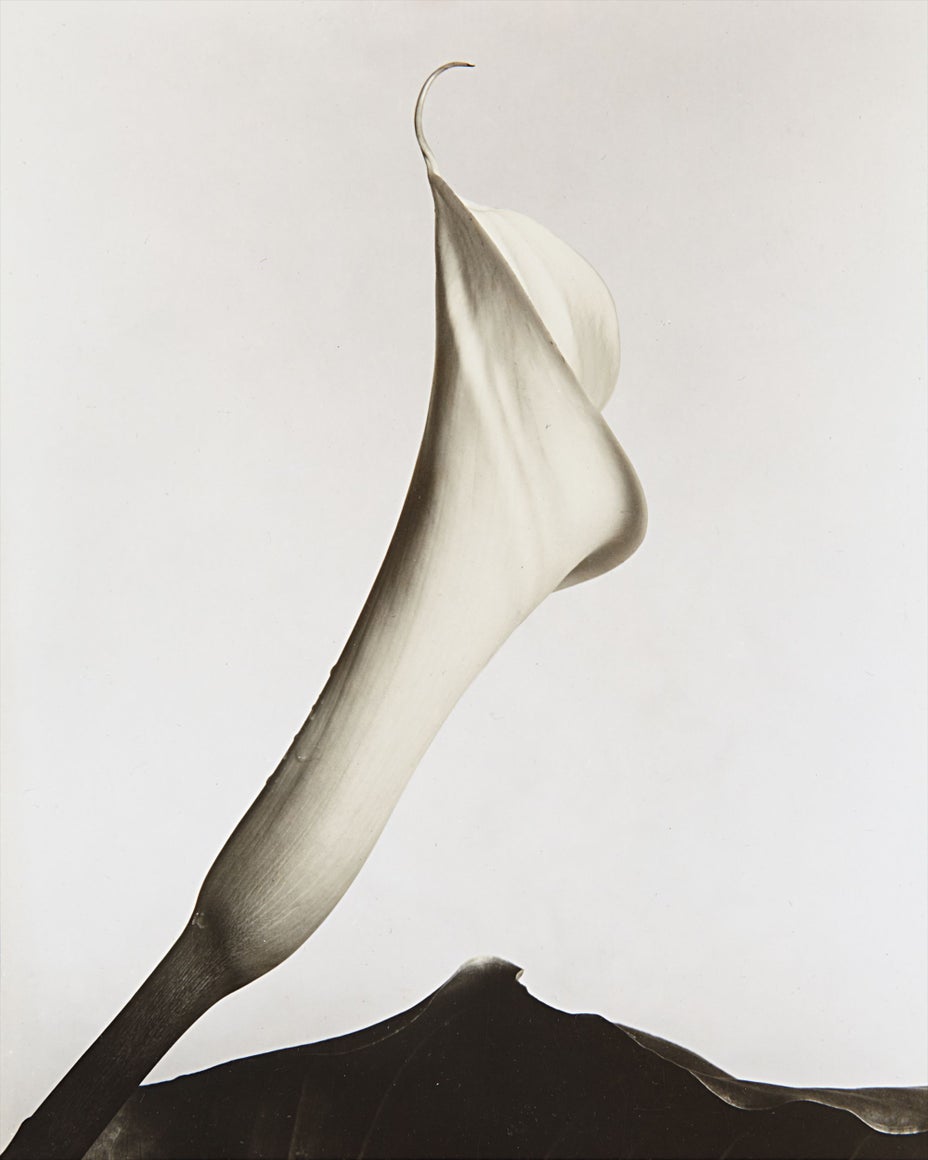
Calla with leaf
Estimate
$80,000–120,000
Sold For
$110,500
circa 1930
Gelatin silver print.
9 3/8 x 7 1/2 in. (23.8 x 19.1 cm)
Signed in pencil on the mount; printed title 'Calla Lilly' on the artist's 'Mills College, California' label affixed to the reverse of the mount.
Full-Cataloguing
Imogen Cunningham’s photographic interest in flora seems a natural progression from her studies at the University of Washington where she studied chemistry and wrote
her thesis on the chemical process of photography. She also helped to produce slides for the botany department, which, with the help of magnifcation, brought her into
direct contact with the smallest details of nature. It was here that botany first became a source of endless fascination for Cunningham and she consistently returned to the subject throughout her impressive career.
Initially, Cunningham incorporated flora into her commissioned portraits as a way to imbue ambiance into the scene. Eventually, however, she isolated it entirely, endeavoring to explore the beauty and rhythm inherent to the natural world. While Cunningham’s photographs include both exterior and interior images of flora,
her studio shots, as seen in Calla with Leaf, circa 1930, have come to defne this body of work. Here, a single white lily is isolated against a stark background as strong
lighting highlights the flower's outline and subtle gradation in shade. Cunningham photographed the flower in its prime so as to eternalize its feeting beauty. Her work thus reminds us of the fragility of her subject and, by extension, the natural world around us.
As two of the founding members of Group f/64, which advocated for the Modernist aesthetic, Imogen Cunningham and Edward Weston both championed the transition to straight photography and, in looking at the present lot, one cannot escape the dialogue and similarities between the two photographers. While Weston preferred a more abstract approach and Cunningham’s is rooted in her analytical studies as student of science, each artist, through the transformative power of photography, has turned objects as ordinary as shells (lot 14) and lilies, into extraordinary images.
Cunningham also notes Albert Renger Patzsch and Karl Blossfeldt, both of whom she became familiar with while studying abroad in Germany, as having the most
significant impact on her evolution as a photographer. Like Cunningham, Blossfeldt approached his floral studies from a similar background in science and with his magnifying camera was able to capture his subjects in detail undetectable to the human eye. Inspired by Blossfeldt’s keen and patient observation, Cunningham diligently studied her subject at its most basic form. In so doing, she likewise elevated minute details of nature to the status of the great architecture and sweeping landscapes that
had captured photographers’ lens since the early days of photography.
her thesis on the chemical process of photography. She also helped to produce slides for the botany department, which, with the help of magnifcation, brought her into
direct contact with the smallest details of nature. It was here that botany first became a source of endless fascination for Cunningham and she consistently returned to the subject throughout her impressive career.
Initially, Cunningham incorporated flora into her commissioned portraits as a way to imbue ambiance into the scene. Eventually, however, she isolated it entirely, endeavoring to explore the beauty and rhythm inherent to the natural world. While Cunningham’s photographs include both exterior and interior images of flora,
her studio shots, as seen in Calla with Leaf, circa 1930, have come to defne this body of work. Here, a single white lily is isolated against a stark background as strong
lighting highlights the flower's outline and subtle gradation in shade. Cunningham photographed the flower in its prime so as to eternalize its feeting beauty. Her work thus reminds us of the fragility of her subject and, by extension, the natural world around us.
As two of the founding members of Group f/64, which advocated for the Modernist aesthetic, Imogen Cunningham and Edward Weston both championed the transition to straight photography and, in looking at the present lot, one cannot escape the dialogue and similarities between the two photographers. While Weston preferred a more abstract approach and Cunningham’s is rooted in her analytical studies as student of science, each artist, through the transformative power of photography, has turned objects as ordinary as shells (lot 14) and lilies, into extraordinary images.
Cunningham also notes Albert Renger Patzsch and Karl Blossfeldt, both of whom she became familiar with while studying abroad in Germany, as having the most
significant impact on her evolution as a photographer. Like Cunningham, Blossfeldt approached his floral studies from a similar background in science and with his magnifying camera was able to capture his subjects in detail undetectable to the human eye. Inspired by Blossfeldt’s keen and patient observation, Cunningham diligently studied her subject at its most basic form. In so doing, she likewise elevated minute details of nature to the status of the great architecture and sweeping landscapes that
had captured photographers’ lens since the early days of photography.