823
Heuer
Ref. 2447 NST
Carrera 'Reverse Panda'
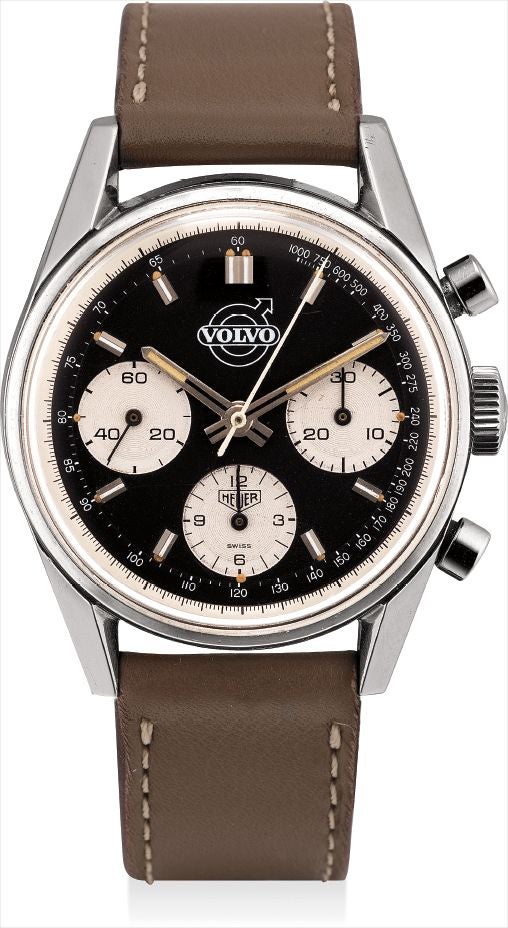
A highly rare and attractive stainless steel chronograph wristwatch with black dial, made for "Volvo"
Estimate
HK$160,000–250,000
€19,300–30,100
$20,000–32,000
Sold For
HK$200,000
Manufacturer
Heuer
Year
Circa 1967
Reference No
2447 NST
Case No
78'498
Model Name
Carrera 'Reverse Panda'
Material
Stainless steel
Calibre
Mechanical, 72, 17 jewels
Bracelet/Strap
Brown calf strap
Clasp/Buckle
Stainless steel buckle
Dimensions
35.5 mm. diameter
Signed
<em>Case, dial and movement signed, dial further signed for Volvo</em>
Full-Cataloguing
While some may discuss the Heuer Carrera in conversation with the Rolex Daytona (the Singer dial and Valjoux movement usually being the topic of choice), the Heuer Carrera is an incredible watch in its own right. Its name originates from the "Carrera Panamericana", a highly dangerous and thrilling car race which takes place in Mexico. At the time of inception, Jack Heuer's main goal was to create absolute legibility when timing car races.
The present watch is playfully dubbed "reverse panda" due to its black dial and white registers. It features the rare tachymeter ring to the dial. Thus, the reference is called 2447 NST.
Jack Heuer's support for the automobile industry is unrivaled. As such, it comes as no surprise that Heuer created custom pieces for Volvo. The present watch displays all the details of a well preserved 2447 NST. Yet, what truly sets it apart is the "Volvo" logo above 12 o'clock, where the Heuer shield should be. The Heuer logo has thus been moved to the subsidiary register at 6 o'clock, displaying Heuer's modesty. Research shows that Volvo had presented these watches one year for their Board of Directors.
Its rarity, coupled with aesthetic beauty, renders the present example and extremely historically interesting and attractive wristwatch.
The present watch is playfully dubbed "reverse panda" due to its black dial and white registers. It features the rare tachymeter ring to the dial. Thus, the reference is called 2447 NST.
Jack Heuer's support for the automobile industry is unrivaled. As such, it comes as no surprise that Heuer created custom pieces for Volvo. The present watch displays all the details of a well preserved 2447 NST. Yet, what truly sets it apart is the "Volvo" logo above 12 o'clock, where the Heuer shield should be. The Heuer logo has thus been moved to the subsidiary register at 6 o'clock, displaying Heuer's modesty. Research shows that Volvo had presented these watches one year for their Board of Directors.
Its rarity, coupled with aesthetic beauty, renders the present example and extremely historically interesting and attractive wristwatch.
Heuer
Swiss | 1860This iconic chronograph manufacturer has a long tradition of precision timekeeping. As early as 1882, founder Edouard Heuer held a patent for a chronograph watch; in 1887, he received a patent for an oscillating pinion, which is still in use today. These specialized timepieces have been at the heart of the firm's success, enabling the brand to be chosen as early timekeepers for the Olympics. In 1969, the company introduced their first automatic chronograph watch, the Monaco Heuer, which celebrated the Monaco Grand Prix. Other key chronograph models include the Autavia and the Carrera, all of which having become iconic models of the firm.