
Sold to benefit the Jörg G. Bucherer-Foundation
327
Henri Auguste
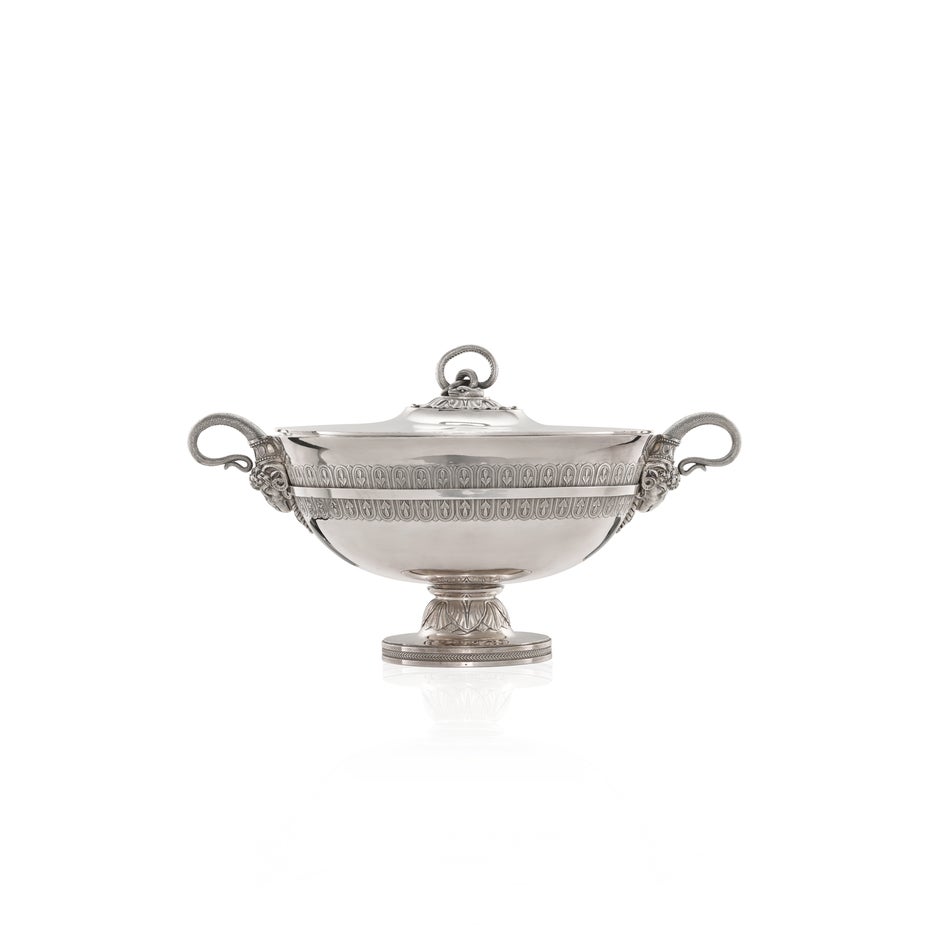
Silver soup tureen, 1789-1790
Estimate
CHF32,000–42,000•︎
€35,000–45,000
$40,000–55,000
Priority BiddingAvailable through 7 November 3pm CET 2026. Learn more
Of oval form, raised on an oval spreading foot, the handles in the form of a serpent’s body, resting on a ram's head, decorated with a band of trilobed leaves, fitted with a removable liner, the cover with handle in the form of an entwined serpent, with foliate decorations, the underside engraved 'Auguste Orfèvre du Roi à Paris 1790', measuring approximately 480 x 245 x 270 mm, maker's marks for Henri Auguste.
Full-Cataloguing
The last great silversmith of the Ancien Régime and the first great silversmith of the Empire, Henri Auguste occupies an essential place in the history of French decorative arts. Trained in the workshop of his father, Robert-Joseph Auguste, silversmith to the King, he took over the direction of the family firm in 1785 and brought Parisian silversmithing to a degree of perfection rarely equalled.
At the turning point between two eras, he embraced the evolution of taste, gradually abandoning the final accents of the Louis XVI style to participate, alongside Percier and Fontaine, in the emergence of the Empire style. His creations are distinguished by the purity of their lines, the rigour of their architecture, the exceptional finesse of their chasing, and a perfect mastery of proportion—qualities that today make his work one of the most accomplished expressions of French Neoclassicism.
His most celebrated work remains the monumental Service de la Ville de Paris, presented by the municipality of Paris to Napoleon I on the occasion of his Coronation in 1804. Originally comprising more than four hundred pieces, it was undoubtedly the most ambitious silver service produced in France since the great royal services of the eighteenth century.
The fate of this work reflects that of French silverware as a whole. Successive meltings, undertaken from the Revolution onwards to supply the public treasury and continued throughout the nineteenth century, resulted in the disappearance of the vast majority of masterpieces of civic silver. The Service de la Ville de Paris was no exception: only around twenty-five pieces survive today, now housed together at the Château de Fontainebleau, while no elements are still displayed at Malmaison. This extensive destruction explains the exceptional rarity of Henri Auguste’s works, each surviving piece constituting an important testament to the excellence of French silversmithing.
Today, the few works that escaped the melting pot rank among the most precious surviving examples of French silverware. Preserved in the greatest public and private collections, they bear witness to the genius of an artist whose production, almost entirely lost, remains one of the high points of European decorative art.
Henri Auguste thus appears as the last heir to the great tradition of the Parisian silversmiths of the Ancien Régime and one of the principal architects of the aesthetic renewal that characterised the First Empire.
In 1809, he fled to England, having failed to settle his debts with his creditors. In 1810, he was stripped of his French nationality. He subsequently went to Saint-Domingue, where he died in 1826.
Thus departed the last heir to the traditions of the silversmiths of the Ancien Régime. Fortunately, remarkable creations survive, notably at Fontainebleau, offering a window onto the Empire style.
At the turning point between two eras, he embraced the evolution of taste, gradually abandoning the final accents of the Louis XVI style to participate, alongside Percier and Fontaine, in the emergence of the Empire style. His creations are distinguished by the purity of their lines, the rigour of their architecture, the exceptional finesse of their chasing, and a perfect mastery of proportion—qualities that today make his work one of the most accomplished expressions of French Neoclassicism.
His most celebrated work remains the monumental Service de la Ville de Paris, presented by the municipality of Paris to Napoleon I on the occasion of his Coronation in 1804. Originally comprising more than four hundred pieces, it was undoubtedly the most ambitious silver service produced in France since the great royal services of the eighteenth century.
The fate of this work reflects that of French silverware as a whole. Successive meltings, undertaken from the Revolution onwards to supply the public treasury and continued throughout the nineteenth century, resulted in the disappearance of the vast majority of masterpieces of civic silver. The Service de la Ville de Paris was no exception: only around twenty-five pieces survive today, now housed together at the Château de Fontainebleau, while no elements are still displayed at Malmaison. This extensive destruction explains the exceptional rarity of Henri Auguste’s works, each surviving piece constituting an important testament to the excellence of French silversmithing.
Today, the few works that escaped the melting pot rank among the most precious surviving examples of French silverware. Preserved in the greatest public and private collections, they bear witness to the genius of an artist whose production, almost entirely lost, remains one of the high points of European decorative art.
Henri Auguste thus appears as the last heir to the great tradition of the Parisian silversmiths of the Ancien Régime and one of the principal architects of the aesthetic renewal that characterised the First Empire.
In 1809, he fled to England, having failed to settle his debts with his creditors. In 1810, he was stripped of his French nationality. He subsequently went to Saint-Domingue, where he died in 1826.
Thus departed the last heir to the traditions of the silversmiths of the Ancien Régime. Fortunately, remarkable creations survive, notably at Fontainebleau, offering a window onto the Empire style.