208
Guillermo Kuitca
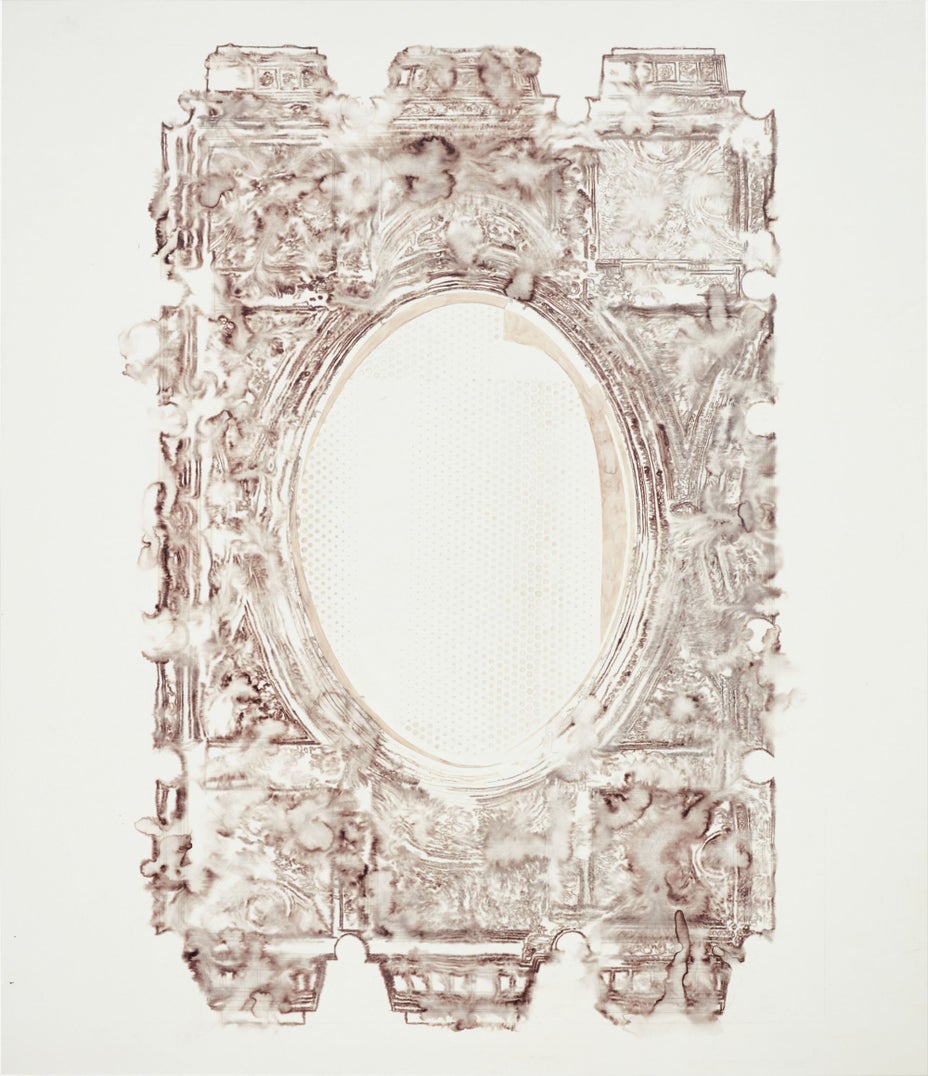
L'Encyclopedie (Ceiling Plan of a Salon in the Palace of the Marquis de Spinola, Genova)
Full-Cataloguing
The present work L'Encyclopedie (Ceiling Plan of a Salon in the Palace of the Marquis de Spinola, Genova), is a superb example of Guillermo Kuitca’s iconic use of architectural floor plans and maps as a philosophical point of entry into discussions of architecture, borders and frontiers. Here, one sees the dazzling architectural rendering of a salon in the Palace of the Marquis de Spinola blurred and obfuscated by the artist’s hand, transforming the spatial diagram into a haunting geometric abstraction. Kuitca’s L'Encyclopedie series is named after an attempt made by the French philosopher Denis Diderot to condense all of human knowledge into a single-volume encyclopedia, with each image from the series inspired by illustrations found in Diderot’s Encyclopédie. As seen here, the absence of a human form in the composition is central to Kuitca’s later work, allowing the viewer to muse on the psychology of space and how one navigates and remembers a place. The present lot also calls into question ideas of displacement and disappearance, and how this relates to the function of memory and knowledge. In L'Encyclopedie (Ceiling Plan of a Salon in the Palace of the Marquis de Spinola, Genova), the grand salon is stripped of its original function and glory; a ghostly shell of its former eminence. The act of drawing is central to Kuitca's practice, and when examining the work closely, one can see faint graphite lines and ink beneath the layers of paint, musing on both the permanence and reinvention of ideas. As the artist explains, “I am interested in the major contradiction between a medium…which is so specific and partial, and the abyss of an enormous knowledge of things." (Guillermo Kuitca , Hauser & Wirth, London, June 2012).
Guillermo Kuitca
Argentinian | 1961Guillermo Kuitca is an Argentinean child prodigy who held his first solo exhibition at age thirteen. He emerged as a painter during the 1980s, rejecting the neoexpressionist trend of the time. Yet his art is intellectually demanding, formally complex and relevant to the historical moment.
Kuitca is influenced by Antoni Tápies, Francis Bacon, Jenny Holzer and Pina Bausch. His paintings denote total abstraction and deal with space, language, deat, and travel. His series of maps from the 1990s depicted on canvases and mattresses explore themes of disappearance, migration and the importance of memory. He rarely depicts humans, and his map paintings are difficult to decipher geographically, allowing viewers to meditate on the psychology of space.