Property of a Distinguished Italian Family
31
Giorgio Morandi
Natura morta
Estimate
$600,000–800,000
Sold For
$1,935,000
signed and dated “Morandi 1930” lower center
oil on canvas
21 5/8 x 24 in. (55 x 61 cm.)
Painted in 1930.
Full-Cataloguing
“There is nothing…more abstract than reality” – Giorgio Morandi
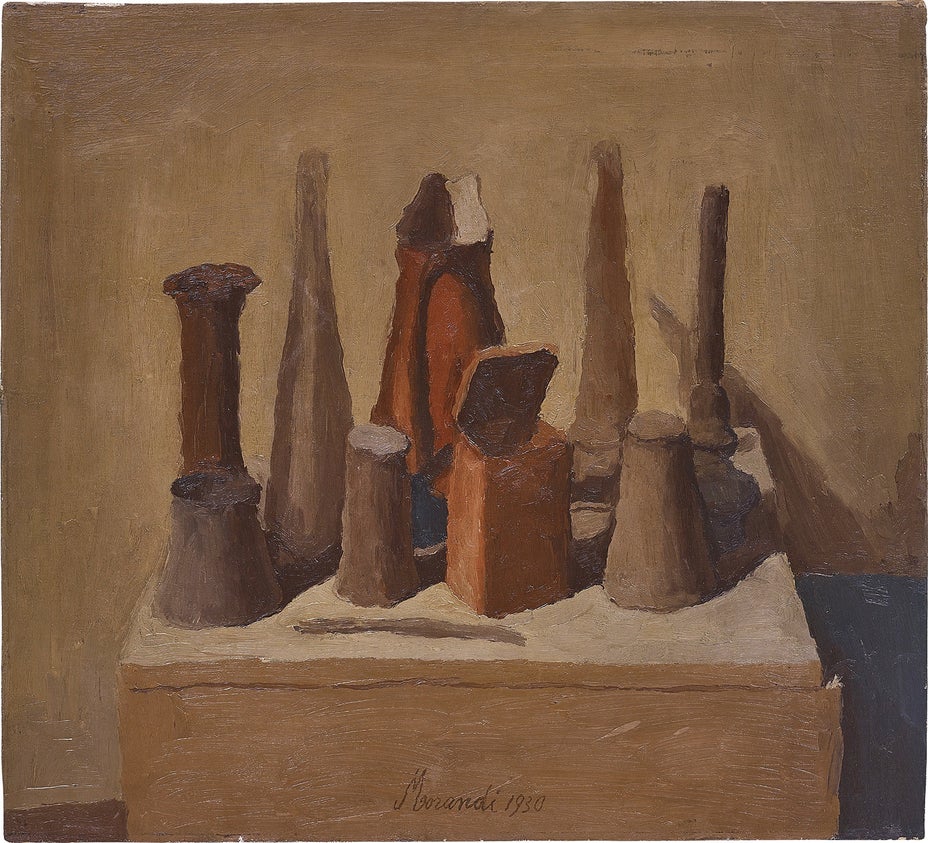
An exceptionally rare work by Giorgio Morandi, Natura Morta invites us into the ethereal microcosm of the artist’s famous table top still-lifes. The painting depicts Morandi’s iconic repertoire of opaque vases, jugs, bottles, cans, knives and boxes, masterfully rendered in an array of subtle earthy hues and dramatically orchestrated across the width of the table. Painted in 1930, the present work is among the largest still-life paintings in the artist’s oeuvre and was the largest of only five created that year. It has since been prominently included in some of Morandi’s most seminal monographic exhibitions over the past five decades and is further distinguished by its exceptional provenance, having been acquired by Duchess Marguerite Caetani di Sermoneta and then gifted to a friend in whose family it remained. Living between France and Italy, the American-born Duchess was a passionate patron and collector of the arts, as well as an editor and publisher of modernist literary journals. A true connoisseur, she played a crucial role in championing Morandi’s work – to the extent that she co-organized a group exhibition encompassing his work in Paris in 1934, his fourth exhibition in the heart of the modern art world.
When Morandi painted the present work he had been pursuing the still-life genre for nearly two decades. Having experimented with the movements of Cubism, Futurism, and, most notably, the Pittura Metafisica (Metaphysical Art) pioneered by Giorgio de Chirico and Carlo Carrà in the 1910s, and had been developing his mature, more naturalistic style since 1920. Painted in 1930, Natura Morta sits at a significant transitional moment within Morandi’s career. In the same year, the artist’s growing reputation had garnered him the chair of Professor of Etching at the Bologna Accademia di Belle Arti and his work was included in the XVII Venice Biennale. A laborious, experimental and diversified period of artistic research, the 1930s saw the artist produce only a limited number of still-life paintings: only 14 between 1930 and 1932, all but abandoning the subject between 1933 and 1934 in favor of landscapes.
Natura Morta powerfully articulates the new formal direction the artist was beginning to take in this period, which was characterized by a darker palette, an exaggerated use of chiaroscuro, and, significantly, a shift towards abstraction. Deliberately allowing for his brushwork to remain visible, Morandi here weaves a dense composition that achieves the rare feat of suggesting both flatness and depth. While his modulation of paint in some instances captures the appearance of three-dimensional vessels, the knife placed at the foreground and the slender bottle at the upper right become soft and silhouette-like, blurring like shadows into the background. Whereas in Natura Morta, 1930 (Vitali 155), Morandi rendered these objects with a defined solidity, here he began dissolving volume through the materiality and application of impasto paint in a manner that clearly sets the foundation for the seminal and oft-cited Natura Morta, 1931 (Vitali 164).
Morandi’s still-lifes also gained a palpable emotional density in the 1930s, as can be seen in the dynamic constellation and intense lighting in the present work which imbues the microcosm of his tabletop with elusive tensions. While the present work is then a figurative image borne from reality, it is also an abstracted and highly atmospheric image that appeals to the viewer’s senses in a manner indebted to 18th century still-life master Jean Siméon Chardin. A contemplative picture filled with latent drama, Natura Morta is typical for the overarching multivalence inherent to Morandi’s practice.
Throughout his over five-decade long career, Morandi embraced the still-life as the means to pursue a meditation of art in and of itself. For centuries relegated to the sphere of imitation or the symbolism of vanitas, the subject matter had become favored by modern artists as means of exploring questions of perception. Like his great hero Paul Cézanne, Morandi abandoned the notion of the still-life as a straightforward representation of reality. A veritable modern master of the still life, he instead sought to convey the feelings and images aroused by the visual world through an emphasis on form, space, color and light. Natura Morta encapsulates a crucial phase in Morandi’s practice, setting the foundation for the serial still-life variations he would concentrate on from the early 1940s to his death in 1964, and which has come to influence generations of artists to come.
An exceptionally rare work by Giorgio Morandi, Natura Morta invites us into the ethereal microcosm of the artist’s famous table top still-lifes. The painting depicts Morandi’s iconic repertoire of opaque vases, jugs, bottles, cans, knives and boxes, masterfully rendered in an array of subtle earthy hues and dramatically orchestrated across the width of the table. Painted in 1930, the present work is among the largest still-life paintings in the artist’s oeuvre and was the largest of only five created that year. It has since been prominently included in some of Morandi’s most seminal monographic exhibitions over the past five decades and is further distinguished by its exceptional provenance, having been acquired by Duchess Marguerite Caetani di Sermoneta and then gifted to a friend in whose family it remained. Living between France and Italy, the American-born Duchess was a passionate patron and collector of the arts, as well as an editor and publisher of modernist literary journals. A true connoisseur, she played a crucial role in championing Morandi’s work – to the extent that she co-organized a group exhibition encompassing his work in Paris in 1934, his fourth exhibition in the heart of the modern art world.
When Morandi painted the present work he had been pursuing the still-life genre for nearly two decades. Having experimented with the movements of Cubism, Futurism, and, most notably, the Pittura Metafisica (Metaphysical Art) pioneered by Giorgio de Chirico and Carlo Carrà in the 1910s, and had been developing his mature, more naturalistic style since 1920. Painted in 1930, Natura Morta sits at a significant transitional moment within Morandi’s career. In the same year, the artist’s growing reputation had garnered him the chair of Professor of Etching at the Bologna Accademia di Belle Arti and his work was included in the XVII Venice Biennale. A laborious, experimental and diversified period of artistic research, the 1930s saw the artist produce only a limited number of still-life paintings: only 14 between 1930 and 1932, all but abandoning the subject between 1933 and 1934 in favor of landscapes.
Natura Morta powerfully articulates the new formal direction the artist was beginning to take in this period, which was characterized by a darker palette, an exaggerated use of chiaroscuro, and, significantly, a shift towards abstraction. Deliberately allowing for his brushwork to remain visible, Morandi here weaves a dense composition that achieves the rare feat of suggesting both flatness and depth. While his modulation of paint in some instances captures the appearance of three-dimensional vessels, the knife placed at the foreground and the slender bottle at the upper right become soft and silhouette-like, blurring like shadows into the background. Whereas in Natura Morta, 1930 (Vitali 155), Morandi rendered these objects with a defined solidity, here he began dissolving volume through the materiality and application of impasto paint in a manner that clearly sets the foundation for the seminal and oft-cited Natura Morta, 1931 (Vitali 164).
Morandi’s still-lifes also gained a palpable emotional density in the 1930s, as can be seen in the dynamic constellation and intense lighting in the present work which imbues the microcosm of his tabletop with elusive tensions. While the present work is then a figurative image borne from reality, it is also an abstracted and highly atmospheric image that appeals to the viewer’s senses in a manner indebted to 18th century still-life master Jean Siméon Chardin. A contemplative picture filled with latent drama, Natura Morta is typical for the overarching multivalence inherent to Morandi’s practice.
Throughout his over five-decade long career, Morandi embraced the still-life as the means to pursue a meditation of art in and of itself. For centuries relegated to the sphere of imitation or the symbolism of vanitas, the subject matter had become favored by modern artists as means of exploring questions of perception. Like his great hero Paul Cézanne, Morandi abandoned the notion of the still-life as a straightforward representation of reality. A veritable modern master of the still life, he instead sought to convey the feelings and images aroused by the visual world through an emphasis on form, space, color and light. Natura Morta encapsulates a crucial phase in Morandi’s practice, setting the foundation for the serial still-life variations he would concentrate on from the early 1940s to his death in 1964, and which has come to influence generations of artists to come.