PROPERTY FROM A PRIVATE AMERICAN COLLECTION
38Ο︎◆︎
Gilbert & George
Spitalfields
Estimate
£120,000–180,000‡︎♠︎
Sold For
£146,500
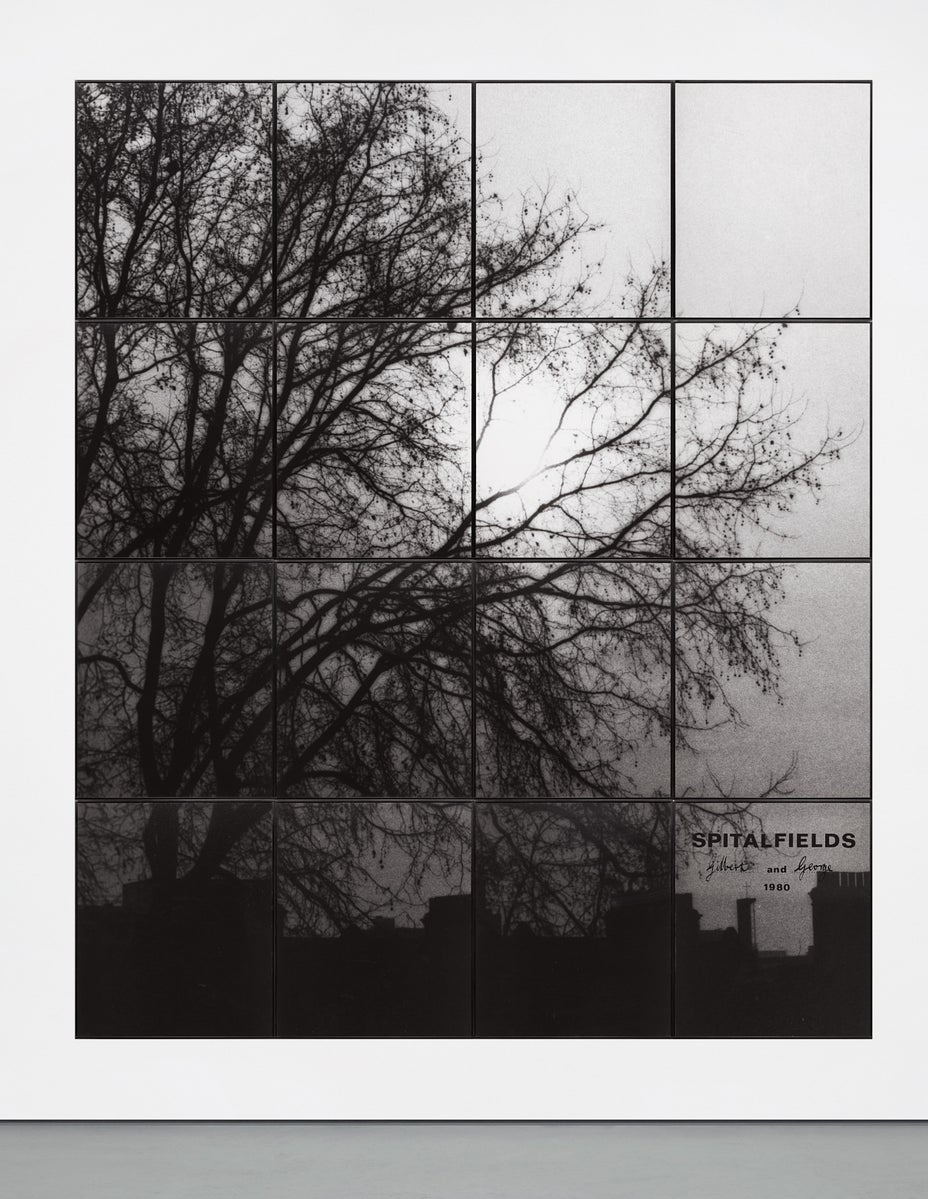
16 black and white photographs, in artist's frames
243.8 x 203.2 cm (96 x 80 in.)
Signed, titled and dated 'SPITALFIELDS Gilbert and George 1980' lower right. Each framed part individually named, titled and consecutively numbered 'GILBERT + GEORGE SPITALFIELDS No. 1-16/16' on the reverse.
Full-Cataloguing
Gilbert and George have lived together at 8 Fournier Street, a Georgian house in Spitalfields, since 1968. According to George, ‘nothing happens in the world that doesn’t happen in the East End.’ (Gilbert and George in Anna van Praagh, ‘Gilbert and George: “Margaret Thatcher did a lot for art,”’ Telegraph, 5 July 2009). Taking East London as their microcosm, they explore what they have called the three main ‘life-forces’ of art: The Head, The Soul and The Sex.
Spitalfields is from a series of large-scale photographic works titled Modern Fears (1980-1981). The duo had begun to introduce colour into their compositions from the mid-seventies, but here return to a haunting monochrome; attenuated and quiet, the themes of sex, death, and religion that pervade so much of their oeuvre are barely suggested. The artists themselves, most often ‘living sculptures’ in their images, are uncharacteristically absent. The possibilities of humanity and meaning are glimpsed in the silhouetted skyline of houses: who lives there and what they are doing remain tantalising propositions. Organic and expansive, the form of the tree branching through the grid assemblage carries a further hint of vibrant life transcending boundaries. The moon (or is it the sun?) that shines beyond imbues the outline with gentle optimism even as an air of mystery reigns.
With their idiosyncratic dress sense and unique mission of living as an art form, Gilbert and George are true eccentrics, and a familiar sight in their neighbourhood. They breakfast at the same café at 6:30 every morning, and walk to the same Kurdish restaurant each evening for dinner. Spitalfields is a historic parish with a rich heritage: first settled in Roman times, the area became famous as the heart of the Huguenot silk industry from the 17th century before drawing a large influx of Jews from Eastern Europe and Russia; in the 1970s it became the heart of the Bengali community. Today it remains a lively cultural hub even as gentrification creeps.
In this world, yet somehow not quite of it, Gilbert and George view their environment with the detached eye of the flaneur, immersed but distanced through a keen honesty inflected by irony and humour. The graffiti in their Dirty Words series was sourced from these gritty surroundings; further images in Modern Fears include local tramps and other figures from outside mainstream society, with whom Gilbert and George had good reason to identify as a homosexual couple in the era. The caption in Spitalfields’ lower right panel locks its subject in time and place, giving the work the air of a strange picture postcard or historical document; preemptively nostalgic in tone, it presents an ambiguous portrait of rich and chaotic East London that glows with unmistakable fondness.
Spitalfields is from a series of large-scale photographic works titled Modern Fears (1980-1981). The duo had begun to introduce colour into their compositions from the mid-seventies, but here return to a haunting monochrome; attenuated and quiet, the themes of sex, death, and religion that pervade so much of their oeuvre are barely suggested. The artists themselves, most often ‘living sculptures’ in their images, are uncharacteristically absent. The possibilities of humanity and meaning are glimpsed in the silhouetted skyline of houses: who lives there and what they are doing remain tantalising propositions. Organic and expansive, the form of the tree branching through the grid assemblage carries a further hint of vibrant life transcending boundaries. The moon (or is it the sun?) that shines beyond imbues the outline with gentle optimism even as an air of mystery reigns.
With their idiosyncratic dress sense and unique mission of living as an art form, Gilbert and George are true eccentrics, and a familiar sight in their neighbourhood. They breakfast at the same café at 6:30 every morning, and walk to the same Kurdish restaurant each evening for dinner. Spitalfields is a historic parish with a rich heritage: first settled in Roman times, the area became famous as the heart of the Huguenot silk industry from the 17th century before drawing a large influx of Jews from Eastern Europe and Russia; in the 1970s it became the heart of the Bengali community. Today it remains a lively cultural hub even as gentrification creeps.
In this world, yet somehow not quite of it, Gilbert and George view their environment with the detached eye of the flaneur, immersed but distanced through a keen honesty inflected by irony and humour. The graffiti in their Dirty Words series was sourced from these gritty surroundings; further images in Modern Fears include local tramps and other figures from outside mainstream society, with whom Gilbert and George had good reason to identify as a homosexual couple in the era. The caption in Spitalfields’ lower right panel locks its subject in time and place, giving the work the air of a strange picture postcard or historical document; preemptively nostalgic in tone, it presents an ambiguous portrait of rich and chaotic East London that glows with unmistakable fondness.