29
Gerhard Richter
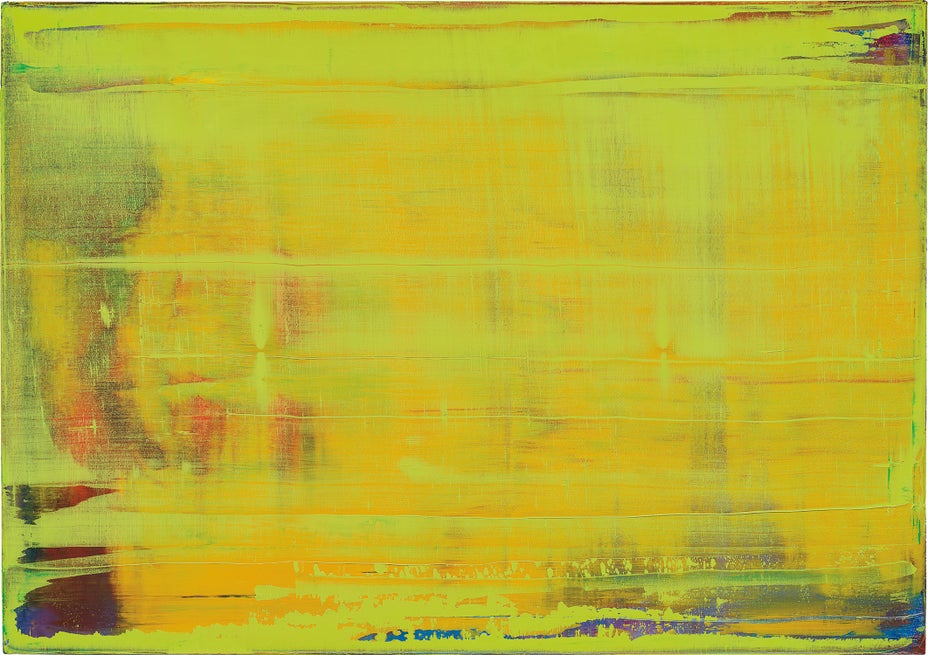
Abstraktes Bild
Full-Cataloguing
Chance within Richter’s Abstract Paintings takes on paramount importance, guiding the artist’s decisions throughout the works’ incremental process of creation. ‘When I paint an abstract picture, I neither know in advance what it is meant to look like nor, during the painting process, what I am aiming at and what to do about getting there’, he wrote. ‘Painting is consequently an almost blind, desperate effort, like that of a person abandoned, helpless, in totally incomprehensible surroundings – like that of a person who possesses a given set of tools, materials and abilities and has the urgent desire to build something useful which is not allowed to be a house or a chair or anything else that has a name; who therefore hacks away in the vague hope that by working in a proper, professional way he will ultimately turn out something proper and meaningful’ (Gerhard Richter, quoted in ‘Notes’, 1985, Gerhard Richter: Text. Writings, Interviews and Letters, 1961-2007, London, 2009, p. 142). Encapsulating Richter’s animated process defined by trust, repetition, and persistence, Abstraktes Bild displays the progressive meanderings that the artist has gone through whilst working on the canvas, ultimately amounting to an irrepressibly dynamic result, redolent of the energy deployed in Abstract Expressionist canvases. With its vigorous yellow hue and its elements of striation, Abstraktes Bild recalls Clyfford Still’s PH-1074 from 1956-59, which today resides in the artist’s museum in Colorado.
Moving past the paintings’ eponymously established abstract nature, Richter has elucidated that his Abstract Paintings were, in his eyes, evocative of reality to the point of phenomenological sentience. ‘Almost all the abstract paintings show scenarios, surroundings and landscapes that don't exist, but they create the impression that they could exist’, he exclaimed. ‘As though they were photographs of scenarios and regions that had never yet been seen’ (Gerhard Richter, quoted in 'I Have Nothing to Say and I'm Saying It: Conversations between Gerhard Richter and Nicholas Serota', Gerhard Richter Panorama, London, 2011, p. 19). With the present work, Richter brings to mind a number of objects endowed with the composition’s constitutive hue, most convincingly the sun that shines on the earth and all its perceptive beings.
Gerhard Richter
German | 1932Powerhouse painter Gerhard Richter has been a key player in defining the formal and ideological agenda for painting in contemporary art. His instantaneously recognizable canvases literally and figuratively blur the lines of representation and abstraction. Uninterested in classification, Richter skates between unorthodoxy and realism, much to the delight of institutions and the market alike.
Richter's color palette of potent hues is all substance and "no style," in the artist's own words. From career start in 1962, Richter developed both his photorealist and abstracted languages side-by-side, producing voraciously and evolving his artistic style in short intervals. Richter's illusory paintings find themselves on the walls of the world's most revered museums—for instance, London’s Tate Modern displays the Cage (1) – (6), 2006 paintings that were named after experimental composer John Cage and that inspired the balletic 'Rambert Event' hosted by Phillips Berkeley Square in 2016.