PROPERTY FROM A U.K. COLLECTION
32
Gerald Summers
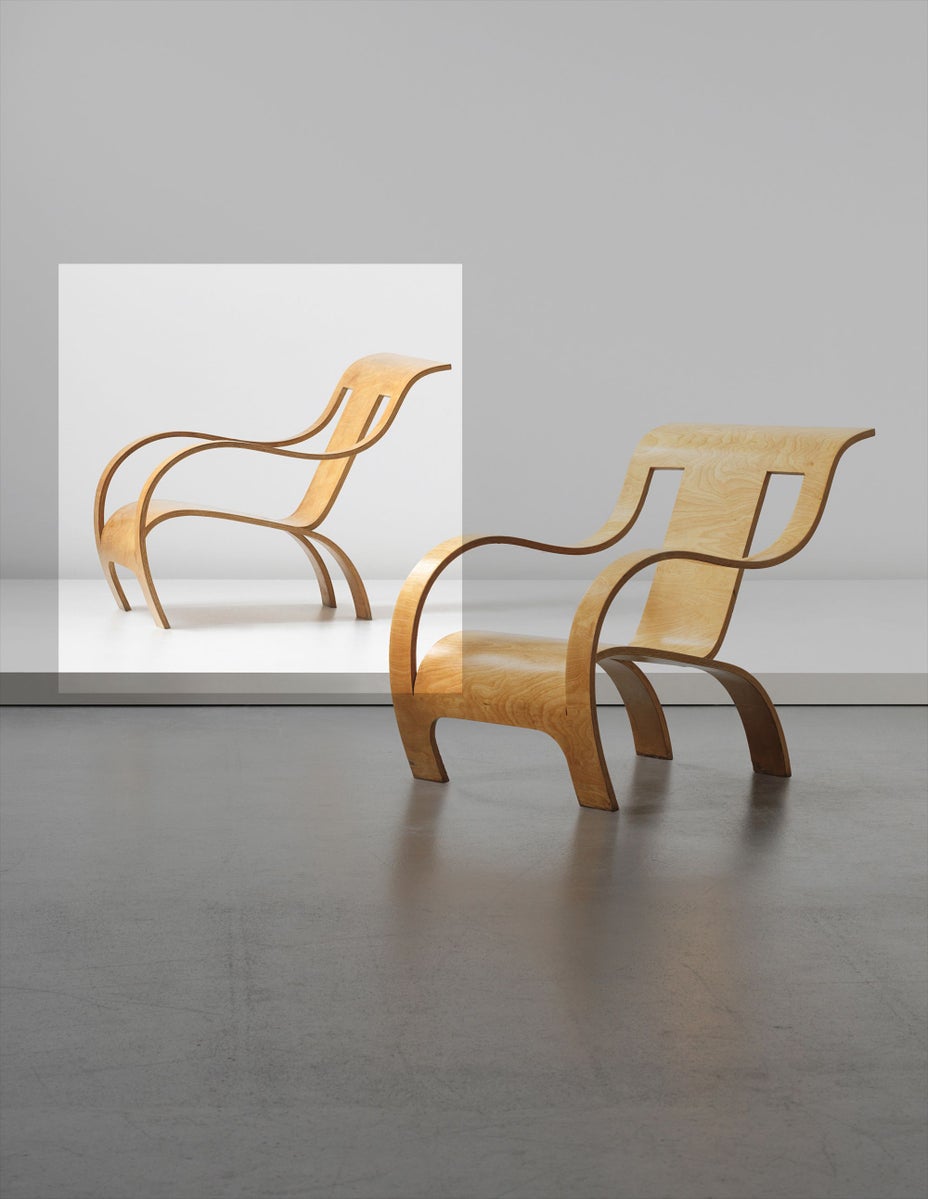
Rare armchair
Estimate
£25,000–35,000♠︎
circa 1934-1939
Moulded birch laminated plywood.
75 x 59.9 x 89.1 cm (29 1/2 x 23 5/8 x 35 1/8 in.)
Manufactured by Makers of Simple Furniture, U.K.
Full-Cataloguing
The present and following lots are two of the 120 examples manufactured by Summers’s company, Makers of Simple Furniture Ltd. beginning in 1934. Each chair was constructed out of a single plywood sheet of thirteen layers of cross-grained veneer which was cut, pressed and cut again. This elegantly simple process produced a chair that was comfortable enough to sit in without a cushion. Ultimately the manufacture was too costly to compete with Scandinavian imports and production ceased in 1939.
Summers designed the present model shortly after he began his experiments with aeroplane ply, a type of plywood developed for airplanes. While plywood had come into widespread use in Britain in the early decades of the twentieth century most furniture makers disguised it under expensive veneers. Unlike his contemporaries, Summers was not deterred by plywood’s visual properties and instead chose to leave it bare, highlighting its colourr and texture with a simple French polish.
The design of these iconic chairs has been attributed both to the influence of Alvar Aalto and to Jack Pritchard, the founder of Isokon Ltd. However, unlike Breuer’s chairs manufactured by Isokon, Summers’s design did not require additional supports, a distinction he was quick to point out in a 1935 interview: ‘In pure design we expect each part and member to pull its full weight in making the design suitable for its purpose…if we use a brace only to strengthen two members the design is bad’. (Design for To-day, June, 1935.) In this way, the present chairs are emblematic of modernism’s most defining tenet of a seamless relationship between form and function.
Summers designed the present model shortly after he began his experiments with aeroplane ply, a type of plywood developed for airplanes. While plywood had come into widespread use in Britain in the early decades of the twentieth century most furniture makers disguised it under expensive veneers. Unlike his contemporaries, Summers was not deterred by plywood’s visual properties and instead chose to leave it bare, highlighting its colourr and texture with a simple French polish.
The design of these iconic chairs has been attributed both to the influence of Alvar Aalto and to Jack Pritchard, the founder of Isokon Ltd. However, unlike Breuer’s chairs manufactured by Isokon, Summers’s design did not require additional supports, a distinction he was quick to point out in a 1935 interview: ‘In pure design we expect each part and member to pull its full weight in making the design suitable for its purpose…if we use a brace only to strengthen two members the design is bad’. (Design for To-day, June, 1935.) In this way, the present chairs are emblematic of modernism’s most defining tenet of a seamless relationship between form and function.