Property from a Private Collection, Chicago
137
George Condo
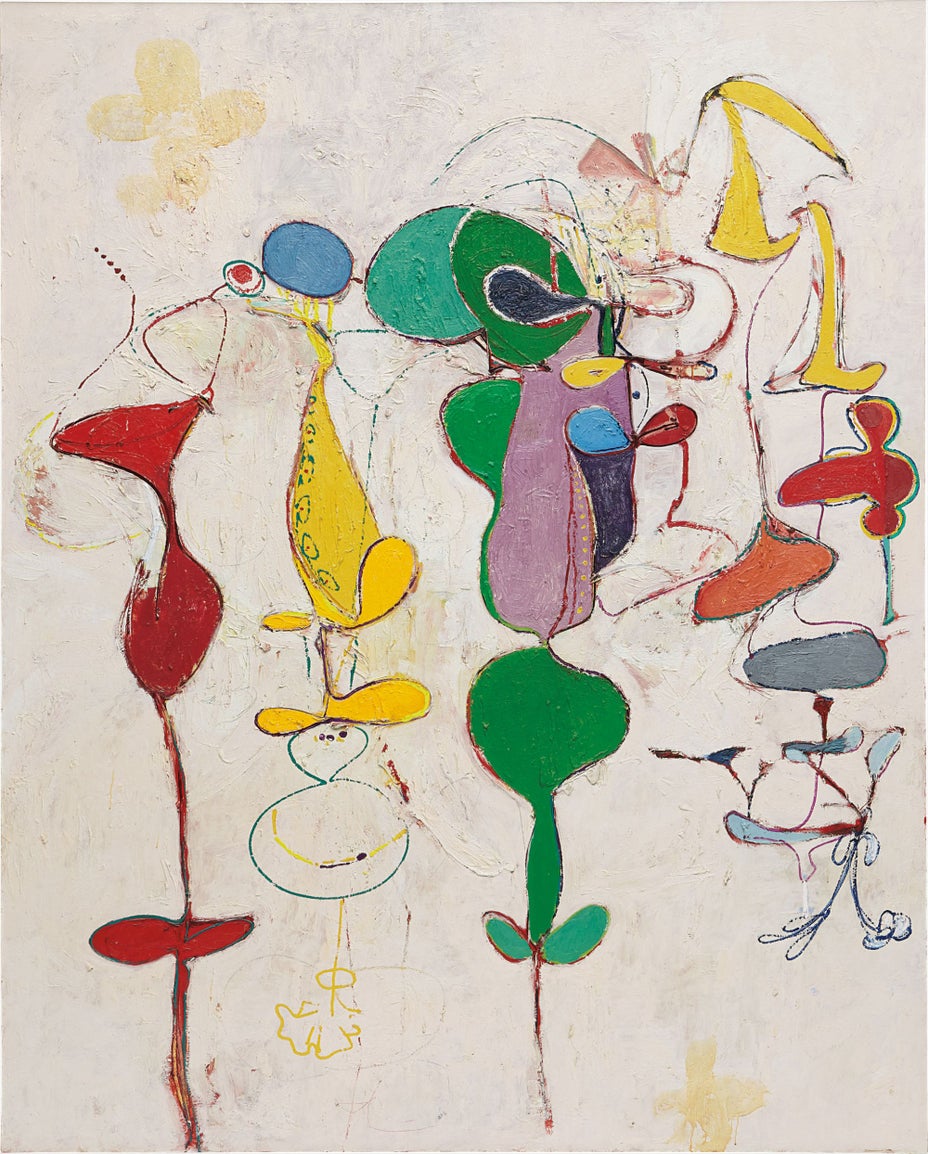
Expanding Color Painting
Estimate
$150,000–200,000
Sold For
$149,000
oil on canvas
98 1/4 x 78 1/2 in. (249.6 x 199.4 cm)
Signed, inscribed and dated "the days of color Condo 87" on the reverse. Further signed "Condo" on the stretcher.
Full-Cataloguing
"Expanding Color Painting is an extremely attractive mélange of motifs recalling those in Gorky's late paintings, and it even approximates the chromatic tonalities of The Betrothal II.”
Holland Cotter, "George Condo at Pace," Art in America, May 1988
As George Condo has cited “abstractions are pictures of the artist's mind” and the present lot, Expanding Color Painting, 1987 is an example of Condo’s most vivid imagination. Bulbous, natural forms rendered in primary reds, yellow, greens and blues seem to grow upward from the lower quadrant of the composition. Swirling like colorful ivy, crawling across the creamy background Condo has created an intricate pattern of delicate modular structures emerging at various stages of formation, slowly rising to the surface of the composition. A blend of historical references can be seen, from Gorky’s breakthrough series entitled Garden in Sochi to Joan Miró’s surrealist shapes, Condo places himself at the crux of New York’s 1980’s painterly revival.
The philosopher Félix Guattari, who lived on the Rue de Condé in the same building as Condo in the 1980’s when Expanding Color Painting was executed describes “a very specific 'Condo effect,’” stating that Condo “sacrifices everything to this effect, particularly pictorial structure, which he systematically destroys, thus removing a protective guardrail, a frame of reference which might reassure the viewer, who is denied access to a stable set of meanings." Expanding Color Painting, 1987 lies at the heart of Condo’s practice, a dive into the depths of what the artist refers to as “psychological cubism.”
Holland Cotter, "George Condo at Pace," Art in America, May 1988
As George Condo has cited “abstractions are pictures of the artist's mind” and the present lot, Expanding Color Painting, 1987 is an example of Condo’s most vivid imagination. Bulbous, natural forms rendered in primary reds, yellow, greens and blues seem to grow upward from the lower quadrant of the composition. Swirling like colorful ivy, crawling across the creamy background Condo has created an intricate pattern of delicate modular structures emerging at various stages of formation, slowly rising to the surface of the composition. A blend of historical references can be seen, from Gorky’s breakthrough series entitled Garden in Sochi to Joan Miró’s surrealist shapes, Condo places himself at the crux of New York’s 1980’s painterly revival.
The philosopher Félix Guattari, who lived on the Rue de Condé in the same building as Condo in the 1980’s when Expanding Color Painting was executed describes “a very specific 'Condo effect,’” stating that Condo “sacrifices everything to this effect, particularly pictorial structure, which he systematically destroys, thus removing a protective guardrail, a frame of reference which might reassure the viewer, who is denied access to a stable set of meanings." Expanding Color Painting, 1987 lies at the heart of Condo’s practice, a dive into the depths of what the artist refers to as “psychological cubism.”
George Condo
AmericanPicasso once said, "Good artists borrow, great artists steal." Indeed, American artist George Condo frequently cites Picasso as an explicit source in his contemporary cubist compositions and joyous use of paint. Condo is known for neo-Modernist compositions staked in wit and the grotesque, which draw the eye into a highly imaginary world.
Condo came up in the New York art world at a time when art favored brazen innuendo and shock. Student to Warhol, best friend to Basquiat and collaborator with William S. Burroughs, Condo tracked a different path. He was drawn to the endless inquiries posed by the aesthetics and formal considerations of Caravaggio, Rembrandt and the Old Masters.