134
George Condo
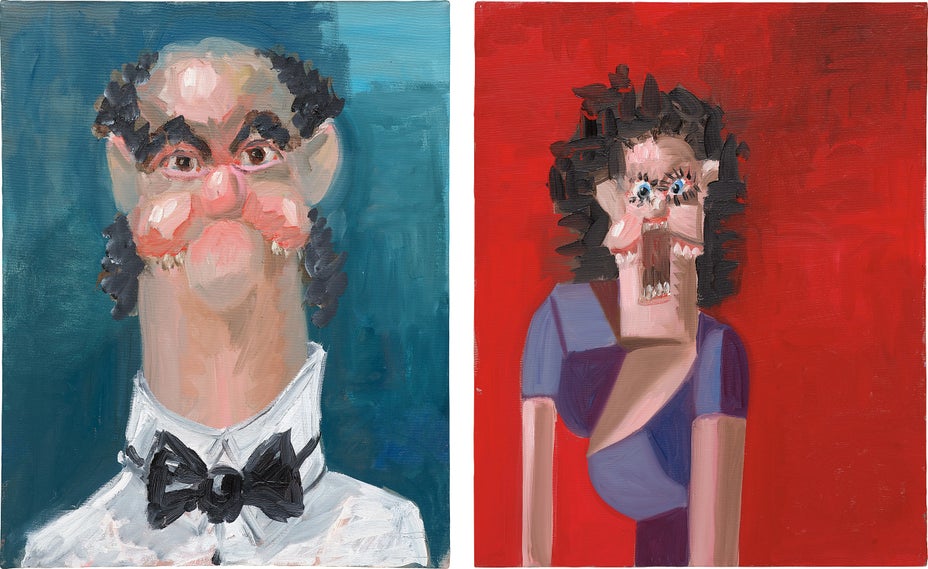
Two Works: (i) Jean Louis; (ii) Jean Louis’ Wife
Estimate
HK$3,500,000–5,500,000
€398,000–625,000
$449,000–705,000
Sold For
HK$3,750,000
(i) signed, titled and dated 'George Condo "JEAN LOUIS" 05' on the reverse
(ii) signed and titled 'George Condo "JEAN LOUIS' WIFE"' on the reverse
(ii) signed and titled 'George Condo "JEAN LOUIS' WIFE"' on the reverse
oil on canvas
each 50.8 x 40.6 cm. (20 x 15 7/8 in.)
Painted in 2005.
Full-Cataloguing
What is Jean Louis? Is he a waiter, a chef, a driver? Is he a real person?
- George Condo
The present lots hail from George Condo’s seminal early portraiture series, Existential Portraits, a small handful of works that the artist created which investigated the human psyche. Featuring figures that ‘are questioning their existence’ (George Condo quoted in Ralph Rugoff, ‘The Enigma of Jean Louis’, in George Condo: Existential Portraits, exh. cat., Luhring Augustine, New York, 2006, p.11), Condo draws from a wide repertoire of characters, creating a cast of unlikely protagonists who each come with individual prologues concocted by the artist himself.
Painting entirely from his imagination and art historical memory, Condo synthesises influences ranging from Old Master painting to modern day photography, with a sensibility informed by popular culture, to construct his pieces. When investigating this particular series of works, the artist offers Chuck Close’s self-portraits from the 1970s as possible points of departure—with their tightly framed compositions, they resemble photographic sources or effects, offering the audience intimate glimpses into the personas depicted.
Speaking about the character Jean Louis in the present two lots, the artist describes the ‘imaginary butler’ as a spontaneously made-up character (George Condo quoted in Marina Cashdan, ‘The Mental States of George Condo’). Coupled with the long-regarded art historical significance of portraiture being a veritable window into the soul, the three characters—Jean Louis, his wife, and his wife’s sister—each carry their own underlying narratives, their interlinked stories a mystery to the audience. Curiously, the inspiration taken from Chuck Close’s photographic works also lends itself to another form of present-day photography: mug shots, further fuelling a somewhat clandestine understanding of the three characters’ possibly nefarious interrelationship. In particular, the title of Jean Louis with One Ear all the more calls to mind Vincent Van Gogh’s self-mutilation, a deliberate link perhaps that hints at more portentous undertones.
Furthermore, the depiction of the two women demonstrates Condo’s penchant for exaggeration and distortion. Jean Louis’ Wife and Jean Louis’ Wife’s Sister feature two figures whose physiognomy confronts us with a threatening gaze, reminiscent of Willem de Kooning’s women or the screaming heads in Picasso’s Guernica, 1937. The palpable psychological intensity of these works is exemplary of Condo’s approach to portraiture as a form of ‘Psychological Cubism’.
At the time of creating such works, Condo remarked that the Existential Portraits ‘have to do with the idea of people’s despair today, with the idea that they don’t really have a choice…but the choices they make are very much within the geopolitical map for how people should live their lives at any given time. So in the paintings, these characters expand beyond those boundaries’ (George Condo quoted in Ralph Rugoff, ‘The Enigma of Jean Louis’). In such pieces, the characters exist in a realm between comedy and tragedy, bound by a reaction that mirrors the typical Condo effect: a frenetic grimace that ‘goes between a scream and a smile’ (George Condo, quoted in ‘George Condo: Interview’, Time Out,
6 February 2007, online).
- George Condo
The present lots hail from George Condo’s seminal early portraiture series, Existential Portraits, a small handful of works that the artist created which investigated the human psyche. Featuring figures that ‘are questioning their existence’ (George Condo quoted in Ralph Rugoff, ‘The Enigma of Jean Louis’, in George Condo: Existential Portraits, exh. cat., Luhring Augustine, New York, 2006, p.11), Condo draws from a wide repertoire of characters, creating a cast of unlikely protagonists who each come with individual prologues concocted by the artist himself.
Painting entirely from his imagination and art historical memory, Condo synthesises influences ranging from Old Master painting to modern day photography, with a sensibility informed by popular culture, to construct his pieces. When investigating this particular series of works, the artist offers Chuck Close’s self-portraits from the 1970s as possible points of departure—with their tightly framed compositions, they resemble photographic sources or effects, offering the audience intimate glimpses into the personas depicted.
Speaking about the character Jean Louis in the present two lots, the artist describes the ‘imaginary butler’ as a spontaneously made-up character (George Condo quoted in Marina Cashdan, ‘The Mental States of George Condo’). Coupled with the long-regarded art historical significance of portraiture being a veritable window into the soul, the three characters—Jean Louis, his wife, and his wife’s sister—each carry their own underlying narratives, their interlinked stories a mystery to the audience. Curiously, the inspiration taken from Chuck Close’s photographic works also lends itself to another form of present-day photography: mug shots, further fuelling a somewhat clandestine understanding of the three characters’ possibly nefarious interrelationship. In particular, the title of Jean Louis with One Ear all the more calls to mind Vincent Van Gogh’s self-mutilation, a deliberate link perhaps that hints at more portentous undertones.
Furthermore, the depiction of the two women demonstrates Condo’s penchant for exaggeration and distortion. Jean Louis’ Wife and Jean Louis’ Wife’s Sister feature two figures whose physiognomy confronts us with a threatening gaze, reminiscent of Willem de Kooning’s women or the screaming heads in Picasso’s Guernica, 1937. The palpable psychological intensity of these works is exemplary of Condo’s approach to portraiture as a form of ‘Psychological Cubism’.
At the time of creating such works, Condo remarked that the Existential Portraits ‘have to do with the idea of people’s despair today, with the idea that they don’t really have a choice…but the choices they make are very much within the geopolitical map for how people should live their lives at any given time. So in the paintings, these characters expand beyond those boundaries’ (George Condo quoted in Ralph Rugoff, ‘The Enigma of Jean Louis’). In such pieces, the characters exist in a realm between comedy and tragedy, bound by a reaction that mirrors the typical Condo effect: a frenetic grimace that ‘goes between a scream and a smile’ (George Condo, quoted in ‘George Condo: Interview’, Time Out,
6 February 2007, online).
George Condo
AmericanPicasso once said, "Good artists borrow, great artists steal." Indeed, American artist George Condo frequently cites Picasso as an explicit source in his contemporary cubist compositions and joyous use of paint. Condo is known for neo-Modernist compositions staked in wit and the grotesque, which draw the eye into a highly imaginary world.
Condo came up in the New York art world at a time when art favored brazen innuendo and shock. Student to Warhol, best friend to Basquiat and collaborator with William S. Burroughs, Condo tracked a different path. He was drawn to the endless inquiries posed by the aesthetics and formal considerations of Caravaggio, Rembrandt and the Old Masters.