5
Francine Del Pierre
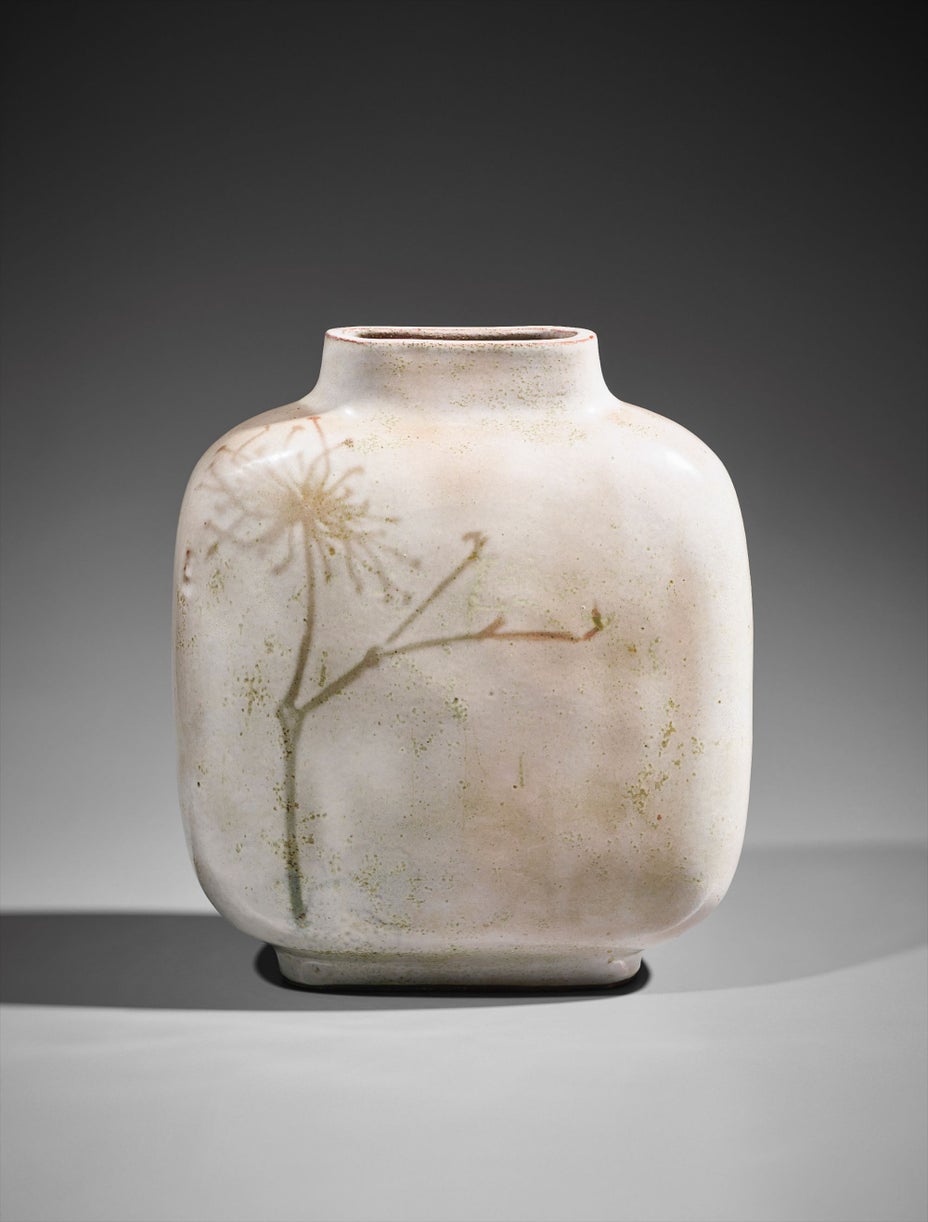
Large flat vase
Estimate
£5,000–7,000♠︎
Sold For
£8,125
1963
Earthenware, grey glaze with a floral motif.
39 cm (15 3/8 in.) high
Incised with artist's seal.
Full-Cataloguing
The French ceramicist Francine Del Pierre, well known in her lifetime, perfected the ancestral and rudimentary pottery technique of coiling. She managed to perfect the discipline in such a way, that she was able to stack the clay with great finesse and lightness. Her use of decoration was poetic, depicting motifs of flowers and meadow herbs.
Del Pierre turned to ceramics aged 31 whilst she was the editorial secretary of a newspaper. She spent her summer in the south where she encountered a santonnier (a maker of Saton figurines), and had a revelation to work with clay. She decided to live with two young students, Albert Diato and Gilbert Portanier, and to settle in a workshop in Vallauris. There they founded the workshop ‘The Triptych’. Eventually, the group drifted apart. Francine returned to Paris where she met Fance Franck and the two never parted.
In the early 1960s, Del Pierre was set up in an atelier situated on Rue Bonaparte in Paris. After meeting Bernard Leach she gained an interest in Asia, as he introduced her to the influential teachings of the Japanese Living National Treasure, the master potter Shoji Hamada, who suggests that the true path will be found by working in solitude in one’s atelier.
Shoji Hamada was the leader of a new wave of ‘studio pottery’ founded by Bernard Leach, presenting the idea that ceramics had become too industrialised, their qualitative and aesthetic results being sometimes questionable. Leach was an advocate of the great tradition of Japanese and Chinese ceramics, whose foundation rested upon the idea of the absolute artist, being both, designer and producer, artisan and creator. The artist alone controls all the stages of production in the atelier and in solitude. This doctrine is a way of life, a search for the absolute that induces a disciplinary intellectual and physical transformation.
The style of Francine Del Pierre was based on strict intellectual constraints of ‘studio pottery’. Everything was produced with her own hands, making her own enamels and preparing her own earthenware. She was constantly in search of new forms which obeyed strict aesthetic rules. Although aspects of utility are present within her work, she was always pushing boundaries and would remove elements, such as handles, which she deemed too utilitarian. The influence of Chinese goldsmith trade was omnipresent in her work.
However, Del Pierre was French at heart and the return to floral motifs, applied in a Chinese style, marked a strong presence of ‘French taste’ in her work, something that had already made Sèvres a success in the 18th Century. This extraordinary singularity of her work, remarked by Leach early on, propelled her into the international scene which many potters of Vallauris were unable to access. She exhibited in London at Gallery Primavera founded by Henry Rothschild, in Zurich and in Rotterdam.
Francine Del Pierre died prematurely in 1968. Thanks to the intervention of the Minister of Culture, André Malraux, Francine is the first ceramicist whose work has been honoured by a retrospective at the Museum of Sèvres, just after her death.
Jean d’Albis
Fance Franck, Francine Del Pierre Foundation, Paris
Del Pierre turned to ceramics aged 31 whilst she was the editorial secretary of a newspaper. She spent her summer in the south where she encountered a santonnier (a maker of Saton figurines), and had a revelation to work with clay. She decided to live with two young students, Albert Diato and Gilbert Portanier, and to settle in a workshop in Vallauris. There they founded the workshop ‘The Triptych’. Eventually, the group drifted apart. Francine returned to Paris where she met Fance Franck and the two never parted.
In the early 1960s, Del Pierre was set up in an atelier situated on Rue Bonaparte in Paris. After meeting Bernard Leach she gained an interest in Asia, as he introduced her to the influential teachings of the Japanese Living National Treasure, the master potter Shoji Hamada, who suggests that the true path will be found by working in solitude in one’s atelier.
Shoji Hamada was the leader of a new wave of ‘studio pottery’ founded by Bernard Leach, presenting the idea that ceramics had become too industrialised, their qualitative and aesthetic results being sometimes questionable. Leach was an advocate of the great tradition of Japanese and Chinese ceramics, whose foundation rested upon the idea of the absolute artist, being both, designer and producer, artisan and creator. The artist alone controls all the stages of production in the atelier and in solitude. This doctrine is a way of life, a search for the absolute that induces a disciplinary intellectual and physical transformation.
The style of Francine Del Pierre was based on strict intellectual constraints of ‘studio pottery’. Everything was produced with her own hands, making her own enamels and preparing her own earthenware. She was constantly in search of new forms which obeyed strict aesthetic rules. Although aspects of utility are present within her work, she was always pushing boundaries and would remove elements, such as handles, which she deemed too utilitarian. The influence of Chinese goldsmith trade was omnipresent in her work.
However, Del Pierre was French at heart and the return to floral motifs, applied in a Chinese style, marked a strong presence of ‘French taste’ in her work, something that had already made Sèvres a success in the 18th Century. This extraordinary singularity of her work, remarked by Leach early on, propelled her into the international scene which many potters of Vallauris were unable to access. She exhibited in London at Gallery Primavera founded by Henry Rothschild, in Zurich and in Rotterdam.
Francine Del Pierre died prematurely in 1968. Thanks to the intervention of the Minister of Culture, André Malraux, Francine is the first ceramicist whose work has been honoured by a retrospective at the Museum of Sèvres, just after her death.
Jean d’Albis
Fance Franck, Francine Del Pierre Foundation, Paris