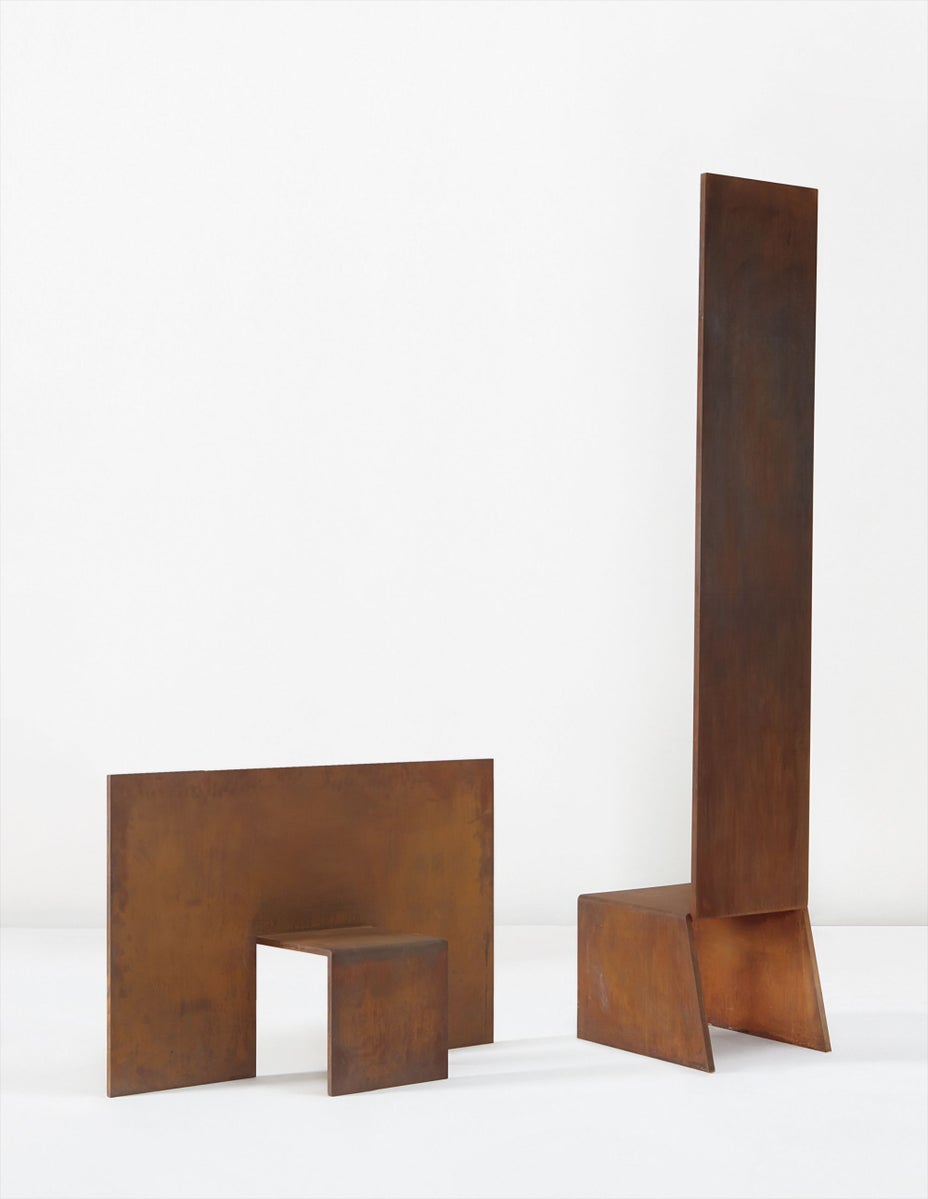
402
Forrest Myers
"King and Queen"
Estimate
$50,000–70,000
Sold For
$56,250
2006
COR-TEN weathering steel.
King: 100 x 19 1/2 x 22 in. (254 x 49.5 x 55.9 cm)
Queen: 40 x 60 x 18 1/4 in. (101.6 x 152.4 x 46.4 cm)
Queen: 40 x 60 x 18 1/4 in. (101.6 x 152.4 x 46.4 cm)
One of two examples produced. Underside of "King" with metal tag incised Forrest Myers/KING & QueeN/CHAIRS 0 / 6, underside of "Queen" with metal tag incised Forrest Myers/KING & QueeN/CHAIRS 86-06.
Full-Cataloguing
In his half-century career as a sculptor and light artist, Forrest Myers has hit many of the cultural touch points of late 20th-century creative life in New York: reared on California surf and car culture, he moved to SoHo in 1961 on the advice of Mark di Suvero; co-founded the seminal Park Place Gallery shortly thereafter; “drew a straight line” from his studio to the back room of Max’s Kansas City (literally, with a laser); and in 1973 installed “The Wall,” a landmark public sculpture on the southwest corner of Broadway and Houston. Decades later Myers engaged in another right of New York passage: a protracted legal battle to save “The Wall” from a landlord’s wrecking ball. Feeling squeezed by Manhattan—“the rents just got too ridiculous”—Myers decamped in 1985 to a meat-packing warehouse in Williamsburg, a move which allowed him to work at greater scale and to begin making tables and chairs. “I have been thinking about the design of furniture for as long as I have been a sculptor,” he says in affinity with famed forebears, Brancusi among them, who produced furniture for personal use. Although Myers conceived the present pair during this period of renewal, he had experimented with similar forms much earlier. “King and Queen,” cut and bent from steel plates, directly relate to his “Fold Chair” (1970), formed from a single sheet of aluminum, and to the floating planes of his “Cut Out” chair (1971), both of which predate the nearly identical forms of Shiro Kuramata’s “Glass Chair” (1976) and Scott Burton’s “Steel Furniture” side chair (1978).