24Σ︎
Finn Juhl
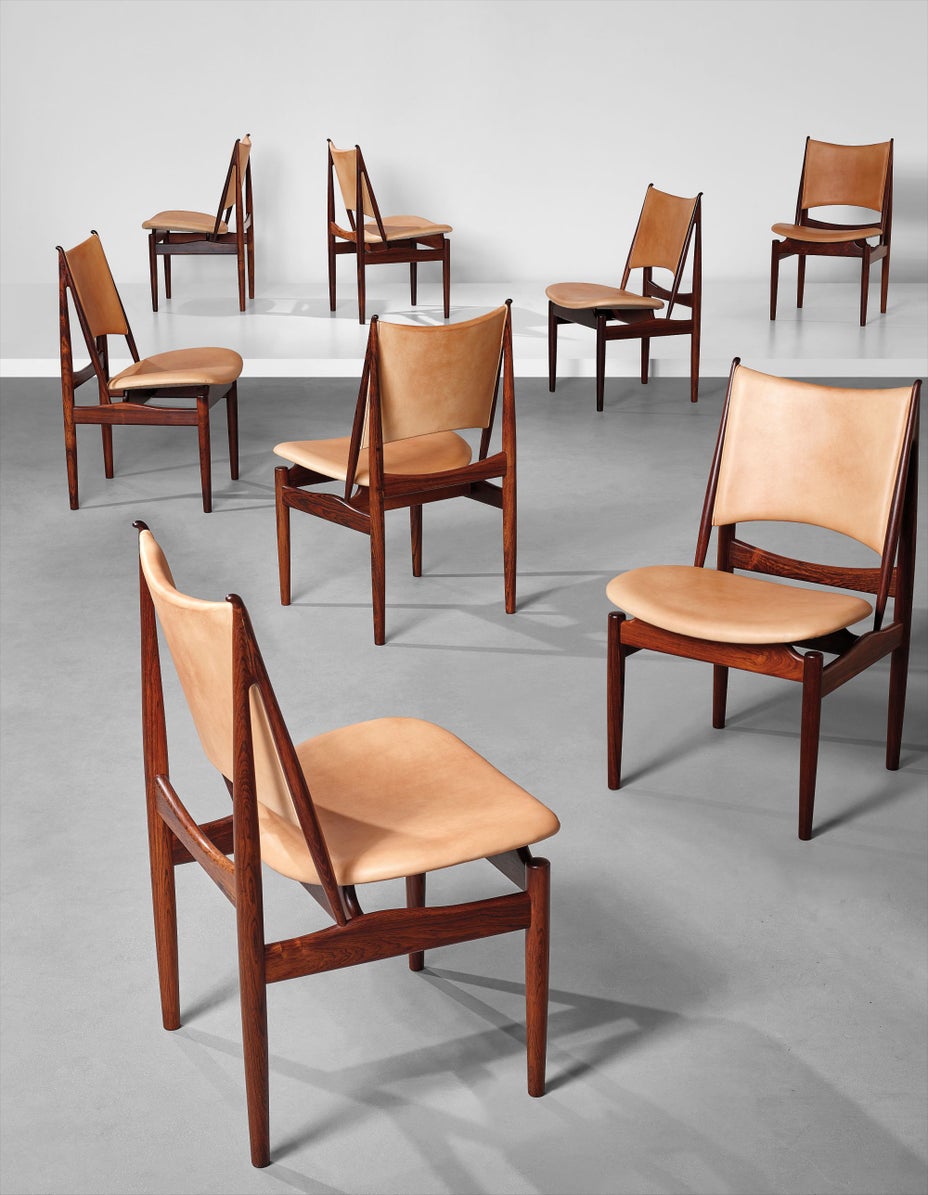
Rare set of eight ‘Egyptian’ dining chairs, model no. FJ 49
Estimate
HK$570,000–700,000
€68,600–84,300
$73,100–89,700
Sold For
HK$900,000
Brazilian rosewood, leather
Each: 89 x 54 x 57 cm (35 x 21 1/4 x 22 1/2 in.)
Executed by master cabinetmaker Niels Vodder, Copenhagen, Denmark. Each underside branded with CABINETMAKER NIELS VODDER/COPENHAGEN DENMARK/DESIGN: FINN JUHL.
Designed in 1949.
Designed in 1949.
Full-Cataloguing
The present two lots are exquisite examples and produced in Brazilian rosewood. Each work was designed by the Danish architect Finn Juhl and executed by the master cabinetmaker Niels Vodder for the Cabinetmakers’ Guild, which started in 1927 and was held annually in Copenhagen until 1966. Although the collaboration between Juhl, then aged twenty-five, and Vodder began in 1937, it was not until the breakthrough period of 1944-1949 at the Cabinetmakers’ Guild in which Juhl began to incorporate his burgeoning organic and percipient approach towards furniture design. The synergy and symbiosis of these two artistic characters created many masterpieces of 20th century design.
In 1949, Finn Juhl designed the ‘FJ 49’ dining chair which became primarily known as the ‘Egyptian’ chair. Much like the ‘Chieftain’ armchair, which was another of Juhl’s masterpieces, the ‘Egyptian’ chair designed the same year features handcrafted, accentuated and organic stiles, using exquisite Brazilian rosewood. The stiles support the backrest whilst elegantly revealing the interstice between the seat and the load-bearing legs. The following statement by Juhl is manifested within the construction of the ‘Egyptian’ chair: ‘I have always been interested in analysing a piece of furniture’s different parts, surely a consequence of my early excitement for Corbusier’s cubist architecture.’ Juhl continues to credit Le Corbusier further for the use of materials to ‘accentuate different planes and load-bearing parts’ (Per H. Hansen, Finn Juhl and His House, Ostfildern, 2014, p. 34). These distinctive, yet brief comments by Juhl amplify his pragmatic approach and reveal architectural principles, which he then applied to the design of the ‘Egyptian’ chair. Another salient influence occurred when Finn Juhl saw an Egyptian chair at the Musée du Louvre. He was inspired by Egyptian furniture and became impressed by the construction: ‘I honestly admit that I have stolen the construction, just as I have stolen the right angle and the circle. It should also be admitted that I have been and am more captivated by the most simple and elegant furniture from Egypt than by other furniture of the past’. (Politiken, 9th October 1976).
Finn Juhl was always eager to assert that he functioned as an autodidact when designing furniture and that he was never formally trained. Finn Juhl does not imitate profundity; he does not leave us masterpieces of modern furniture but masterpieces of modern design. Edgar Kaufmann, Jr., whom Finn Juhl worked with extensively, reflects upon the architect in his essay, ‘Product and Process’: ‘His forms are masterful, now as when they were new. They are capable of a plenitude of embodiments still unexplored. Juhl is no performer, he is a creator. We need more of him.’ (Patricia Yamada, ed., Finn Juhl Memorial Exhibition, p. 13).
When discussing Niels Vodder, the master cabinetmaker of the ‘Egyptian’ chair, the Danish architectural journalist Henrik Sten Møller accurately refers to him as an ‘original craftsman with a distinct sense of humour.’ He then goes further to explain possibly why Vodder had ever agreed to collaborate with Juhl: ‘The reason why Niels Vodder became Finn Juhl’s cabinetmaker was that nobody else wanted to produce his furniture. They thought the furniture too strange and furthermore often technically complicated’ (Ibid, Finn Juhl Memorial Exhibition, exh. cat., Osaka, 1990, p. 18).
In 1949, Finn Juhl designed the ‘FJ 49’ dining chair which became primarily known as the ‘Egyptian’ chair. Much like the ‘Chieftain’ armchair, which was another of Juhl’s masterpieces, the ‘Egyptian’ chair designed the same year features handcrafted, accentuated and organic stiles, using exquisite Brazilian rosewood. The stiles support the backrest whilst elegantly revealing the interstice between the seat and the load-bearing legs. The following statement by Juhl is manifested within the construction of the ‘Egyptian’ chair: ‘I have always been interested in analysing a piece of furniture’s different parts, surely a consequence of my early excitement for Corbusier’s cubist architecture.’ Juhl continues to credit Le Corbusier further for the use of materials to ‘accentuate different planes and load-bearing parts’ (Per H. Hansen, Finn Juhl and His House, Ostfildern, 2014, p. 34). These distinctive, yet brief comments by Juhl amplify his pragmatic approach and reveal architectural principles, which he then applied to the design of the ‘Egyptian’ chair. Another salient influence occurred when Finn Juhl saw an Egyptian chair at the Musée du Louvre. He was inspired by Egyptian furniture and became impressed by the construction: ‘I honestly admit that I have stolen the construction, just as I have stolen the right angle and the circle. It should also be admitted that I have been and am more captivated by the most simple and elegant furniture from Egypt than by other furniture of the past’. (Politiken, 9th October 1976).
Finn Juhl was always eager to assert that he functioned as an autodidact when designing furniture and that he was never formally trained. Finn Juhl does not imitate profundity; he does not leave us masterpieces of modern furniture but masterpieces of modern design. Edgar Kaufmann, Jr., whom Finn Juhl worked with extensively, reflects upon the architect in his essay, ‘Product and Process’: ‘His forms are masterful, now as when they were new. They are capable of a plenitude of embodiments still unexplored. Juhl is no performer, he is a creator. We need more of him.’ (Patricia Yamada, ed., Finn Juhl Memorial Exhibition, p. 13).
When discussing Niels Vodder, the master cabinetmaker of the ‘Egyptian’ chair, the Danish architectural journalist Henrik Sten Møller accurately refers to him as an ‘original craftsman with a distinct sense of humour.’ He then goes further to explain possibly why Vodder had ever agreed to collaborate with Juhl: ‘The reason why Niels Vodder became Finn Juhl’s cabinetmaker was that nobody else wanted to produce his furniture. They thought the furniture too strange and furthermore often technically complicated’ (Ibid, Finn Juhl Memorial Exhibition, exh. cat., Osaka, 1990, p. 18).