20
Elisabeth Frink
Tribute II
Estimate
£150,000–250,000‡︎♠︎
Sold For
£161,000
incised with the artist's signature and numbered '1/6 Frink' on the base
bronze
86.4 x 72.4 x 48.3 cm (34 x 28 1/2 x 19 in.)
Executed in 1975. This work is number 1 from an edition of 6.
Full-Cataloguing
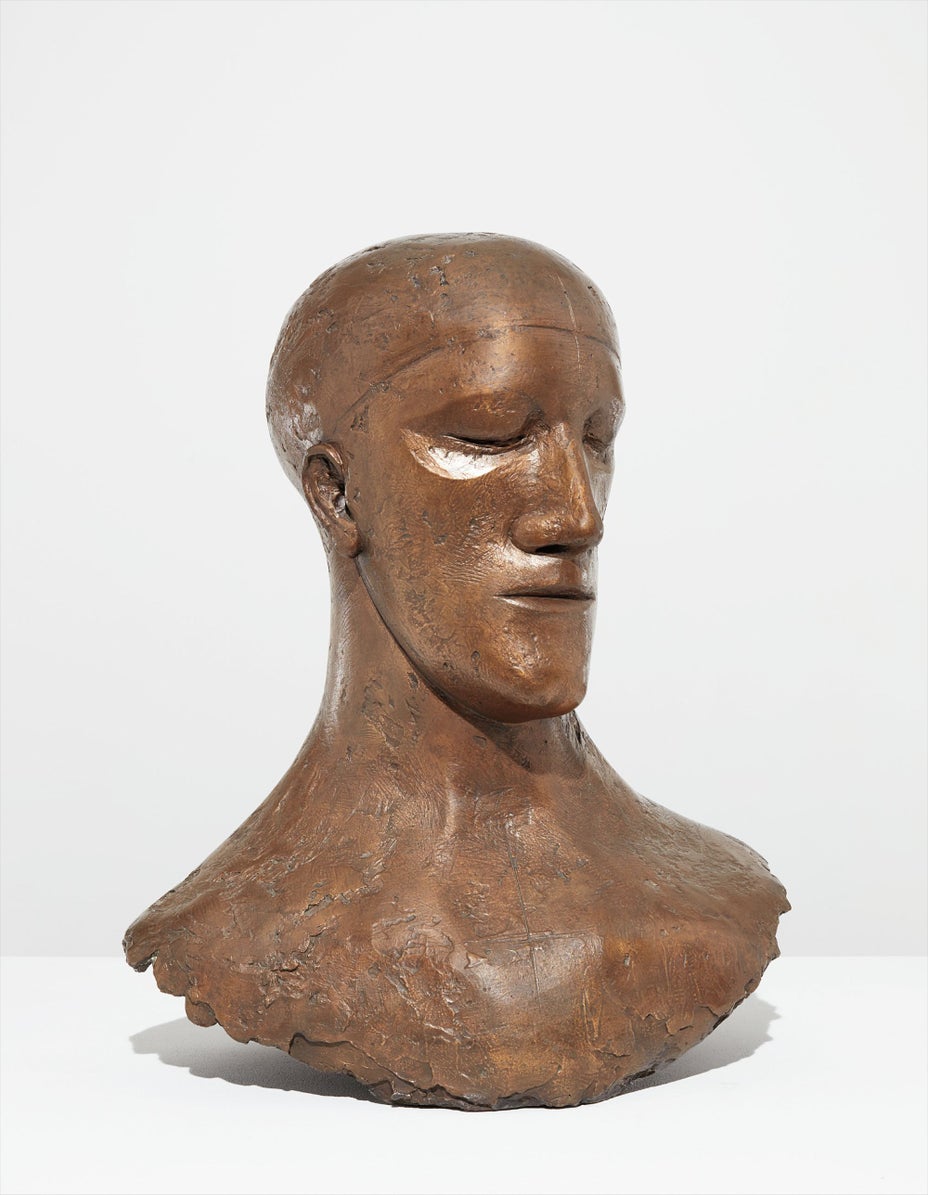
Elisabeth Frink’s Tribute II is a large-scale bronze head which combines the essentially brutish features of many of her antiheroic male figures with an intense pathos and tenderness, captured through its closed eyes. Tribute II was originally conceived in 1975 as one of a pair of related sculptures, which were soon joined by another couple. The four Tribute heads were to become some of Frink’s most successful and recognised sculptures. Despite being created in an edition of six, they were widely exhibited and published. At the same time, several have entered museum collections. Indeed, examples of Tribute II are held by Auckland Art Gallery and also the Dorset County Museum, near the home Frink made for herself at Woolland. Indeed, in her gardens at Woolland, Frink had a full set of the four Tributes on display, underscoring their importance to her.
For over two decades, Frink’s sculptures had often explored weighty subjects through the male form. Some of these were ravaged figures, or sinister ones, revealing the mark left upon the artist by the Second World War, which became the backdrop to her her childhood. Frink’s own father was a professional soldier who had been evacuated at Dunkirk. His features are seen by some to haunt the large-scale heads that Frink created. The legacy of Frink’s father was all the more current in 1975, as it was only two years earlier that he had died, leaving a vast chasm in her life.
Frink’s earlier heads convey the cost of war, played out in the gnarled texture of their visages. During the following decades, many of her figures had gradually become smoother and fuller, as is the case in Tribute II. Here, there is a sense of hope and plenty lurking underneath the apparent pain writ upon the face. The closed eyes and tilt of the head indicate that this is some form of male counterpart to the Pietà, a comparison perhaps all the more apt as the Tribute sculptures were created in the wake of a number of commissions, including several religious ones that had seen Frink mining her Catholic upbringing for her subject matter and treatment. This notion of religion, and of redemption, must have been prominent in Frink’s mind at the time, as she herself said of the Tribute heads:
‘They are perhaps a comment on where we’re heading: as far as I can see, towards a new dark age in human relations. They are about peace and freedom of spirit: people who have been through the horrors and got through to the other side. They are not political prisoners, but maybe they were’ (Frink, quoted in A. Ratuszniak (ed.), Elisabeth Frink: Catalogue Raisonné of Sculpture 1947-93, London, 2013, p. 130).
The link to political prisoners related to one of Frink’s great, more current, concerns: she was a supporter of Amnesty International, and linked the Tribute series to that organisation. Discussing these heads in terms that remain current to this day, she explained that they were, ‘for those people who are living under repressive regimes, who are not allowed freedom of thought, who are being persecuted for their politics or religion, or being deprived of the dignity of daily living and working. The heads are compassionate yet defiant. I hope they represent suffering and survival. And finally the optimism to go through suffering to the other side’ (Frink, quoted in Stephen Gardiner, Frink: The Official Biography of Elisabeth Frink, London, 1998, p. 205). That defiance is delineated in the heavy set and colossal features of this head, which is timeless, classical and yet ultimately modern.
Tribute II and its sister works were shown shortly after their creation in an exhibition that took place at the Terry Dintenfass Gallery in New York. Reviewing that show, the critic Hilton Kramer wrote in terms that clearly relate to this sculpture:
‘Miss Frink’s work is very definitely and unequivocally sculpture as we used to understand the term… It encompasses large emotions. It is cast in bronze, and is very beautifully made. It does not shrink from attempting the heroic mode. It is sculpture in the grand tradition... Elisabeth Frink is the real thing—a sculptor of large powers essaying large themes’ (Hilton Kramer, ‘Art: A Sculptor in Grand Tradition’, The New York Times, 2 February 1979, p. 21, quoted in Julian Spalding, ‘Frink: Catching the Nature of Life’, pp. 9-23, Ratuszniak (ed.), loc. cit., 2013, p. 110).
For over two decades, Frink’s sculptures had often explored weighty subjects through the male form. Some of these were ravaged figures, or sinister ones, revealing the mark left upon the artist by the Second World War, which became the backdrop to her her childhood. Frink’s own father was a professional soldier who had been evacuated at Dunkirk. His features are seen by some to haunt the large-scale heads that Frink created. The legacy of Frink’s father was all the more current in 1975, as it was only two years earlier that he had died, leaving a vast chasm in her life.
Frink’s earlier heads convey the cost of war, played out in the gnarled texture of their visages. During the following decades, many of her figures had gradually become smoother and fuller, as is the case in Tribute II. Here, there is a sense of hope and plenty lurking underneath the apparent pain writ upon the face. The closed eyes and tilt of the head indicate that this is some form of male counterpart to the Pietà, a comparison perhaps all the more apt as the Tribute sculptures were created in the wake of a number of commissions, including several religious ones that had seen Frink mining her Catholic upbringing for her subject matter and treatment. This notion of religion, and of redemption, must have been prominent in Frink’s mind at the time, as she herself said of the Tribute heads:
‘They are perhaps a comment on where we’re heading: as far as I can see, towards a new dark age in human relations. They are about peace and freedom of spirit: people who have been through the horrors and got through to the other side. They are not political prisoners, but maybe they were’ (Frink, quoted in A. Ratuszniak (ed.), Elisabeth Frink: Catalogue Raisonné of Sculpture 1947-93, London, 2013, p. 130).
The link to political prisoners related to one of Frink’s great, more current, concerns: she was a supporter of Amnesty International, and linked the Tribute series to that organisation. Discussing these heads in terms that remain current to this day, she explained that they were, ‘for those people who are living under repressive regimes, who are not allowed freedom of thought, who are being persecuted for their politics or religion, or being deprived of the dignity of daily living and working. The heads are compassionate yet defiant. I hope they represent suffering and survival. And finally the optimism to go through suffering to the other side’ (Frink, quoted in Stephen Gardiner, Frink: The Official Biography of Elisabeth Frink, London, 1998, p. 205). That defiance is delineated in the heavy set and colossal features of this head, which is timeless, classical and yet ultimately modern.
Tribute II and its sister works were shown shortly after their creation in an exhibition that took place at the Terry Dintenfass Gallery in New York. Reviewing that show, the critic Hilton Kramer wrote in terms that clearly relate to this sculpture:
‘Miss Frink’s work is very definitely and unequivocally sculpture as we used to understand the term… It encompasses large emotions. It is cast in bronze, and is very beautifully made. It does not shrink from attempting the heroic mode. It is sculpture in the grand tradition... Elisabeth Frink is the real thing—a sculptor of large powers essaying large themes’ (Hilton Kramer, ‘Art: A Sculptor in Grand Tradition’, The New York Times, 2 February 1979, p. 21, quoted in Julian Spalding, ‘Frink: Catching the Nature of Life’, pp. 9-23, Ratuszniak (ed.), loc. cit., 2013, p. 110).