33
Edward Weston
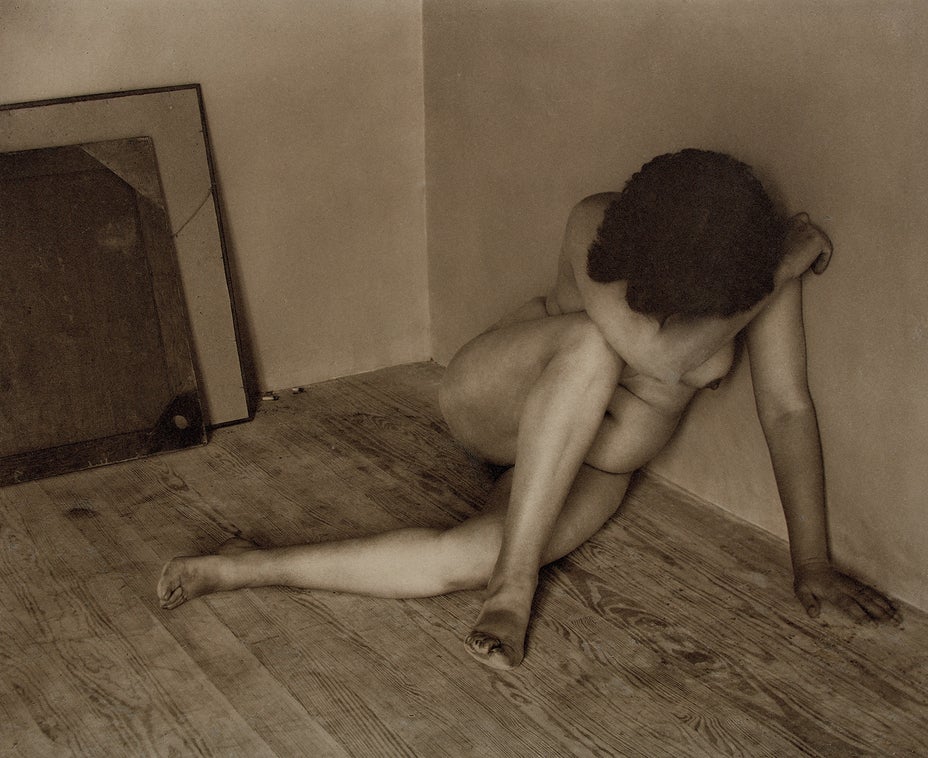
Nude in Studio
Estimate
$25,000–35,000
1920s
Palladium print.
6 1/2 x 7 7/8 in. (16.5 x 20 cm)
Annotated '5.00' (crossed out) and '4.00' in pencil on the verso.
Full-Cataloguing
This Edward Weston photograph, previously unknown, was originally acquired from the photographer by Toyo Miyatake, a Japanese-American photographer who lived in Los Angeles. At the time, Weston operated a studio in nearby Tropico (now Glendale) and he and Miyatake were drawn together by their shared interests. As they became friends and colleagues, Weston began to establish a following within Los Angeles’s Japantown. Miyatake was a founding member of Shakudo-Sha, an association devoted to the promotion of arts and literature in the Japanese community, and the group sponsored an exhibition of Weston’s photographs in 1925. The show was a financial success, and an overjoyed Weston wrote to his fellow photographer Johan Hagemeyer, ‘I showed in the Japanese quarter—East 1st Street for three days—sold $140.00 worth of prints,’ noting that ‘the curiosity seekers amongst “society”’ would never had bought so strongly (Conger, p. 13). Shakudo-Sha organized three exhibitions of Weston’s work between 1925 and 1931, providing much needed income for the perennially cash-strapped photographer and helping fund his extended residencies in Mexico.
In 1942 Miyatake was imprisoned at Manzanar internment camp along with thousands of other Japanese-Americans. Unbeknownst to authorities, he smuggled in lenses, fabricated a camera body, and began making pictures that documented the life of the camp. While he started his work surreptitiously he ultimately was granted permission to photograph in the camp; his images remain a potent document of this chapter of American history.
The photograph offered here was likely made in one of Weston’s studios in Mexico City. A similar setting can be seen in his 1924 portraits of Rafael Sala and Felipe Texidor. The unconventional pose of the nude within Weston’s taut and highly ordered composition bears a similarity to his nudes of Anita Brenner, Miriam Lerner, Tina Modotti and others made during the early 1920s. This photograph now takes a place within that formative phase of Weston’s career.
As of this writing, no other print of this image has been located.
In 1942 Miyatake was imprisoned at Manzanar internment camp along with thousands of other Japanese-Americans. Unbeknownst to authorities, he smuggled in lenses, fabricated a camera body, and began making pictures that documented the life of the camp. While he started his work surreptitiously he ultimately was granted permission to photograph in the camp; his images remain a potent document of this chapter of American history.
The photograph offered here was likely made in one of Weston’s studios in Mexico City. A similar setting can be seen in his 1924 portraits of Rafael Sala and Felipe Texidor. The unconventional pose of the nude within Weston’s taut and highly ordered composition bears a similarity to his nudes of Anita Brenner, Miriam Lerner, Tina Modotti and others made during the early 1920s. This photograph now takes a place within that formative phase of Weston’s career.
As of this writing, no other print of this image has been located.