843
Edouard Juvet
The Serpent Attack
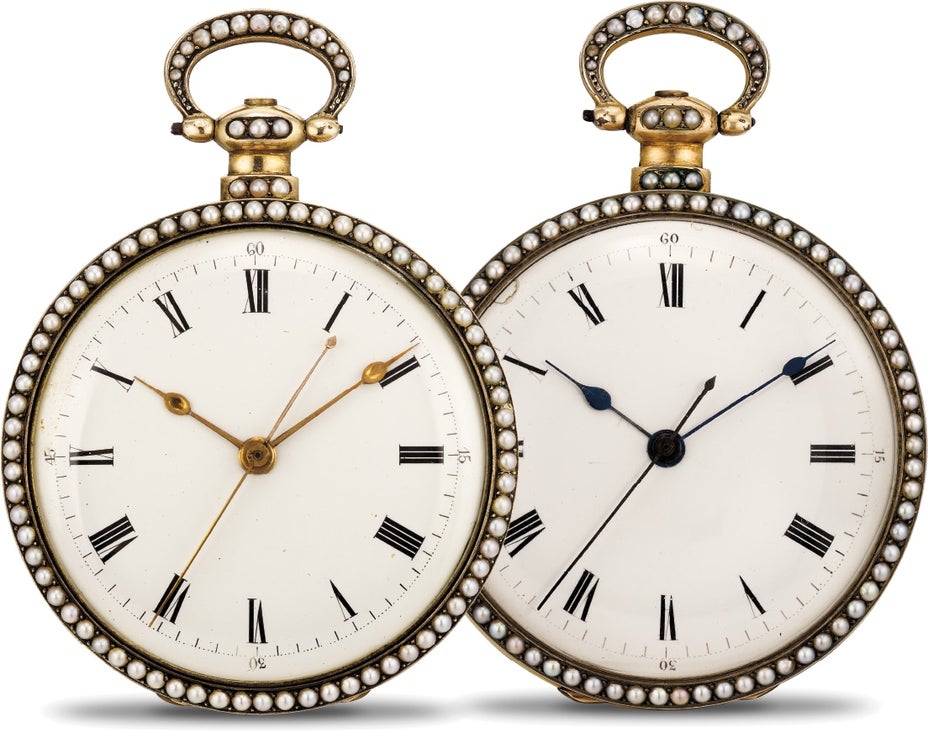
A very rare, exceptionally fine and attractive pair of silver gilt, enamel and pearl-set mirror-image open face center seconds duplex watches with presentation box and winding keys, made for the Chinese market
Estimate
HK$165,000–250,000
€18,200–27,500
$21,200–32,100
Sold For
HK$1,250,000
Manufacturer
Edouard Juvet
Year
Circa 1850
Movement No
44007 and 44008
Case No
44007 and 44008, cuvette on the second also numbered 08
Model Name
The Serpent Attack
Material
Silver gilt, enamel and pearl
Calibre
Manual, duplex movement
Dimensions
Each 57mm. Diameter
Signed
Both movements signed, both movements and cases numbered
Accessories
With later wooden presentation box and winding and setting keys
Full-Cataloguing
The arrival of Matteo Ricci, a Jesuit priest, in Macau in 1552 may have gone little noticed in the annals of history except for the fact that his admiration and respect for the Chinese culture lead him to study classical Chinese becoming fluent in both the spoken and written forms. As a missionary and scholar in astronomy and cosmology he became known for his scholarship and skills in particular pertaining to solar eclipses. With his speaking abilities, he became the first European to enter the Forbidden City (1601) as an invited counselor to the emperor. Upon his death in 1610, the Wanli Emperor was petitioned to allow Ricci’s body to be buried in Beijing, which at the time prohibited the burial of foreigners. Ricci brought to the Chinese court many riches from the western world, and two that became most cherished were chiming mechanical clocks and enameled pocket watches. The popularity of these fine enamel timepieces became so great that in time there arose an industry for pieces made for the “Chinese Market”.
First during the 18th century, manufacturing of these ornate timepieces was centered in England, however by the 19th century the center shifted to Switzerland. The movements were made with decorative and intricate engraved designs appealing to Chinese tastes, and become known as “Chinese Calibers”. Additionally, the cases were decorated in exquisite and elaborate designs such as enamel florals or like the present lot, The Serpent Attack. These two fine watches from the mid-19th century are part of this long tradition. Represented in fine polychrome enamel, the hunt scene features a gentleman and woman in the howdah with a serpent springing from the jungle grass, the elephant firmly grasping the serpent, while the gentleman and driver defend the woman. Sequentially numbered, 44007 and 44008, these two watches have the same scene but when put side by side one realized they are mirror images of each other.
These two attractive pocket watches were made by Edouard Juvet (1820-1883), who originally had a workshop in Buttes Switzerland, but later moved his atelier to Fleurier in 1844. Known for his high-quality enamel pocket watches, Juvet is part of a select group of skilled artisans that worked closely with the Chinese market, so much so that his two sons where based in Shanghai with later branches in Tianjin and Ho Chih Minh City.
While Chinese Market watches were originally made for the imperial court and nobility, overtime they became more commercialized and available to a larger audience. Today, Chinese enamel watches are highly collectible and desirable both for their exquisite beauty of design and technical duplex escapement.
First during the 18th century, manufacturing of these ornate timepieces was centered in England, however by the 19th century the center shifted to Switzerland. The movements were made with decorative and intricate engraved designs appealing to Chinese tastes, and become known as “Chinese Calibers”. Additionally, the cases were decorated in exquisite and elaborate designs such as enamel florals or like the present lot, The Serpent Attack. These two fine watches from the mid-19th century are part of this long tradition. Represented in fine polychrome enamel, the hunt scene features a gentleman and woman in the howdah with a serpent springing from the jungle grass, the elephant firmly grasping the serpent, while the gentleman and driver defend the woman. Sequentially numbered, 44007 and 44008, these two watches have the same scene but when put side by side one realized they are mirror images of each other.
These two attractive pocket watches were made by Edouard Juvet (1820-1883), who originally had a workshop in Buttes Switzerland, but later moved his atelier to Fleurier in 1844. Known for his high-quality enamel pocket watches, Juvet is part of a select group of skilled artisans that worked closely with the Chinese market, so much so that his two sons where based in Shanghai with later branches in Tianjin and Ho Chih Minh City.
While Chinese Market watches were originally made for the imperial court and nobility, overtime they became more commercialized and available to a larger audience. Today, Chinese enamel watches are highly collectible and desirable both for their exquisite beauty of design and technical duplex escapement.