125
Eberhard Scafograf
Ref. 11535
Scafograf 100
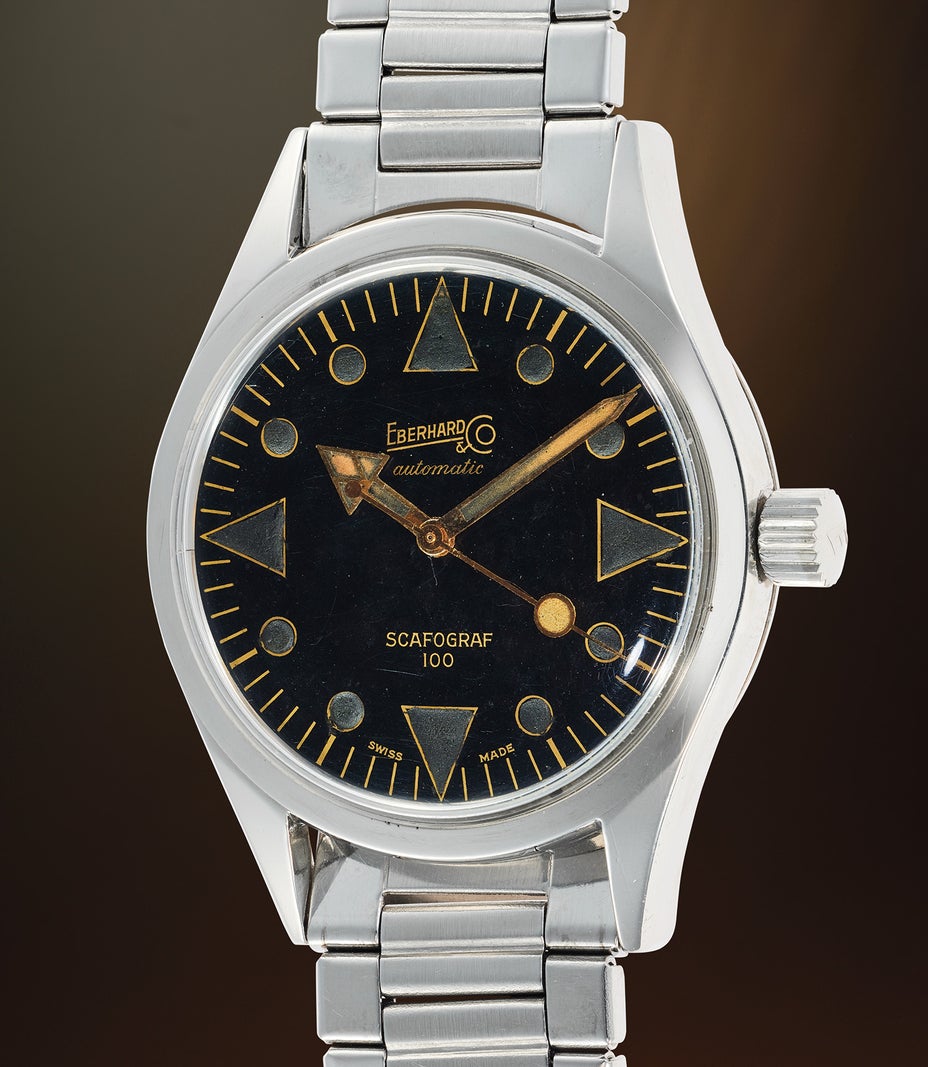
An interesting and extremely rare stainless steel diver’s wristwatch with black gilt dial, bracelet, presentation box, and factory presentation stand
Estimate
$8,000–16,000
Sold For
$13,970
Manufacturer
Eberhard Scafograf
Year
Circa 1960
Reference No
11535
Case No
253
Model Name
Scafograf 100
Material
Stainless steel
Calibre
Automatic, cal. 11500, 27 jewels
Bracelet/Strap
Stainless steel Eberhard bracelet
Clasp/Buckle
Stainless steel Eberhard deployant clasp, stamped 4.61
Dimensions
35mm Diameter
Signed
Case, dial, movement, and bracelet signed.
Accessories
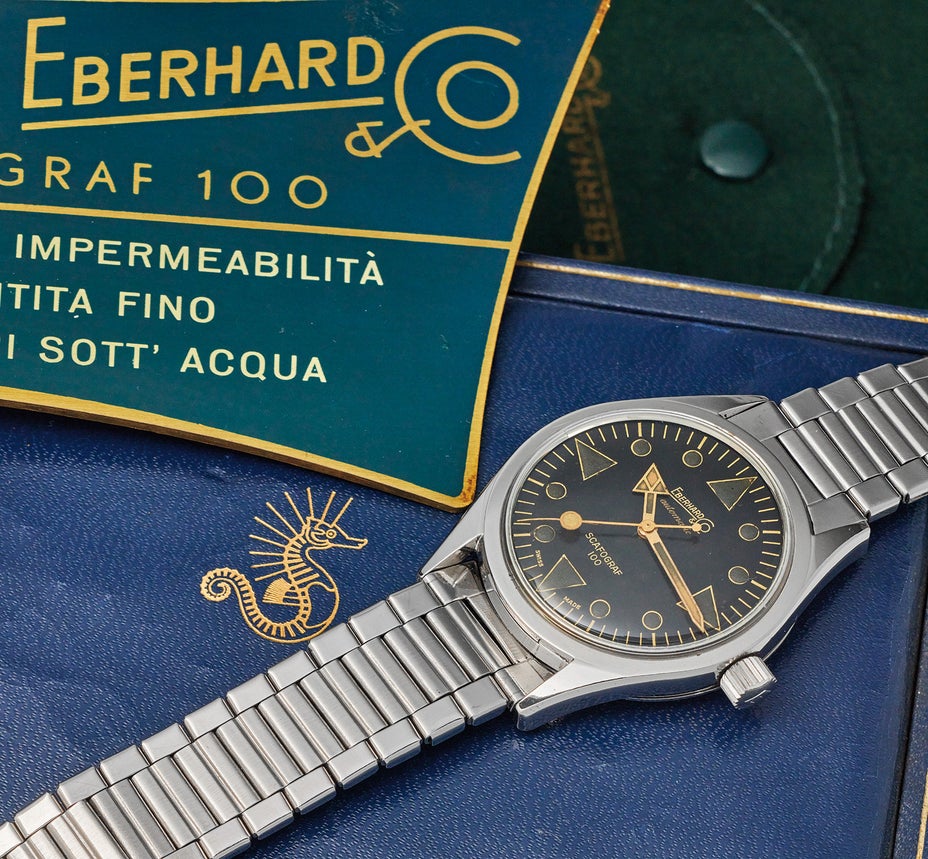
Accompanied by period Eberhard presentation box and Scafograf 100 brass presentation stand.
Full-Cataloguing
Eberhard & Co.’s origins begin in 1887 in La Chaux-de-Fonds, Switzerland, under the guidance of Georges Eberhard. In 1919, a mere three decades after its founding, Eberhard released not only its first chronograph wristwatch, but was also named official timepiece supplier to the Italian Royal Navy.
At the tail end of the 1950s, with the heyday of recreational and commercial diving well upon the world, the major manufacturers of timepieces set out to create the most reliable and functional wristwatch for undersea activities. These wristwatches all retain some common elements: black gilt dials, waterproof cases, larger case diameters, luminous material on the dial to improve visibility, and often an option for steel bracelets. The Rolex Submariner, the Blancpain Fifty Fathoms, and the Jaeger-LeCoultre DeepSea Alarm are some of the examples of this era of innovation – as is the Eberhard Scafograf. With the model name tradmarked in 1958, production began shortly thereafter. At first, the Scafograf featured “100” on the dial, as it was rated to a depth of 100 meters, but this soon became obsolete.
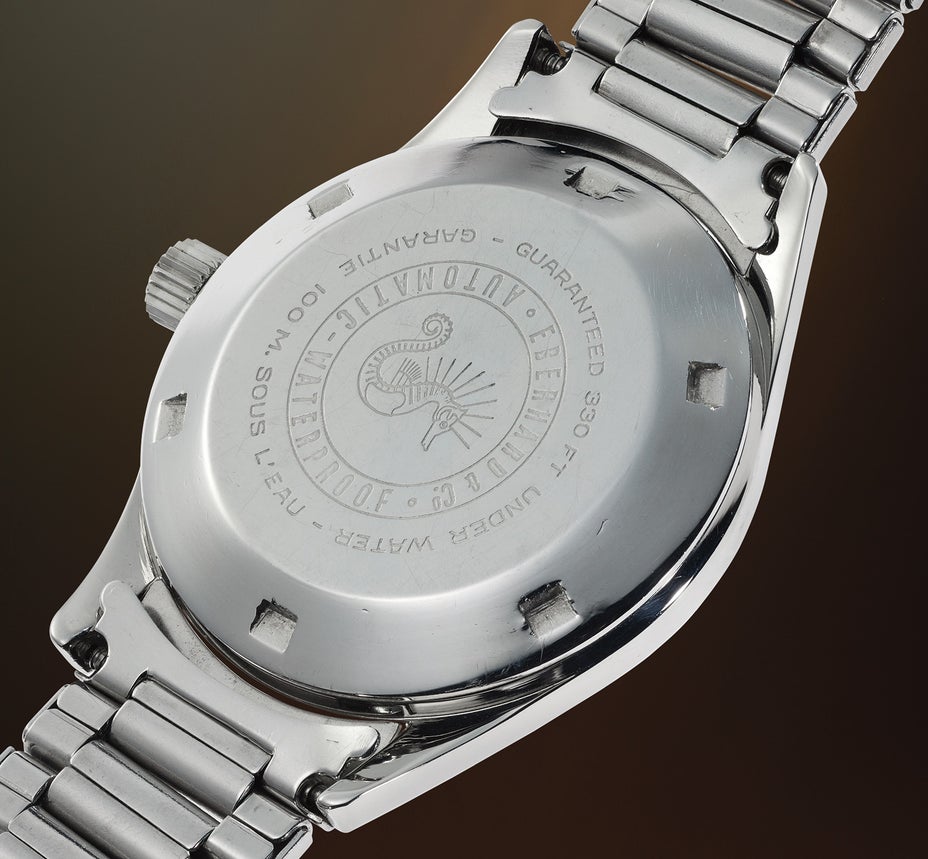
Thus, this Scafograf 100 with early case number is a part of the first series of Scafografs produced in the late 1950s and early 1960s. The original expandable stainless steel bracelet is dated to the fourth quarter of 1961, and signed Eberhard as well. The oversized, geometric hour markers, outlined in gilt and filled with luminous material, immediately draw the eye and set this model apart from its contemporaries. Charmingly, the beautiful engraving of a seahorse on the caseback is still deeply etched – it was later changed to a starfish.
Furthermore, the present watch is accompanied by its rarely ever seen original fitted presentation box, as well as an original dealer’s advertising stand for the model.
At the tail end of the 1950s, with the heyday of recreational and commercial diving well upon the world, the major manufacturers of timepieces set out to create the most reliable and functional wristwatch for undersea activities. These wristwatches all retain some common elements: black gilt dials, waterproof cases, larger case diameters, luminous material on the dial to improve visibility, and often an option for steel bracelets. The Rolex Submariner, the Blancpain Fifty Fathoms, and the Jaeger-LeCoultre DeepSea Alarm are some of the examples of this era of innovation – as is the Eberhard Scafograf. With the model name tradmarked in 1958, production began shortly thereafter. At first, the Scafograf featured “100” on the dial, as it was rated to a depth of 100 meters, but this soon became obsolete.
Thus, this Scafograf 100 with early case number is a part of the first series of Scafografs produced in the late 1950s and early 1960s. The original expandable stainless steel bracelet is dated to the fourth quarter of 1961, and signed Eberhard as well. The oversized, geometric hour markers, outlined in gilt and filled with luminous material, immediately draw the eye and set this model apart from its contemporaries. Charmingly, the beautiful engraving of a seahorse on the caseback is still deeply etched – it was later changed to a starfish.
Furthermore, the present watch is accompanied by its rarely ever seen original fitted presentation box, as well as an original dealer’s advertising stand for the model.