36Ο︎◆︎
David Hammons
African American Flag
85 3/4 x 55 5/8 in. (217.8 x 141.3 cm.)
Another example from the edition is in the permanent collection of The Museum of Modern Art, New York.
Full-Cataloguing
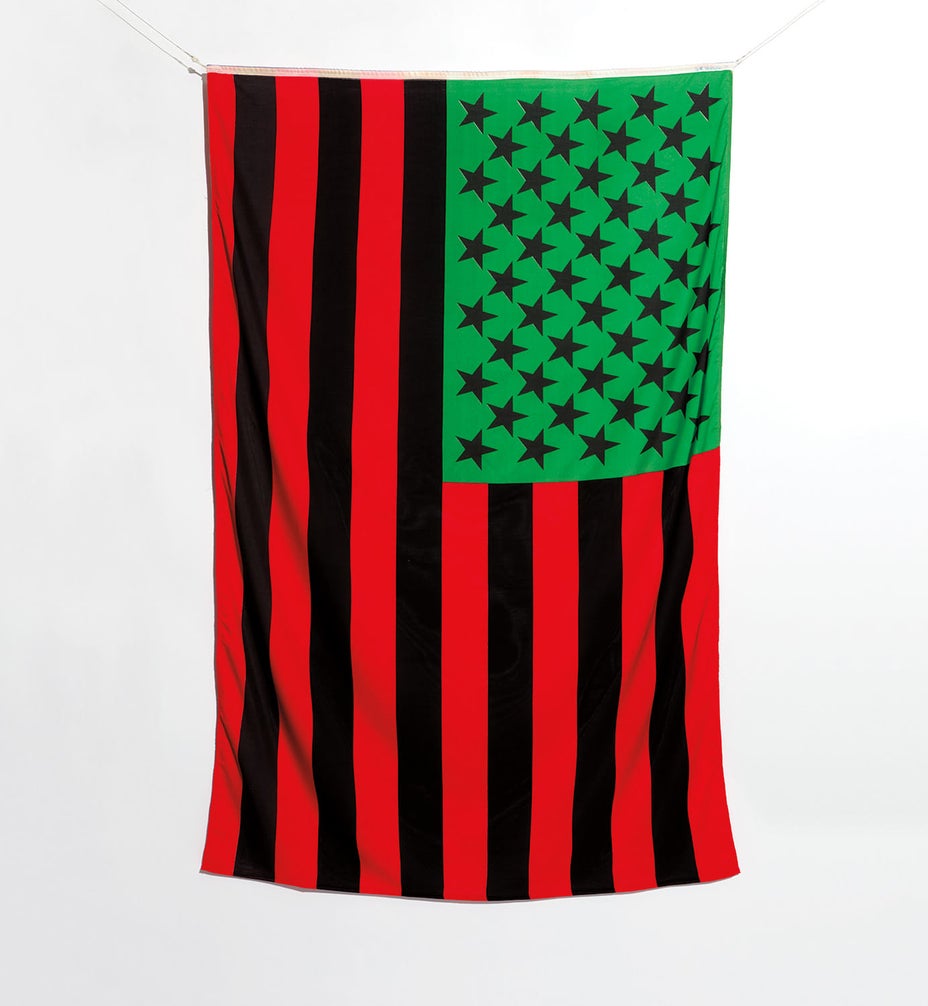
Ten years after its debut, African American Flag entered the pantheon of art history when the Museum of Modern Art, New York, showcased their example next to Jasper Johns’ Flag, 1954-1955, in the Open Ends: Pop and After exhibition in 2000–2001. While there are parallels to Johns’ use of the public symbol, Hammons transformed it with a disruptive approach he described “somewhere between Marcel Duchamp, Outsider art, and Arte Povera” that he had been pursuing since moving to Harlem in the mid-1970s (David Hammons, quoted in Casinò fantasma, exh. cat., The Institute for Contemporary Art, P.S. 1, Venice, 1990, n.p.). Hammons disarms and deconstructs the symbol of the American flag, not to empty it of meaning, but to convey its expanded and fluid scope and imbue it with sharp socio-political commentary.
African American Flag represents Hammons’ return to the loaded motif that had featured two eventful decades earlier in his breakthrough series of body prints. Confronting the burgeoning climate of late 1960s and early 1970s black nationalism, Hammons assertively combined imprints of his body and the American flag. Unflinchingly throwing the virtues of “liberty and the pursuit of happiness” into question, he indicted it, “as a symbol of America’s unkept promises to, and violence against African Americans” (Kellie Jones, David Hammons Rousing the Rubble, exh. cat., The Institute for Contemporary Art, P.S. 1, New York, 1991, p. 16).
These undercurrents continue to inform the present work, yet the combination of the iconography of the United States flag with the symbolism of the Pan-African Flag’s colors transforms it into a more ambivalent emblem. Designed by Marcus Garvey to represent the African diaspora in the colors of its three horizontal bands, the Pan-African flag’s red and black signify the shared blood and skin color, while the green alludes to Africa’s natural abundance. Adopted by the Universal Negro Improvement Association and African Communities League in 1920, it became a potent symbol affirming the existence of black diaspora as a nation, gaining popularity during the 1960s Black Liberation movement and serving as a model for the flags of newly independent countries such as Biafra and Kenya.
Hammons’ visual and linguistic sleight of hand results in an open-ended work of art that generates new meanings as the time and place of the viewer’s experience change. When Hammons created African American Flag for the Museum Overholland in 1990, he presented it outside on a mast pole on the Museumplein. Harkening back to Hammons’ street interventions, the work represented a strategic pendant to the United States Consulate flag flanking the public square. At that time, it had been just a few months since Nelson Mandela’s release from imprisonment under the South Africa’s Apartheid regime, a former Dutch colony, and the election of David Dinkins as the first black mayor of New York City. Coinciding with Mandela’s visit to Amsterdam that year, African American Flag put into focus both American and global histories of institutionalized racism, colonialism, and the struggle for independence; but also offered a novel symbol of transformation and possibility.
Nearly 30 years later, in times of racial injustice, inequality and growing nationalism, African American Flag maintains enduring, universal relevance. “It is not only an artwork,” as artist Thomas Hirschhorn indeed summarized, “it is a flag for a new nation, a flag for a new insight, it is a new flag for a new form and a new truth. David Hammons creates a new truth - what more can art do?” (Thomas Hirschhorn, Stiftung Sommerakademie im Zentrum Paul Klee Reader, Bern, 2016, online).
David Hammons
American | 1943Few artists are afforded the liberty to dictate exhibition schedules and public appearances, but David Hammons eschews the spotlight and rebels against the conventions of the art world. Whether intentionally or not, Hammons creates works so laden with spell-binding metaphor that they have become symbols for movements both in the art world as well as in the public domain. (His now-iconic In the Hood sculpture has been used by Black Lives Matter activist group.)
Hammons doesn't work in mediums or any formal or academic theory—he famously has said, "I can't stand art actually." Still, with controversial works including his PETA-paint-splashed Fur Coat sculpture, Hammons remains one of contemporary art's most watched artists. Hammons also doesn't frequently exhibit, and his last major gallery show, 2016's "Five Decades," only featured 34 works. With a controlled market, Hammons saw Untitled, a basketball hoop with dangling candelabra, achieve $8 million at Phillips in 2013.