25
Damien Hirst
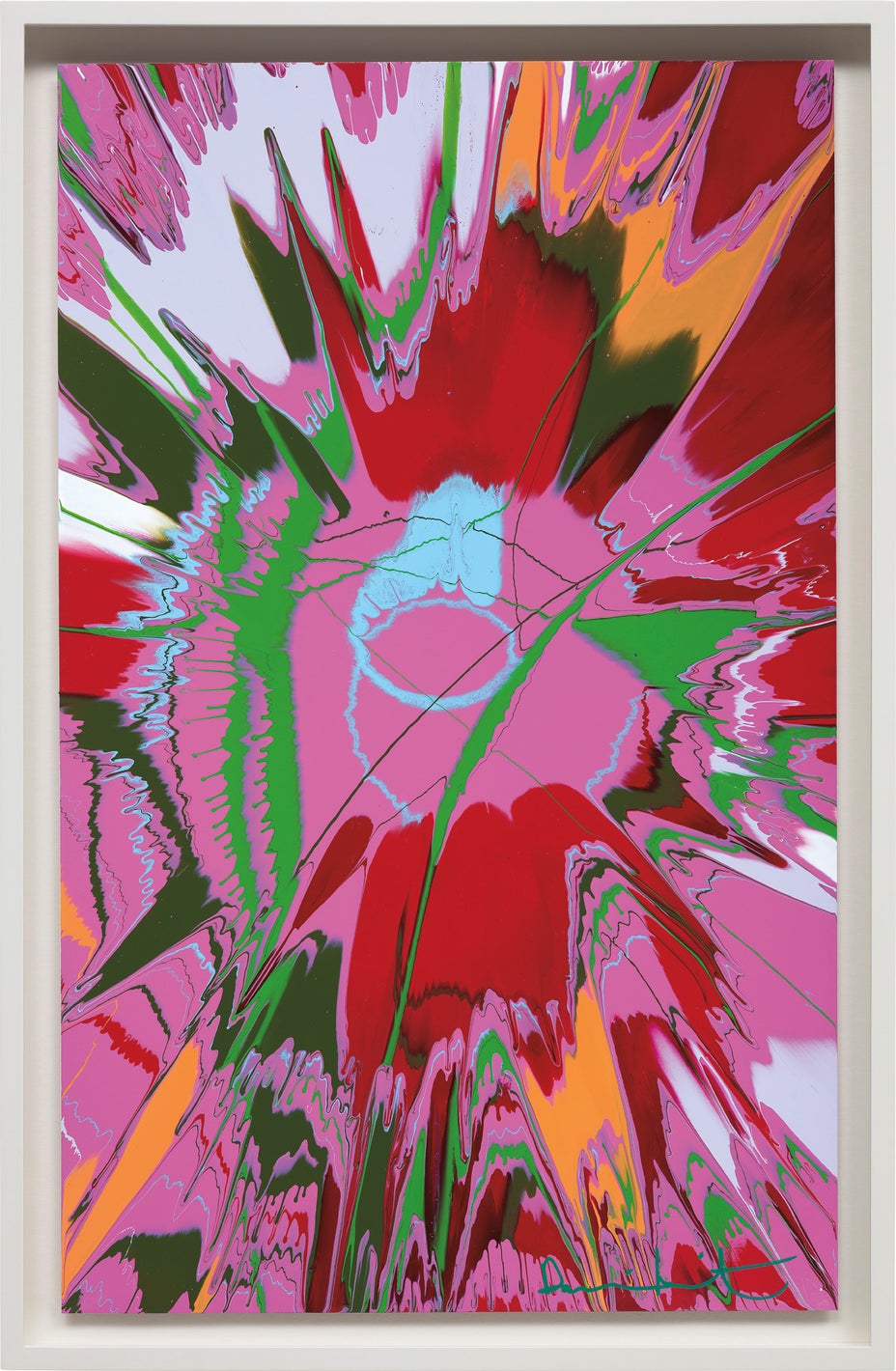
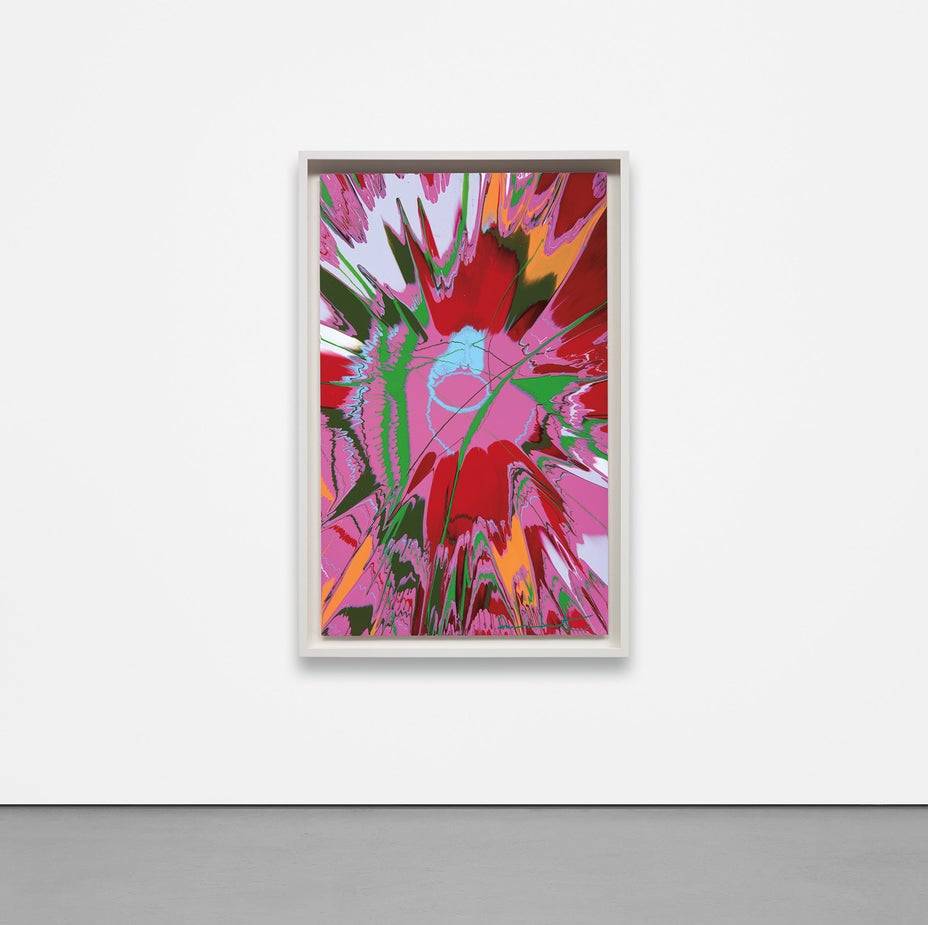
Beautiful If At First You Don't Succeed Then Try, Try Again, One More Time, It's Done Spinning Painting
Full-Cataloguing
In 1988, Damien Hirst orchestrated an exhibition entitled Freeze in an abandoned warehouse in London, and became the principal author of a novel artistic language. Constituting the backdrop of the artist’s daring imagination, Freeze was the inaugural event of the artistic phenomenon which swiftly became known as Young British Art. Auctioned to benefit the Serpentine, the delectably colour-splashed Beautiful If At First You Don’t Succeed Then Try, Try Again, One More Time, It’s Done, Spinning Painting, 2008, is an enthralling example of Hirst’s painterly universe, built off the back of his inextricably YBA-DNA. Forming part of his series of spin paintings – which he began experimenting with in 1992, and officially embarked on in 1994 – the work bears an idiosyncratically elongated title, which, like all other works from the series, begins with ‘Beautiful’ and ends with ‘Painting’. It is composed of amorphous masses of red, green, orange and white on a backdrop of hot-pink household gloss, altogether conjuring a wondrous and vivacious explosion that departs from the artist’s usual intentness on order, repetition, and quasi-scientific formulaism. Unlike Hirst’s infamous medicine cabinets, spot and kaleidoscope paintings, which all rely on the neat arrangement of repeated patterns, the spin paintings are controlled solely by the motion of a machine. They are ‘childish… in the positive sense of the word’, the artist has said (Damien Hirst, quoted in Stuart Morgan, ‘An Interview with Damien Hirst’, 1995, reproduced online). They conjure a gem or candy-like visual universe that seems to spin forevermore – even in their final state. The result of daring spontaneity and dizzying movement, Beautiful If At First You Don’t Succeed Then Try, Try Again, One More Time, It’s Done, Spinning Painting brims with dynamism on an intimate scale.
Damien Hirst
British | 1965There is no other contemporary artist as maverick to the art market as Damien Hirst. Foremost among the Young British Artists (YBAs), a group of provocative artists who graduated from Goldsmiths, University of London in the late 1980s, Hirst ascended to stardom by making objects that shocked and appalled, and that possessed conceptual depth in both profound and prankish ways.
Regarded as Britain's most notorious living artist, Hirst has studded human skulls in diamonds and submerged sharks, sheep and other dead animals in custom vitrines of formaldehyde. In tandem with Cheyenne Westphal, former Chairman of Phillips, Hirst controversially staged an entire exhibition directly for auction with 2008's "Beautiful Inside My Head Forever," which collectively totalled £111 million ($198 million).
Hirst remains genre-defying and creates everything from sculpture, prints, works on paper and paintings to installation and objects. Another of his most celebrated series, the 'Pill Cabinets' present rows of intricate pills, cast individually in metal, plaster and resin, in sterilized glass and steel containers; Phillips New York showed the largest of these pieces ever exhibited in the United States, The Void, 2000, in May 2017.