
Property from an Important European Collection
34
Damien Hirst
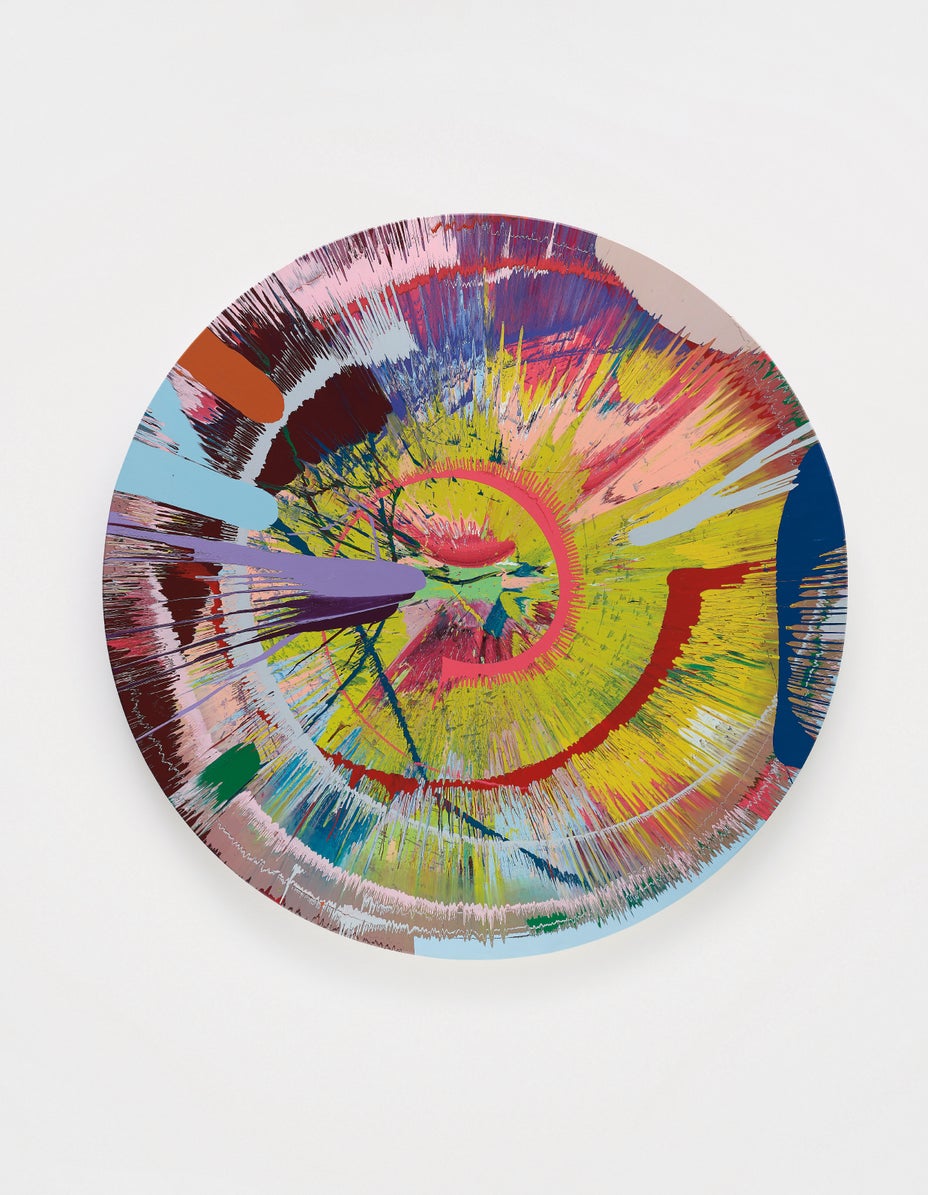
Beautiful, Half a Red Headless Centipede (Painting)
- Estimate
- £250,000 - 350,000‡♠
£273,000
Lot Details
household gloss on canvas
signed 'D Hirst' on the reverse; further signed 'Damien Hirst' on the stretcher
diameter 213.2 cm (83 7/8 in.)
Painted in 2001.
Specialist
Full-Cataloguing
Catalogue Essay
Damien Hirst’s Beautiful, Half a Red Headless Centipede (Painting) captivates viewers with a kaleidoscopic display of colour and a frenetic energy. Harkening back to Hirst’s youth in the 1970s, the psychedelic composition is the result of a dynamic process whereby the artist adds layer after layer of pigment to the spinning circular canvas. Hirst began his Spin series in the early 1990s at a time when he was still emerging as one of the leading Young British Artists (YBAs), having recently graduated from Goldsmiths, first coming to public attention when he conceived and curated the ground breaking Freeze exhibition in 1988. In 1992, the same year Hirst's work was included Charles Saatchi’s Young British Artists exhibition and shortlisted for the Turner Prize, he created his first spin painting and in the following year set up a spin art stall with his fellow artist Angus Fairhurst at Joshua Compston’s artist-led street fair, A Féte Worse than Death. When Hirst started the Spin series in earnest in 1994 on circular shaped canvases, they became one of the most instantly recognisable and popular series to date.
Created in parallel to Hirst’s large-scale installations, the spin paintings demonstrate the artist’s enduring interest in the concept of mechanical intervention that he pursued alongside his Spot Paintings. Hirst recalled how a motorised cardboard spinning machine of his childhood inspired this series, explaining, ‘I never thought it was real art… And then as I got older…I just thought: 'Why does it have to be like that?' I thought: 'No, actually, the better art is the art made with the spin machine’ (Damien Hirst, quoted in The Guardian, 29 August 2011, online).
To produce large-scale works such as the present one, paint is poured from immense height onto large canvases while they are rotated at high speed by a machine in the artist’s studio. Hirst controls the result of his spins purely by his choice of colour and the motion of the machine, this embrace of chance presenting a stark contrast to the meticulous process behind his spot paintings. While referencing Marcel Duchamp’s optical experiments created using rotating machine references from the 1920s and 30s, Hirst focusses on the source of joy that is inherent in movement, describing the Spin series as ‘childish…in the positive sense of the word…I really like making them. And I really like the machine, and I really like the movement. Every time they’re finished, I’m desperate to do another one' (Damien Hirst, quoted in On the Way to Work, London, 2001, p. 221).
Created in parallel to Hirst’s large-scale installations, the spin paintings demonstrate the artist’s enduring interest in the concept of mechanical intervention that he pursued alongside his Spot Paintings. Hirst recalled how a motorised cardboard spinning machine of his childhood inspired this series, explaining, ‘I never thought it was real art… And then as I got older…I just thought: 'Why does it have to be like that?' I thought: 'No, actually, the better art is the art made with the spin machine’ (Damien Hirst, quoted in The Guardian, 29 August 2011, online).
To produce large-scale works such as the present one, paint is poured from immense height onto large canvases while they are rotated at high speed by a machine in the artist’s studio. Hirst controls the result of his spins purely by his choice of colour and the motion of the machine, this embrace of chance presenting a stark contrast to the meticulous process behind his spot paintings. While referencing Marcel Duchamp’s optical experiments created using rotating machine references from the 1920s and 30s, Hirst focusses on the source of joy that is inherent in movement, describing the Spin series as ‘childish…in the positive sense of the word…I really like making them. And I really like the machine, and I really like the movement. Every time they’re finished, I’m desperate to do another one' (Damien Hirst, quoted in On the Way to Work, London, 2001, p. 221).
Provenance
Damien Hirst
British | 1965There is no other contemporary artist as maverick to the art market as Damien Hirst. Foremost among the Young British Artists (YBAs), a group of provocative artists who graduated from Goldsmiths, University of London in the late 1980s, Hirst ascended to stardom by making objects that shocked and appalled, and that possessed conceptual depth in both profound and prankish ways.
Regarded as Britain's most notorious living artist, Hirst has studded human skulls in diamonds and submerged sharks, sheep and other dead animals in custom vitrines of formaldehyde. In tandem with Cheyenne Westphal, former Chairman of Phillips, Hirst controversially staged an entire exhibition directly for auction with 2008's "Beautiful Inside My Head Forever," which collectively totalled £111 million ($198 million).
Hirst remains genre-defying and creates everything from sculpture, prints, works on paper and paintings to installation and objects. Another of his most celebrated series, the 'Pill Cabinets' present rows of intricate pills, cast individually in metal, plaster and resin, in sterilized glass and steel containers; Phillips New York showed the largest of these pieces ever exhibited in the United States, The Void, 2000, in May 2017.
Browse ArtistRegarded as Britain's most notorious living artist, Hirst has studded human skulls in diamonds and submerged sharks, sheep and other dead animals in custom vitrines of formaldehyde. In tandem with Cheyenne Westphal, former Chairman of Phillips, Hirst controversially staged an entire exhibition directly for auction with 2008's "Beautiful Inside My Head Forever," which collectively totalled £111 million ($198 million).
Hirst remains genre-defying and creates everything from sculpture, prints, works on paper and paintings to installation and objects. Another of his most celebrated series, the 'Pill Cabinets' present rows of intricate pills, cast individually in metal, plaster and resin, in sterilized glass and steel containers; Phillips New York showed the largest of these pieces ever exhibited in the United States, The Void, 2000, in May 2017.