25
Damien Hirst
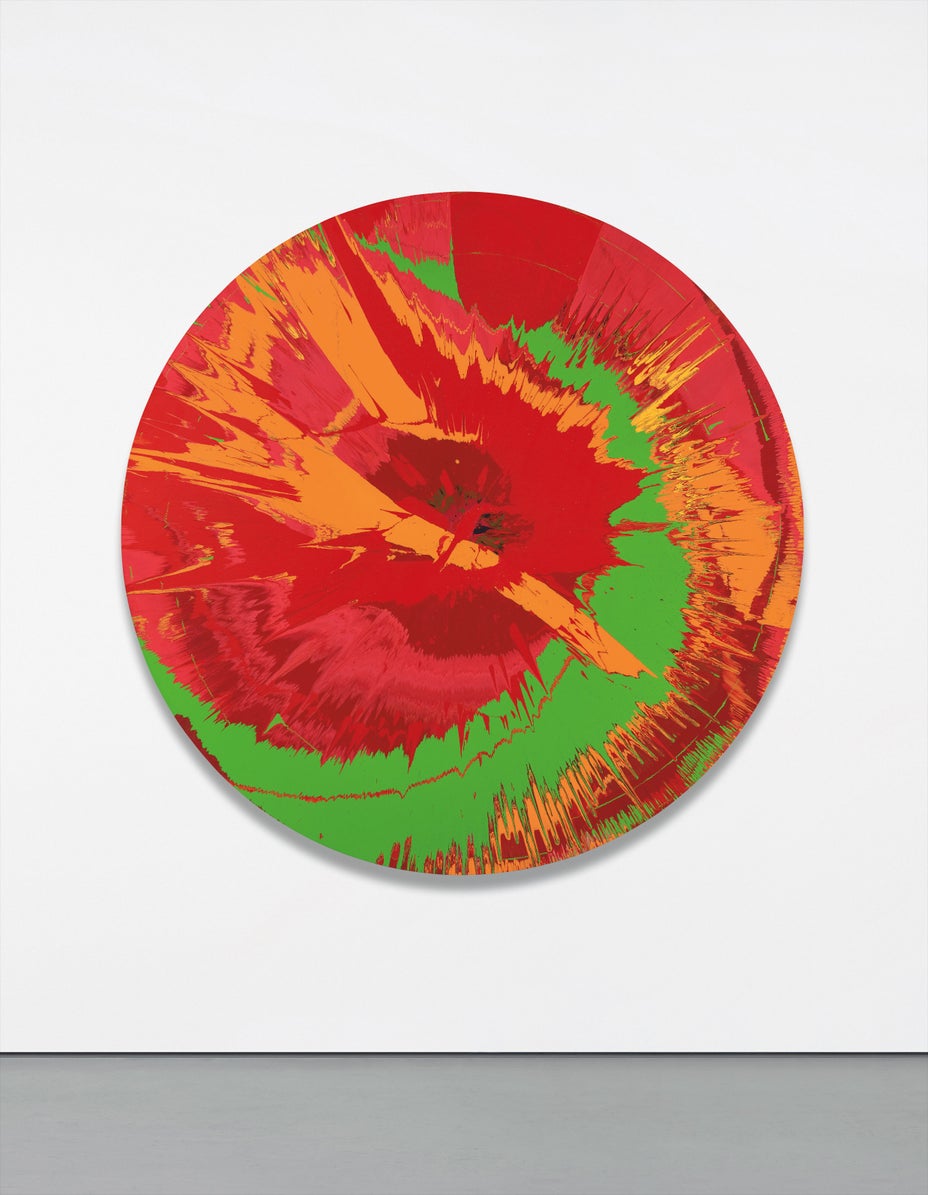
Beautiful Romance in the Age of Uncertainty Party Painting III
Full-Cataloguing
The artist describes the spin series as “childish… in the positive sense of the word.They are each given a playful, elongated title bookended by the words ‘Beautiful’ and ‘painting’." (Damien Hirst and Gordon Burn, On the Way to Work, Faber and Faber: 2001, 221) Hirst credits the inspiration for these works to seeing the spin technique as a child at a school fair. Despite the simplicity of its origins, Beautiful Romance in the Age of Uncertainty Party Painting III challenges the use of spontaneity and irreverence in art. The Spin Paintings form a foundational element of Hirst's artistic vocabulary, contributing to seminal exhibitions including his 2012 retrospective at Tate Modern.
Though the reliance on chance in the present lot provides a stark contrast to the meticulous process of Hirst’s other well-known series of spot paintings, both bodies of work deal with the concept of mechanical intervention. To produce these large-scale works, paint is poured from a height onto the large canvases as they are rotated at high speed by a machine in the artist’s studio. Hirst’s use of a rotating machine references the optical experiments of Marcel Duchamp from the 1920s and 30s. Although Duchamp employed spinning turntables and other motorised devices as a means of creating optical illusions, Hirst's contemporary use of the spin machine focuses on the joy inherent to movement. A prominent member of the influential Young British Artists of the late 1980s and 90s, Hirst has since become one of the most internationally acclaimed artists of his generation.
In Beautiful Romance in the Age of Uncertainty Party Painting III, Damien Hirst continues to encourage emotive, instinctual reactions to his work – here inciting feelings of glee and wonder.
Damien Hirst
British | 1965There is no other contemporary artist as maverick to the art market as Damien Hirst. Foremost among the Young British Artists (YBAs), a group of provocative artists who graduated from Goldsmiths, University of London in the late 1980s, Hirst ascended to stardom by making objects that shocked and appalled, and that possessed conceptual depth in both profound and prankish ways.
Regarded as Britain's most notorious living artist, Hirst has studded human skulls in diamonds and submerged sharks, sheep and other dead animals in custom vitrines of formaldehyde. In tandem with Cheyenne Westphal, former Chairman of Phillips, Hirst controversially staged an entire exhibition directly for auction with 2008's "Beautiful Inside My Head Forever," which collectively totalled £111 million ($198 million).
Hirst remains genre-defying and creates everything from sculpture, prints, works on paper and paintings to installation and objects. Another of his most celebrated series, the 'Pill Cabinets' present rows of intricate pills, cast individually in metal, plaster and resin, in sterilized glass and steel containers; Phillips New York showed the largest of these pieces ever exhibited in the United States, The Void, 2000, in May 2017.