52
Christopher Wool
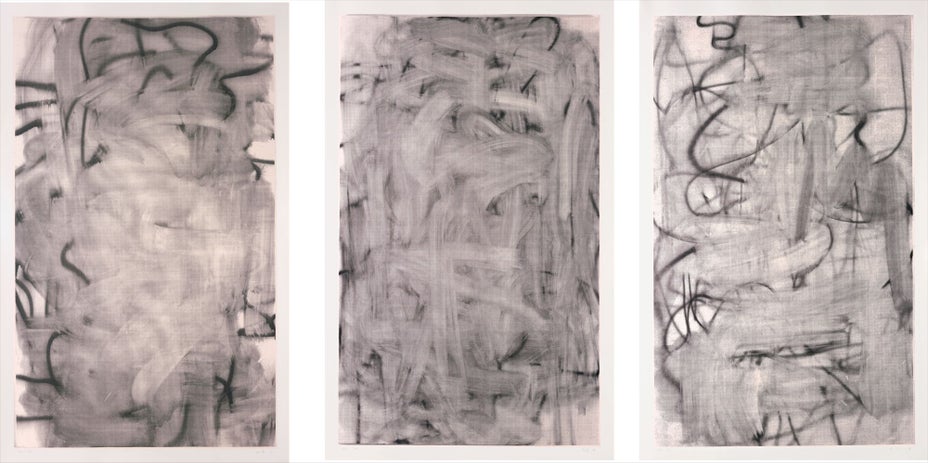
Three Women (Medium I, II, III)
Estimate
$250,000–350,000
Sold For
$449,000
2005
The complete set of three screenprints in colors, on Saunders Watercolor paper, with full margins,
all I. 74 x 45 in. (188 x 114.3 cm)
all S. 81 1/8 x 49 7/8 in. (206.1 x 126.7 cm)
all S. 81 1/8 x 49 7/8 in. (206.1 x 126.7 cm)
all signed, dated '2005', annotated 'I', 'II', and 'III' respectively and numbered `hc 2/2' in pencil (an hors commerce, the edition was 9 and 3 artist's proofs, in variant shades of light, medium and dark rose), published by Edition Schellmann, New York and Munich, all framed.
Full-Cataloguing
This series is titled Three Women, curious in that most of the artist’s works are untitled, including the text works. A clear reference to de Kooning’s paintings of Women of the late 40’s and early 50’s, Woman; Woman I; Woman I Continued; Woman II; Woman III; Woman IV; V; VI; Two Women; Two Women with Still Life; and all the Women that follow, there are hints of Lichtenstein’s Ben-Day dot “Girls” of the sixties, Crying Girl; Drowning Girl; Shipboard Girl; Girl in Mirror, perhaps also 3 Women, Robert Altman’s fascinating and hauntingly memorable film based on his own dream from 1977 with Sissy Spacek and Shelly Duvall.
Photography, erasure and addition, mark-making, blurring and wiping, physical acts of addition and reduction emphasizing any and all the formal qualities that we associate with paint medium are then immortalized in the act of screenprinting. The screenprint as a tool has always been frequently employed by the artist in the development of his paintings, particularly in the early floral works where the motifs were enlarged and layered, then later, as the artist began to self-appropriate previous works rendered in screenprint as starting points to new paintings. Here the edition of 9 was produced in varying shades of this rose color (light, medium, and dark), this example in the medium shade. These works are figurative in color and scale, although the drawing is obliterated to the point of flat abstraction, clearly appropriating the gesture of Abstract Expresionism although far from stale.
Glenn O’Brien poetically wrote in his essay Apocalypse and Wallpaper “It’s not abstract Expressionism for dummies. Wool has absorbed the whole enchilada of the 20th century and he refries afresh each time” *(Wool, Cologne: Taschen, 2012, p. 7)
Photography, erasure and addition, mark-making, blurring and wiping, physical acts of addition and reduction emphasizing any and all the formal qualities that we associate with paint medium are then immortalized in the act of screenprinting. The screenprint as a tool has always been frequently employed by the artist in the development of his paintings, particularly in the early floral works where the motifs were enlarged and layered, then later, as the artist began to self-appropriate previous works rendered in screenprint as starting points to new paintings. Here the edition of 9 was produced in varying shades of this rose color (light, medium, and dark), this example in the medium shade. These works are figurative in color and scale, although the drawing is obliterated to the point of flat abstraction, clearly appropriating the gesture of Abstract Expresionism although far from stale.
Glenn O’Brien poetically wrote in his essay Apocalypse and Wallpaper “It’s not abstract Expressionism for dummies. Wool has absorbed the whole enchilada of the 20th century and he refries afresh each time” *(Wool, Cologne: Taschen, 2012, p. 7)