24
Charlotte Perriand
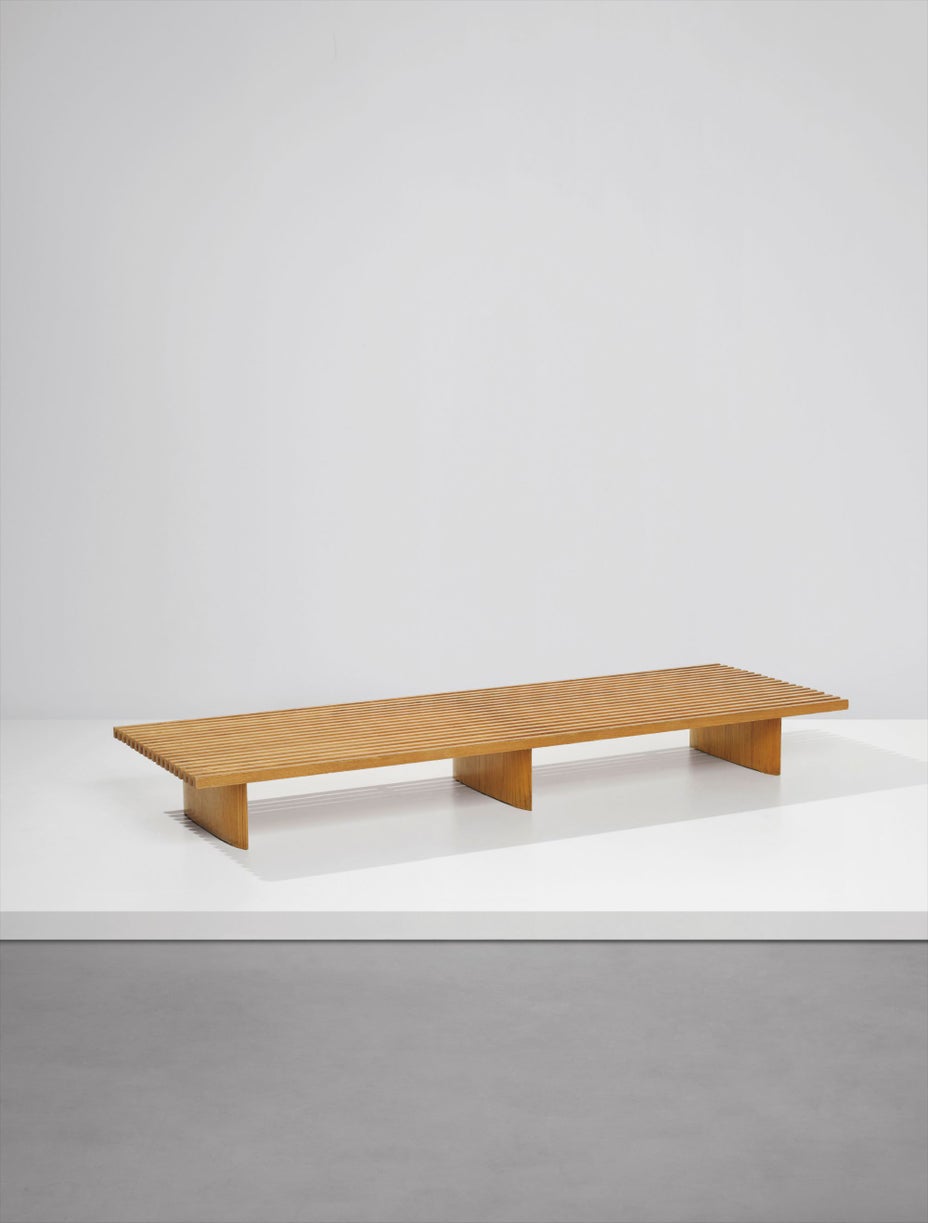
‘Tokyo’ bench
Full-Cataloguing
Charlotte Perriand
In June 1940, Charlotte Perriand embarked on a ship to Japan, leaving Paris just a few days before the Germans entered the city. Perriand had received an official invitation to cover the role of the official adviser to the Imperial Ministry of Commerce from her friend and collaborator Junzo Sakakura, whom she had met a decade earlier whilst working at Le Corbusier's studio. To this unforeseen opportunity she reacted with enthusiasm: “Saka, I never thought to have the chance to see you so soon and above all in your country. You can surely imagine the turmoil your radiogram has stirred in my head and in my heart… in 1940, it is unexpected. I was surprised, thrilled, sad, and ultimately delighted; you know that to leave is to choose” (Jacques Barsac, Charlotte Perriand: Complete Works Volume 2, 1940-1955, Paris, 2015, pp.). Japan, its customs and traditions became an essential source of inspiration for the architect, whose work was largely affected by the techniques acquired during her years in the foreign country. Perriand first designed the 'Tokyo' bench in 1953 for her husband Jacques Martin’s house in Tokyo. Contrary to western style, the present lot features a low seat in line with the Japanese custom.
Charlotte Perriand
French | B. 1903 D. 1999Trailblazer Charlotte Perriand burst onto the French design scene in her early 20s, seemingly undeterred by obstacles in an era when even the progressive Bauhaus school of design barred women from architecture and furniture design courses. She studied under Maurice Dufrêne at the École de l'Union Centrale des art Décoratifs, entering into a competition at the 1925 Expo des Arts Décoratifs by age 22 and gaining critical acclaim for her exhibition at the Salon d'Automne in 1927.
On the heels of this success, that same year she joined the Paris design studio of Le Corbusier and his cousin Pierre Jeanneret. For ten years the three collaborated on "equipment for living," such as the iconic tubular steel B306 Chaise Longue (1928). After World War II, Perriand joined forces with Jean Prouvé to create modernist furniture that combined the precise lines of Prouvé's bent steel with the soft, round edges and warmth of natural wood.