50
Cecil Beaton
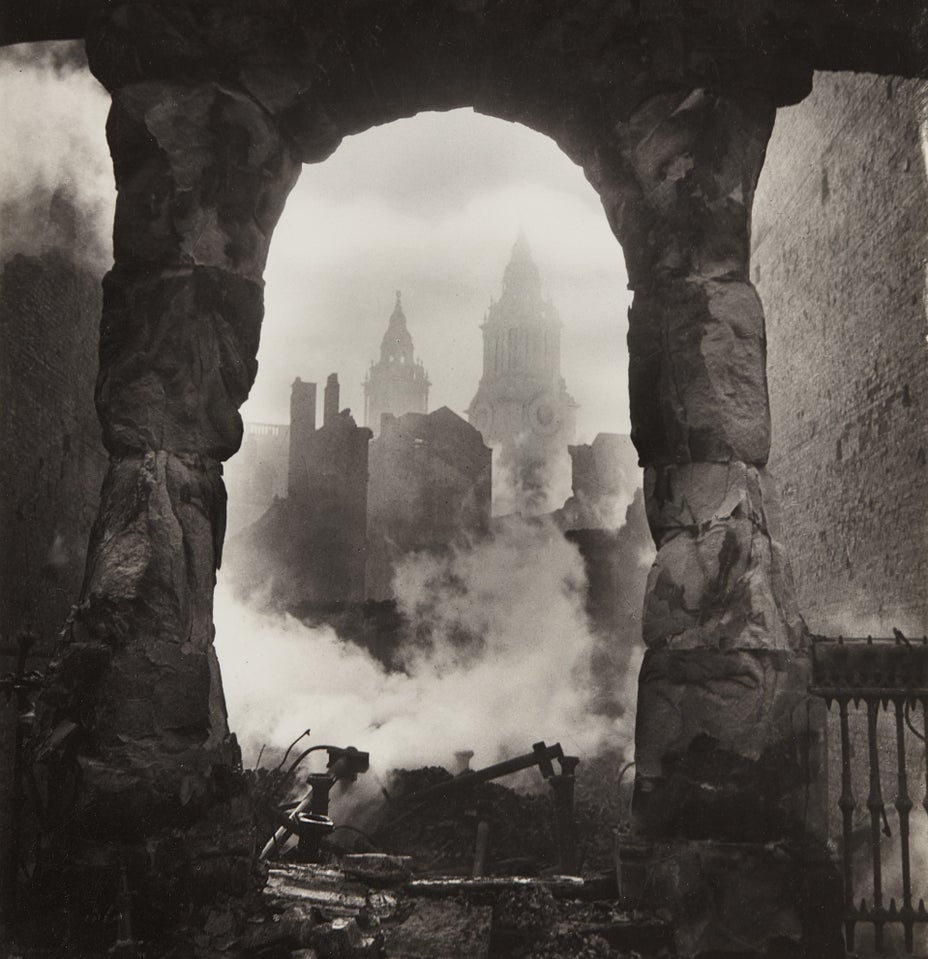
The Blitz/Western Campanile of St. Paul’s seen through Victorian shop-front
Full-Cataloguing
It has recently been discovered that Charles Sheeler used the shape of this stone archway for his 1941 painting Nativity. While Sheeler regularly used his own photographs as source material for his paintings, his use of photographs by others is less documented. For Nativity, a painting in the Magic Realist style, Sheeler replicated the overall shape and textural details of the arch. Sheeler likely encountered the arch in a photograph by Hans Wild in LIFE magazine, taken on the same day and from the same vantage point as Beaton’s.
Cecil Beaton
British | B. 1904 D. 1980Cecil Beaton was a highly celebrated British photographer who is perhaps best known for taking portraits of the colorful celebrities who composed the fashionable society of early-mid twentieth century London, all of whom were within his social circle. According to an autobiographical account, Cecil Beaton's relationship with photography began as a boy when he fell in love with picture postcards of the Edwardian theater actress Miss Lily Elsie. He took up photography at a young age, using his sisters Nancy and Baba as his primary subjects. Initially, Beaton sought to emulate pictures he saw in fashion magazines, especially the soft-focus technique used by Baron Adolphe de Meyer.
In 1929 he moved to New York after signing a contract with American Vogue. Throughout the 1930s Beaton traveled extensively as a portrait photographer, spending time in Hollywood amongst the glitter and glamour of Hollywood film stars. When the Second World War began and focus turned towards its dangers and devastations, Queen Elizabeth II commissioned Beaton to document the ravages of the German blitz. Following the War, in addition to taking photographs, in the late 1950s into the 1960s Beaton was involved in film as a stage and costume designer. During this time, he designed the costume and set for the stage version of My Fair Lady (New York, 1956; London, 1958) and the film Gigi (1958).