1035
Cartier
Portico Mystery Clock
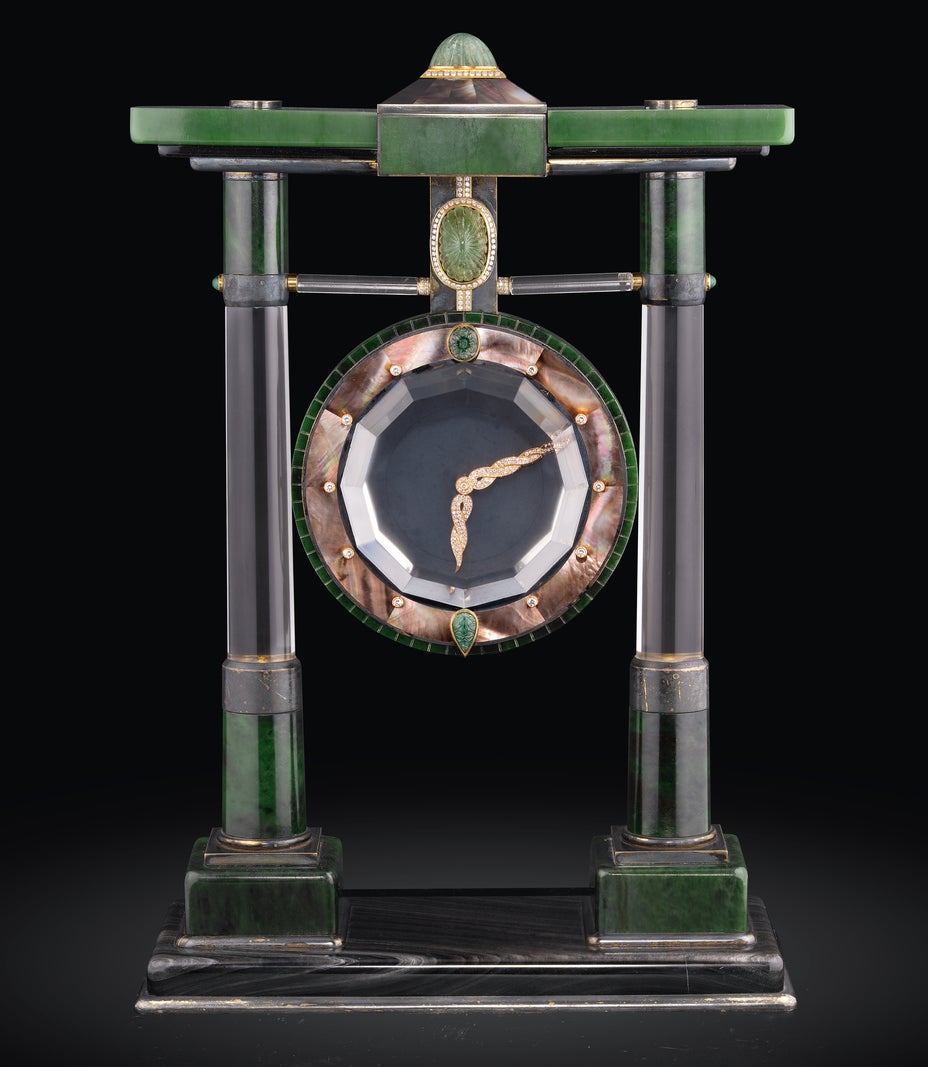
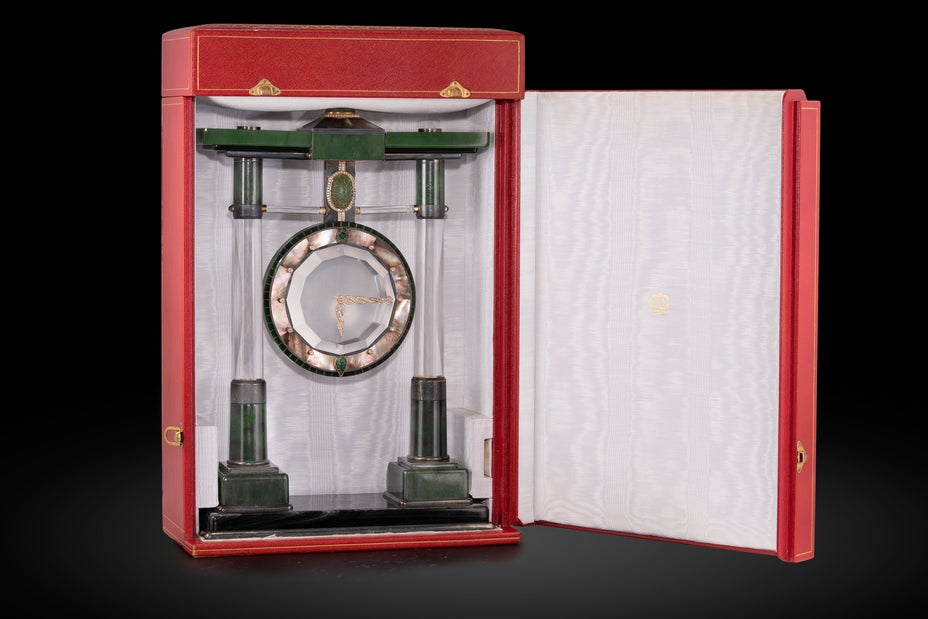
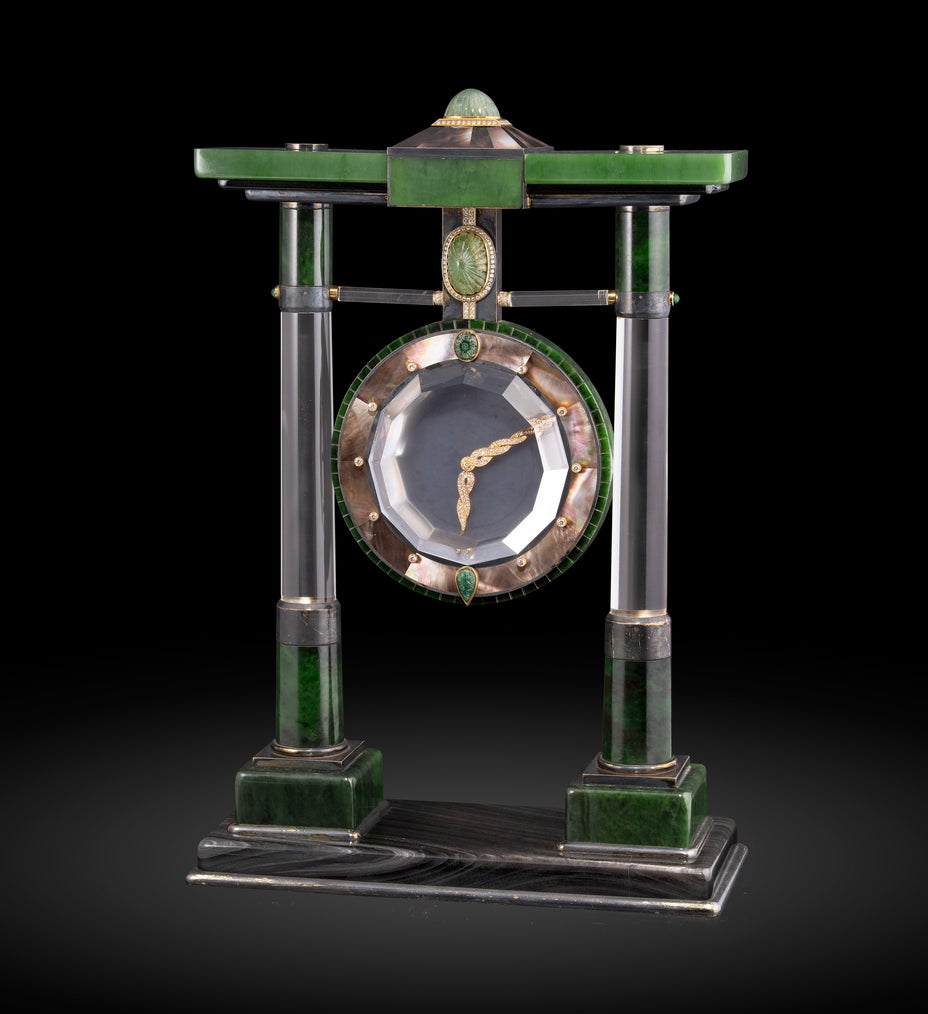
A unique, exceptionally rare and museum quality silver, rock crystal, agate, nephrite and diamond-set portico mystery clock with diamond-set hands, emerald and diamond-set hour markers, nephrite and mother-of-pearl bezel and presentation box
Full-Cataloguing
- Unique 1980s mystery clock in excellent condition
- Portico style clock, reminiscent of 1920s and 30s Cartier Portico Clock
- Nephrite, rock crystal, silver and agate build, decorated with mother-of-pearl, diamonds and emeralds
Cartier mystery clocks represent some of the most exceptional feats in the world of horology. Out of all the influential timepieces that Cartier has made, the mystery clocks, for sure, have to be regarded as amongst the most intriguing and impressive objects that have ever made. First introduced in the early 20th century, the groundbreaking and seemingly magical design is truly fascinating, in which the hours and minutes hands suspend in mid-air without any visible connection to the movement, an intricated and mysterious work of art merging with fine horology.
The “mystery” of the moving floating hands lies in the mechanism of the movement inspired by Jean-Eugène Robert-Houdin, French clockmaker or more notably one of the most influential magicians and illusionists, in the 1830s. Coming from a family of watchmakers, Maurice Coüet drew inspiration from Robert-Houdin, by using transparent disks or rotating panels to cleverly conceal the inner workings, giving the illusion that time is being measured by nothing more than sheer enchantment. He worked closely with Cartier and perfected the design, and the first mystery clock, Model A, was released in 1912.
It might not be as mysterious as it was after a century passed, yet back in time the clockwork was captivating and surprising as it was something the market had never seen before. Even the salespersons at Cartier boutiques could not properly explain how the illusion was achieved. Mystery clocks have since become one of the most prized “grail” items of many, attracting exclusive and high-profile clientele, form royalty to aristocrats and industry giants, namely King Farouk of Egypt, King and Queen of Spain, and J.P Morgan, who purchased the first mystery clock.
Between 1923 and 1925, six unique mystery clocks, Pendules Portique, or in English Portico Clocks, were created by Maurice Coüet. They are large, and certainly the most prestigious and impressive amongst all mystery clocks. The Portico Clocks are suspended from the frame in a manner reminiscent of a Chinese gong. The frame resembles the columns of a temple gate. The overall effect is that of a freestanding Oriental Archway, giving way to the name “Portico”. The major difference between a classic mystery clock and the Portico Clock is that the movement is housed above the dial instead of the base.
The Portico Clocks faithfully display the combination of art styles when Orientalism met Art Deco, romanticizing Far East and Asian cultures via an occident scope. The Cartier clocks clearly took inspiration from Asia, with exoticized Chinese and Japanese elements prominently presented throughout. Designed through the hands of Charles Jacqueau, the clocks are decorated with mythical figures like the Buddhist Lion (as seen in Portico Clock no. 6), and constructs that reminiscence Japanese Shinto Torii or China temple beams, pillars and corners (as seen in Portico Clock no. 3, sold by Phillips in 2025) touched with elaborated, bold geometric lines.
The mystery clocks peaked at production from the 1920s to 1930s and gradually came to a halt. After almost half a century, Cartier revived the iconic Art Deco mystery clocks in the 1980s, creating unique pieces and custom-made clocks for important clients. The present mystery clock mirrors the emblematic Portico Mystery Clocks, though in the 1980s Cartier produced smaller sizes Porticos, this timepiece stands at 37.8cm which shares similar height to the full-size models like the six unique pieces mentioned above.
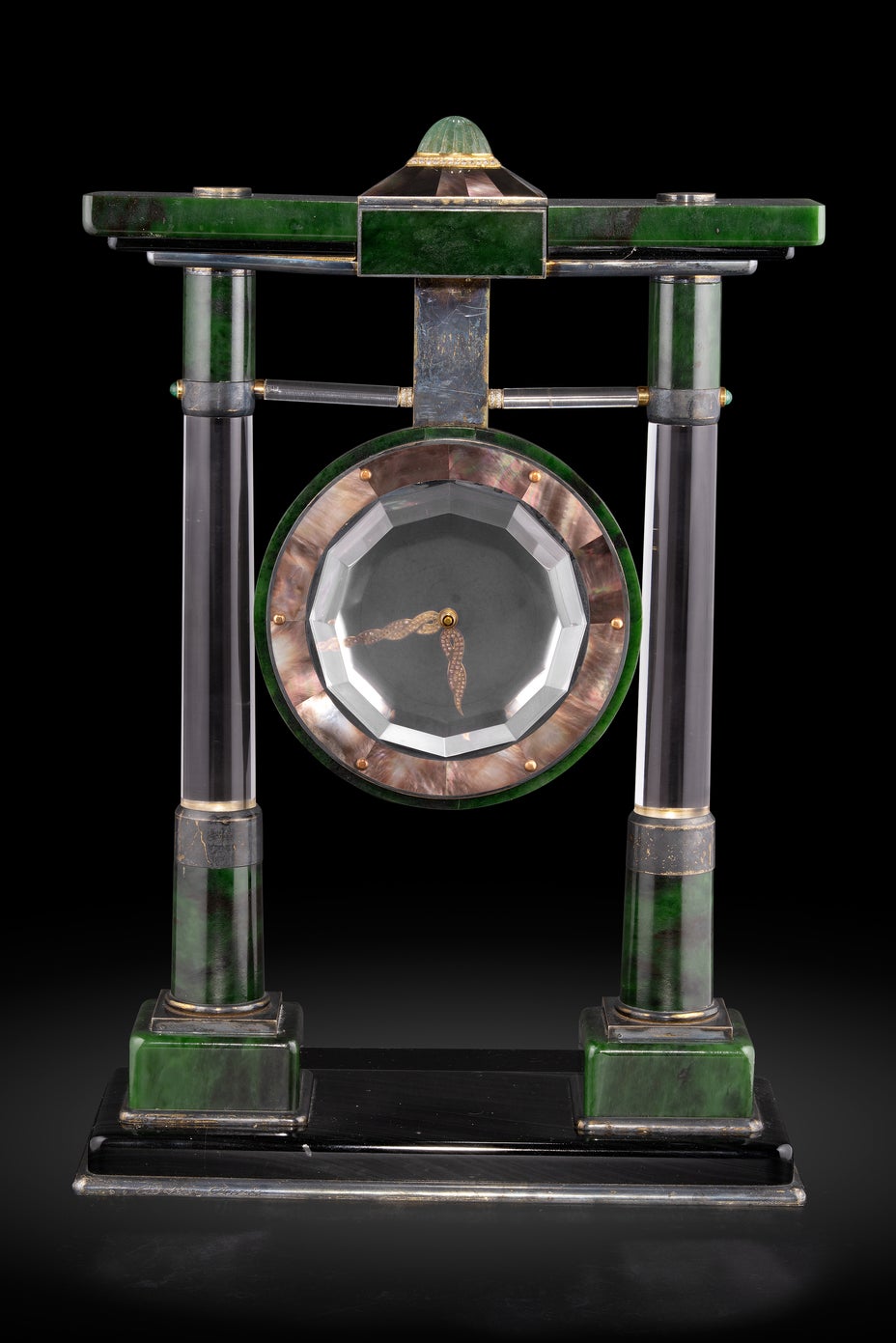
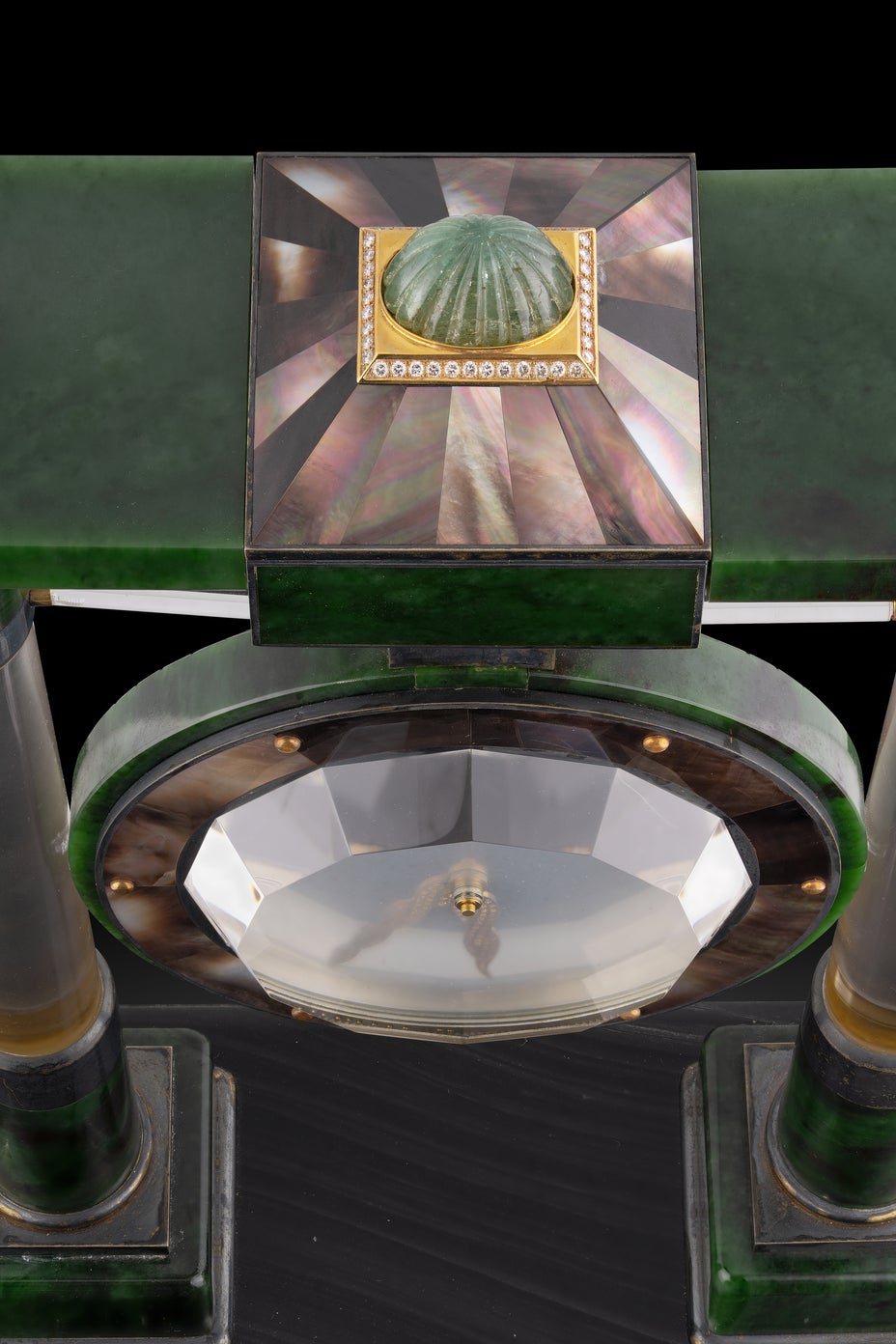
The furniture of the present timepiece is exceptionally impressive, retaining the signature Portico Clock gate-like beam structure with hanging gong-like dial, yet it feels more subtle with less exaggerated Asian decorations. The clock bears geometric features that show the clock is an Art Deco-inspired piece through and through. Most parts of the clock are composed of nephrite, which is usually referred simply as “jade” but is softer compared to jadeite. Nephrite has played an important role in Chinese culture, not only for its beauty but as a form of linkage of heavy and earth and protection. The choice of gemstone in this particular piece can be seen as clever and considerate, making a continuation of the East Asian aesthetics that mystery clocks has carried.
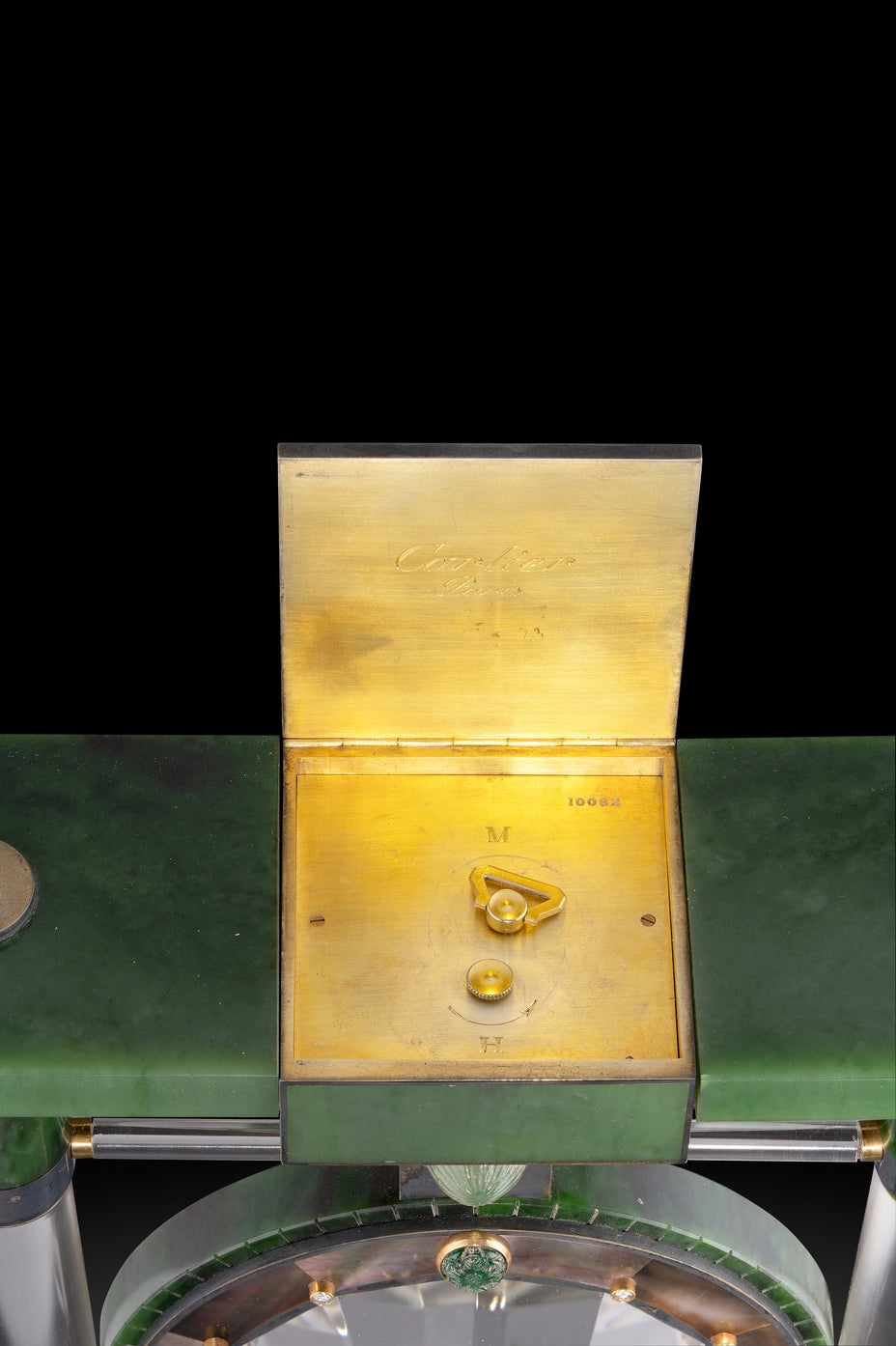
Mystery clock dials come in various polygons, and the present clock features a dodecagonal rock crystal dial with its chapter ring decorated with mother-of-pearl, adorned with diamond-set hour markers and two pieces of carved emeralds highlighted at 12 and 6 o’clock. Suspending within are two fire-shaped hands embellished with diamonds, a luxurious design element that has appeared in past mystery clocks as well. Above the dial is a sizable carved emerald set within a diamond border, and another other emerald at the mother-of-pearl and diamond-set compartment that hides the winding mechanism of the clock. The clock is supported by two magnificent cylindrical rock crystal columns terminating in nephrite and silver blocks on top of a plinth made of black agate with white, creamy bandings.
Of all Cartier timepieces, the mystery clock certainly can be regarded as the pinnacle of clockwork collection. The clock is simply marvelous; it is a delicate masterpiece when couture jewellery and haute horlogerie intersect. Offered in excellent overall condition, it is unlikely that a piece of such significance would reappear anytime sooner. A modern revival of Art Deco design in the neo-vintage era, this piece is reserved for connoisseurs of distinction looking for an item to be added to one’s proud and tasteful collection.
Cartier
FrenchWith the Constitution of 1848 came a new standard for luxury in France. Founded one year prior by Louis-Francois Cartier, the house of Cartier was one of the first to use platinum in jewelry making. This incredibly expensive material became the stepping-stone for Cartier to experiment in form, mechanisms and attitude. It helped men move from pocket watches to wristwatches, effectively making the watch much more functional and prominent in a man's overall wardrobe.
Cartier did not only touch on functionality. Inspired by a commissioned painting by George Barbier featuring a black panther at the feet of an elegantly bejeweled woman, Cartier began incorporating wild animals in his designs—most notably, Cartier Panthère rings, bangle bracelets and watches. Yet it wasn't until the late 1960s that the house of Cartier debuted their iconic yellow and rose gold LOVE collection, which includes the famous bracelet that only a special screwdriver can open.