1088
Cartier
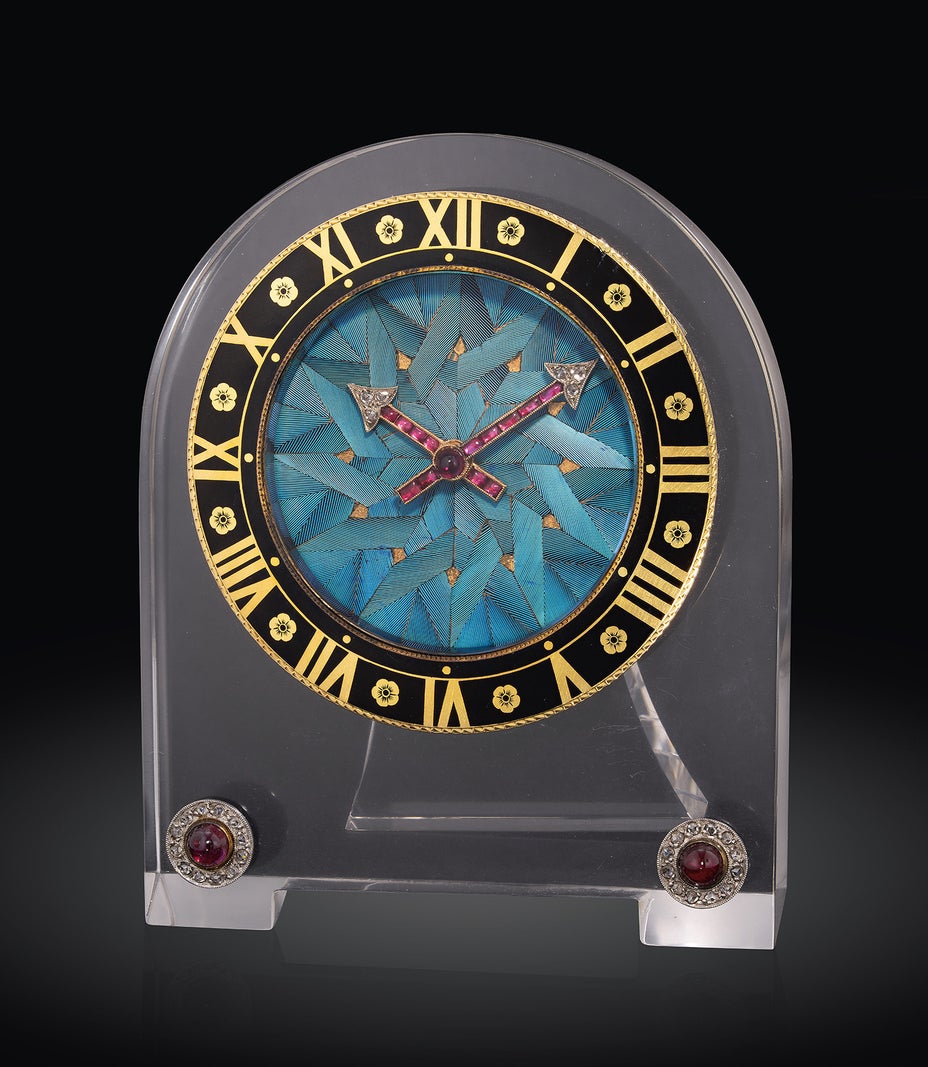
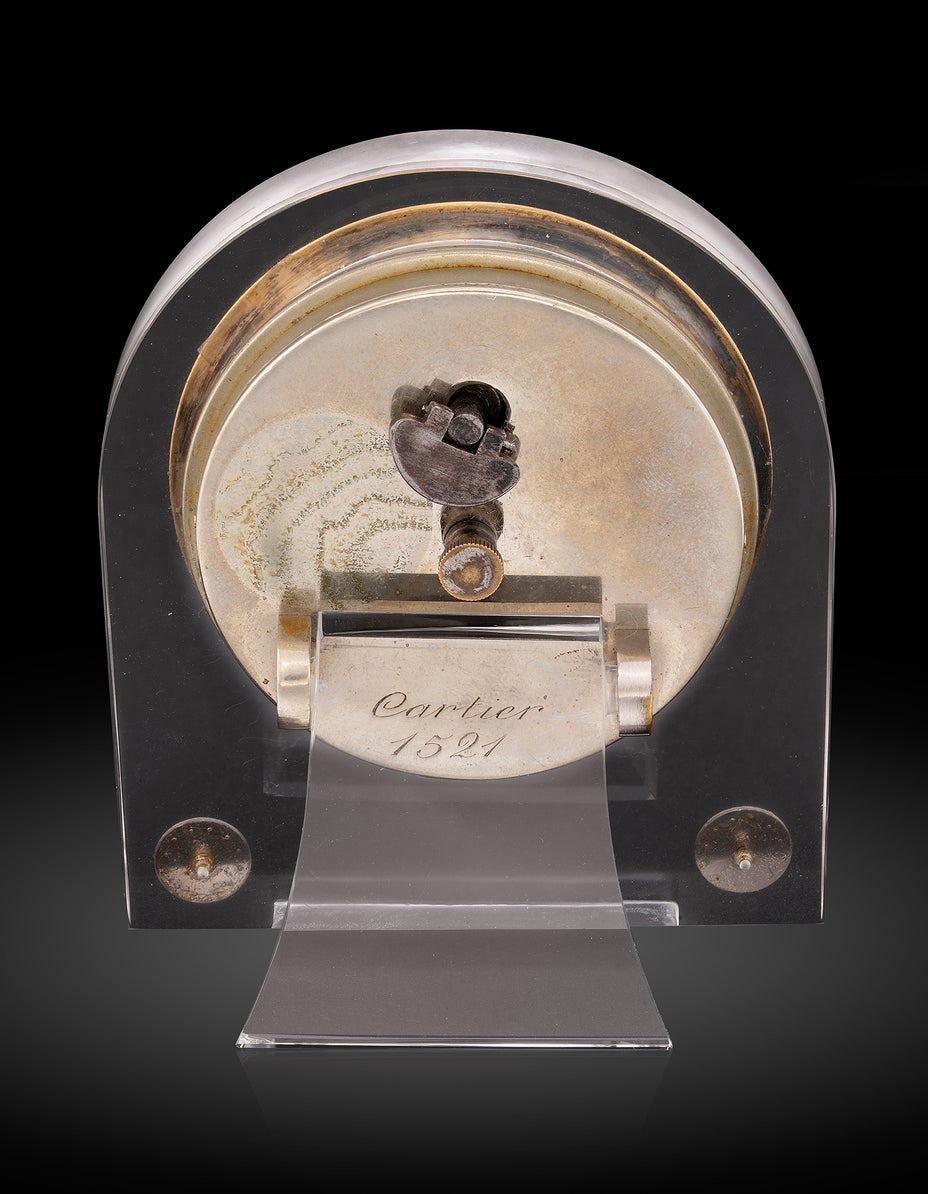
A rare and attractive gold, enamel, rubies and diamond-set rock crystal desk clock with strut and kingfisher feather dial
Full-Cataloguing
This desk clock with a rock crystal surround and strut from circa 1925 exemplifies the masterful creations of Coüet. Extremely elegant, the present desk clock topped it off with a rare craft to this already stunning piece. Tian-Tsui, is a Chinese craft featuring kingfisher feathers. For 2,000 years, the Chinese have been using the iridescent quality of these blue feathers of the majestic bird as inlay for fine art objects, panels and screens. Its unique electric blue sheen from the bird achieves a vivid colour that no enamel can replicate. An extremely painstaking artisanal technique that demands the most skilled craftsmen, back in the days Cartier was able to deliver this rare trade in their Parisian workshop. Within a circular dial the artist cleverly uses the linear qualities of the kingfisher feather to create a radiating star-shaped motif with gold filling. The diamond-set arrow hands are further heighten with rubies for legibility. The delicate black enamel chapter ring decorated with gold Roman numeral markers and floral motif (appearing often on Cartier timepieces throughout the 1920s). The rock crystal arched frame is anchored with two cabochon ruby and rose-cut diamond decorations to complement the hands.
Well-preserved since its last appearance in the auction market 33 years ago, its notable that the kingfisher feather dial is extremely appealing and presented in wonderful condition.
Cartier
FrenchWith the Constitution of 1848 came a new standard for luxury in France. Founded one year prior by Louis-Francois Cartier, the house of Cartier was one of the first to use platinum in jewelry making. This incredibly expensive material became the stepping-stone for Cartier to experiment in form, mechanisms and attitude. It helped men move from pocket watches to wristwatches, effectively making the watch much more functional and prominent in a man's overall wardrobe.
Cartier did not only touch on functionality. Inspired by a commissioned painting by George Barbier featuring a black panther at the feet of an elegantly bejeweled woman, Cartier began incorporating wild animals in his designs—most notably, Cartier Panthère rings, bangle bracelets and watches. Yet it wasn't until the late 1960s that the house of Cartier debuted their iconic yellow and rose gold LOVE collection, which includes the famous bracelet that only a special screwdriver can open.